STM8S-Discovery: Microcontrollers reach a new low

posted Nov 23rd 2009 2:30pm by
filed under: hardware

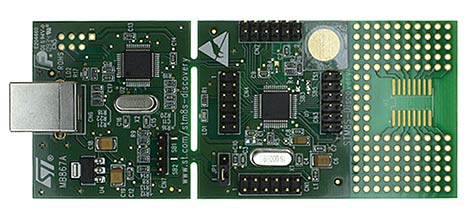
A complete microcontroller development kit for little more than the cost of a bare chip? That’s what STMicroelectronics is promising with their STM8S-Discoveryseven dollars gets you not only a board-mounted 8-bit microcontroller with an decent range of GPIO pins and functions, but the USB programmer/debugger as well.

The STM8S microcontroller is in a similar class as the ATmega328 chip on latest-generation Arduinos: an 8-bit 16 MHz core, 32K flash and 2K RAM, UART, SPI, I2C, 10-bit analog-to-digital inputs, timers and interrupts and all the usual goodness. The Discovery board features a small prototyping area and throws in a touch-sense button for fun as well. The ST-LINK USB programmer/debugger comes attached, but it’s easy to crack one off and use this for future STMicro-compatible projects; clearly a plan of giving away the razor and selling the blades.

The development tools are for Windows only, and novice programmers won’t get the same touchy-feely community of support that surrounds Arduino. But for cost-conscious hackers and for educators needing to equip a whole classroom (or if you’re just looking for a stocking stuffer for your geeky nephew), it’s hard to argue with seven bucks for a full plug-and-play setup.

[thanks Billy]


220 Responses to STM8S-Discovery: Microcontrollers reach a new low

  • rd says:

    “The development tools are for Windows only” kind of ruins it for me. Pretty neat, otherwise.

  • tehgringe says:

    Yeah but that won’t take long to change when there are determined *nix lovers getting all huffy because of that very statement.

    The cost alone makes it tempting to buy one just to keep in my spare parts box for a rainy day.

  • chiefcrash says:

    “The development tools are for Windows only”

    anyone wanna fire up WINE and give it a go?

  • Max says:

    +1 for linux dev tools…

  • nave.notnilc says:

    dang, pretty cheap, pretty neat. certainly looking now.

  • duddface says:

    oohh.shiny toy.i got mine.

  • nave.notnilc says:

    oh, and their tools seem to install and run fine under wine, I played around for a minute.

  • nate says:

    Wow! That’s friggin awesome sauce! Considering I just dropped $400 on a complete PIC dev suit ;)

  • Hackineer says:

    Thanks to this, I just realized Digi-Key charges tax in my state now. That sucks. I’ve always loved Digi-Key.

  • Tof says:

    anyone think this would be the perfect starter project. I’ve been looking for a cheap way to jump in for years.

    I figure I’ll VM some Windows and be all set.

  • phishinphree says:

    Looks like the free compiler, in addition to being windows only, is limited to 16k code size.

  • Hackineer says:

    @Tof:

    Unless you have some previous knowledge of microprocessors/microcontrollers, it might be a little intimidating. But in any case, what have you got to lose? It’s only $7. Give it a try.

  • Tof says:

    @Hackineer

    Yeah I figured with the $7 tag that I’ve got pretty much no reason not to try.

    I’ve got no knowledge, no idea where to start and only a basic knowledge of programing, but my friend has been pushing my to do an arduino. project with him, so I’ll start here and move up later on.

  • geeklord says:

    Any tutorials on how to use this thing?

  • Hackineer says:

    It looks like Digi-Key has sold at least 15 of these since this was posted. lol

  • MS3FGX says:

    “The development tools are for Windows only”

    Seriously? What is this 1999? Even for $7 I wouldn’t bother, I don’t have a Windows machine and I’m not going to setup a VM when there are other platforms that work natively on my OS.

    Even the web-only development evironment from the mbed that was covered a few days back is better than this.

  • threepointone says:

    Holy cow, best marketing decision ever on the part of ST?

    Hopefully this uC is a decent architecture–this is so darn cheap that it’s basically become a new candidate for working on any of the projects currently on my list.

  • BigBubbaX says:

    gonna go download wine to run it on linux…

  • Roadieflip says:

    Crack one off, and touchy feely. I know it’s immature, but – hee hee hee! (giggles like a liitle girl)

  • threepointone says:

    WOW, WAY COOL

    I just went through the datasheets for this guy–reasonably low power consumption (but not that great compared to the really low power uCs these days), and more of a thing is this is a darn 8-bit CISC (!!!) processor. This is actually a REALLY, REALLY powerful 8-bit processor–there’s a bunch of things I’d expect to see in a 16-bit or 32-bit uP in the architecture. The memory is effectively shared program and ram memory, but internally it’s a harvard architecture with separate program and memory buses.

    pretty interesting guy, and given the price tag, I’m definitely picking up a couple of these =)

  • threepointone says:

    heck, now that I think about it, this uC looks a lot like a VERY heavily modified, 8-bit x86 processor. there’s quite a number of similarities, but also quite a number of very major changes in the architecture.

  • Rachel says:

    This sounds so great–until you learn the free compiler is crippled to only use half the available programming space, and it doesn’t even run on a real operating system. I was ready to buy it until I saw this.

    I’m going to send them an email right now to complain. Maybe if enough people do so, they’ll fix things.

  • Rachel says:

    Well, at least I would complain if I could find any real contact info. All I could find was domain.name@st.com in their DNS listing. How I hate corporate websites with no content…

  • threepointone says:

    Welcome to the EE world–I don’t know a single company that actually offers free unlimited C compilers unless they’re more or less just vanilla gcc offerings. And the last time I worked with gcc and ARM, the debug support was terrible–I shaved days (or weeks) off my project when I decided to switch to a commercial solution. I don’t know if it’s because there’s an influx of CS kids wanting to play around with EE or something (no problem with that), but the fact is that so many of the electronics dev tools (arduino or whatever junk most people use, though popular in the hobbyist community, isn’t exactly a good representation of the industry) have drivers written for Windows and were designed on Windows.

    As a EE wanting to make cool things, I honestly believe that making cool things has priority (a LOT of priority) over stupid ideological arguments about why one operating system is better than the other. I just want to make something cool, okay? I’m not going to bother using linux if that means I’m going to have to bitch all the time about software and drivers not working, and exclude myself from using a chip just because I want open source software or something. In my personal experience, anyway, I’ve had more problems with linux (tried ubuntu, some other distro I can’t remember anymore), enough to delete the partition entirely for more disk space. I don’t run a very standard setup and need to use a fair amount of obscure hardware for some of my day-to-day EE work, and from my experience a lot of these open source, unsupported software suites don’t go through the same amount of rigorous testing on all different scenarios that commercial software usually gets (partly probably just because they don’t have the money or time to do so). It’s always nice to have a free, open source solution available on hand, but I’ve found that it’s usually a pretty bad idea to rely on unsupported software (sorry, community forums on gcc don’t constitute “support”). I’ve run into a lot of weird bugs because of this, and I really don’t have the time to find a linux geek to fix these things or to wait for some random guy on the internet to write new drivers or something.

    So the question is, are you going to put your practically irrelevant ideology first or awesome first? My answer has always been awesome first, and I don’t understand why other mainly electronics hobbyists would think otherwise.

    *end rant*

    ST is already generous enough to basically give out these dev boards for free, and I don’t think they’re going to see an incentive to putting out linux tools. It costs a lot of developers with that sort of experience to get that done, and I doubt ST even has a linux dev team available to make a linux version of the software. I don’t think having a linux version is actually going to improve their image to anyone relevant to the following for their processor, anyway.

  • cpmike says:

    excellent response, threepointone. i feel very much the same way.

    regardless, there already is a box over at Digikey with my name on it.

  • ridefst says:

    This is perfect for me.
    I’ve got a Linux pc around, but I live in Windows.
    Don’t have any experience with arduinos, but think they sound neat.
    $7 is a great price, and the built in programming board gets past the issue of building/buying a programmer.
    I’ve got two on order.

  • Rachel says:

    threepointone, that’s all fine and dandy when you have fancy things like money, or employees to buy you quality hardware and software. As a student (soon to be EE), 99% of my hardware was scavenged from dead electronics, and all of my software is free.

  • Rachel says:

    Er, make that employers. And it still doesn’t excuse the lack of contact information on their website.

  • OZ says:

    Anyone see why this is so inexpensive? It seems a bit suspicious as normally you’d lose alot of money producing these and then selling them for so little…

  • Bob says:

    How do I buy it… direct link please?

  • Bob says:

    Gee, I really wish they had packaged it on a DIP.

  • cirictech says:

    These can be bought from mouser and digikey if you search there site it is easy to find. mouser at last check has 77, now 75 after i got my 2.

  • Brett says:

    Someone above confirmed this runs on Wine (and likely DarWine for Mac), so what’s all the whining about operating systems about? Who here doesn’t have a Windows OS AND can’t figure out how to use Wine? If you’re a snob about Linux then you should be capable of running Wine. If you don’t want to do that then go use some other platform (like the Arduino – *gasp*).

    @Bob
    I checked Mouser and they have them, I’m sure many other suppliers like DigiKey have them as well. I thought about ordering a couple but I’m fine with my AVRs for now.

  • Ian says:

    @Bob

    Assuming you’re lazy and don’t want to click the two clicks it took me to get from this article to a list of suppliers, here’s the link:

    http://www.st.com/stonline/stappl/bol/app?page=bol&pn=STM8S-DISCOVERY

    Now that’s not a direct link to a shopping cart checkout of the product, so I do hope you can guide yourself the rest of the way. If you get lost, start at that page again and work your way through. The internet will get easier the harder you try! ;-)

  • Bob says:

    Uh… I appreciate all the folks posting links to the Digi-Key or Mouser or whoever site, but when I said that I wished they packaged it on a DIP, I meant that I would’ve liked to see the STM8S-Discovery board on a dual-inline-package, instead of on the board it’s on.

    You know, so you could plug it into a breadboard or build your own PCB around it?

  • Bob says:

    What are the odds of that…

  • Bob says:

    Thanks everyone for the links.

  • MS3FGX says:

    I imagine the idea here is that people try out their platform, like it, and buy more products from them. Same reason AOL gave out millions of free CDs. Lose money in the short term, but hopefully make up for it in the long run.

  • Georgio says:

    @Rachel

    I follow the same path my friend!

  • OZ says:

    @MS3FGX Well happy birthday to me then :) And You’re more than likely right they’re just starting out and trying to make a name for themselves…

  • tj says:

    I see there being a Linux solution very soon. Running tools in WINE is kind of noob especially for engineering level tools.

  • Andrew says:

    WOW this is really really cool, I ordered one right after trying out the toolset on my Windows box. Looks very nice for $7.

  • cgmark says:

    For $7 you are a fool if you can’t see that this is an amazing deal . Saying you will not get it because it isn’t for linux is foolish or you have just have too much money.

  • cgmark says:

    DIP as a format is disappearing. Everything is surface mount now. But don’t let that scare you, this board makes it easy to connect to a breadboard.

  • SavvyFx says:

    Are there any Australian distributors?

  • cirictech says:

    My two should be here tomorrow. mouser is great order by 8pm cst gets here next day, woot for living 4 hours from Dallas. ill post something on my site about them tomorrow.

  • djo says:

    Has anyone else noticed that either of the free compilers require registration? One of them even has an “I don’t want to receive offers”-esque checkbox.

    Maybe they’re subsidizing the costs a bit with address harvesting for marketers? Don’t get me wrong as I’ve ordered mine, but it seems kind of interesting that all of the “free” compilers require requesting a “free” unlock key.

  • cgmark says:

    ST isn’t losing money on these. I would guess they are selling them at cost. There really isn’t a lot there on the board part wise, and if you have the manufacturing capability of ST turning out boards like this in bulk is really cheap.

  • Drone says:

    Has anyone looked to see if the “key” you get with the “free” crippled compiler expires at some point?

  • Keith says:

    I did some unskilled programming a while back, but no hardware experience; can anyone tell me if this would be fast enough to work with low-end video? I’d like to build a car camera that saves video to an SD card, like on a continuous loop, but where I could trigger it to save the last 3 minutes of video or something like that (not overwrite that section, so I can download it). When I looked into this idea a few years ago, I was told that the lowest board that could process fast enough was going to be over $100, so I’m always interested in new offerings and I haven’t checked on this in a while. Thanks for any input.

  • The STM8S-DISCOVERY is among the items offered as free samples from ST. You can request one here:

    https://my.st.com/esample/app?page=basket

    For the sake of all of us, don’t be greedy!

  • markii says:

    I had to order a free sample, and I am willing to pay for it. In my country DigiKey or Mouser charges delivery around 50 USD! Idiots…

  • santiago says:

    threepointone: I used to agree with you on the subject of windows dev tools. I’ve used commercial tools from keil + various other commercial embedded development vendors on projects before. I used to use them in preference to GCC / GDB. However, about six months ago I decided to switch completely over to GCC / GDB, and spent about 2 weeks writing custom automation software that I use for all my ARM projects now. I can’t be happier. While GCC + GDB has an extremely difficult learning curve before you become productive; I’ve found my productivity now is greater than it used to be on windows, purely due to the amount of automation I now have in my design flow.

    While some may argue that the same kind of automation is doable on windows; I’ve found that the availability, and ease of scripting of linux command line tools is superior to that on windows. But then again, I’m very proficient in linux.

    For the record, I design electronics for a living.

  • aurel says:

    @threepointone
    great that you like to have tools working on widows or whatever, other prefers open source software:
    - it’s not incompatible, lots of professional embedded system development is done nowadays using open source,
    - there are plenty of commercial offers for opensource based development toolkits with professional support, this benefits everybody
    - ST does work on open source toolchains (e.g. some of the ST staff are (full time?) developers on gcc/binutils ARM toolchain )
    - maybe there is no open source support for those CPU because no one had the incentive to … the success of the MSP430 and AVR’s in “open”/hackers projects will give this incentive, and providing such a cheap kit is probably one step in this direction…

  • sigtermer says:

    This is amazing.
    But like others have mentioned, no native linux support is a drag.
    once (and if) that’s cleared up, i’ll probably get one.

  • Mr Foo says:

    For what it’s worth, I was about to order an mbed, but the final cost of ~70€ from Farnell put me off a bit. I can live with the online nature of that, and I’ll probably end up with one or two anyway, but for the moment I’ve held off – these little cards look like just the ticket for what I want to do at the moment.

    So I just ordered a couple of these, for a total of 30€ delivered with some other bits and pieces.

    I can live with the windows-only aspect for the moment – after all, Wine OSX or VirtualBox should do the job until I’ve reverse engineered the USB aspect of the programmer, at which point all I need is wine and the compiler. The protocols and instruction set are well documented, so I have confidence that gcc and friends will end up targetting these pretty damn fast.

    Anyway, we’ll see what happens. My boards arrive tomorrow.

  • Skinner says:

    Very interesting. A decent price for a very powerful chip with many I/Os. A starter kit for $7 is a great idea to get people easily hooked to these chips.

    FYI, the chip by themselves is $3.15 from mouser.

  • Deyjavont says:

    STM is very wise to offer a great uC for cheap (or free). I am very fond of Texas Instruments products and they have been great to me. I even was given an ez430-f2013 msp dev tool for free, which these devices are around $20 to purchase.
    Lately all of my uC work has been with the MSP430 for the fact of ease of use, great support, great IDE and debugger, and also being free.

    Now that STM offers this uC dev kit it will be easy to introduce hobbyists/EEs to thier products that we didn’t know existed, or cared to work with. Once they get thier foot in the door, they have you hooked for all your future transistor needs. Same with the MSP430..I never used it until I got my free dev tool from TI, and now I am hooked and I turn to TI for all my IC needs. Now that STM offers a comparable product to TI, they will now get thier share of my business. Good marketing plan! (check out thier samples program, it is good)

    (I use XP and Kubuntu, so stop fighting. It is only 7 dollars!)

  • therian says:

    Achtung Achtung !
    The grief and excitement in the air.
    The King is dead. Long live the King!
    This is historical moment,… official death of Arduino. .. Now, even those who have panic fear phobia of programmers will have not a single reason to continue with overpriced non standard sized breakout board with serial converter, unwisely selected uC and unpronounceable name.
    More power for LED blinking. ;)

    To Linux/Mac nags :
    Was you somehow misguided that it is not minority OS ?
    And probably it won’t be hard to use gcc with it, just give some time to pioneers.

    @nate
    “Wow! That’s friggin awesome sauce! Considering I just dropped $400 on a complete PIC dev suit ;)”

    How you come up with such number, no seriously did you just mistype extra zero ? It took me about 3$ for some resistors, transistors and copper board when I star learning them (well now they charge for shipping of samples but anyway <10$), and you need whole 400$ to do the same thing? Maybe you mean price of good industrial auto code optimizing compiler ? Well microchip offer great full compiler for 18F chips. And I’m sorry to tell you that STM8S-Discovery come with castrated compiler, and basically this is truth for all cases, free compilers just some implementation of GCC or limited hobby projects.

    Ashes to ashes & dust to dust, farewell Arduino

  • Chuckt says:

    I have a Parallax Starter kit and I still don’t use it and their staff won’t help me because they say I have to buy a microcontroller kit first to learn that. I’m a busy parent and I don’t have time to read the 31 page manual just to operate the text editor. Most things that are understandable and easy to use should be written by people who can get you to use it in ten minutes.

    I know people who program professionally and they don’t want one because they say they aren’t easy to use and Arduino isn’t a real microcontroller because it is programmed for you because most people couldn’t program the real thing.

    I met someone retired who works in the industry and he suggested a TI or Atmel starter kit. One runs on a battery for months and has plenty of IO. according to him, the Propeller chip is a pic of an unknown origin and it is programmed to behave a certain way.

    If you want to learn Microcontrollers the hard way then hit those books because there is a learning curve and it isn’t easy unless you want something pre-programmed like the Arduino which is what you might need to learn because people don’t know how to teach; they know how to take the instructions out of sequential order and how to put them in alphabetical order so you are more confused.

  • Mr Foo says:

    There ain’t no easy way to learn microcontrollers. At least not if you want to use them to their full extent. Get in there, bang your head against the metal. No other way to do it.

    Of course, very few µC projects even scratch the surface of what the most minimalist chip can do – this 7€ board, apart from RAM constraints, is more powerful than the machines we used to run Visicalc on back in the day.

  • therian says:

    By the way WINE most likely will not help here, probably because of debugging software too deeply tied up to hardware .
    Again this is great. Honestly I was feeling sorry to see so many people recently hook on company that have serious financial struggle, recently was on the edge of sell out and can’t provide stable continuous supply of their product to manufacturers leading them to abandon projects and give up on supplier which lead back to beginning of this close loop of financial struggling . It would be huge middle finger to all those hobbits and hackers if they went out of business. At least STMicroelectronics large enough to survive today’s economical crisis

  • Ben Ryves says:

    @Mr Foo: PICAXE chips are extremely easy to learn, being aimed at the education market, coming with extensive documentation and being programmed in an interpreted BASIC. (Programming hardware is a serial cable and two resistors). Dev tools are available for Windows, Mac OS and Linux, too!

    @Rachel: As a student, you may have access to MSDNAA which could get you a free or heavily discounted copy of Windows. Though from the fact that you refer to it as somehow not being a “real” operating system implies that it’s an ideological problem, not a financial one.

  • dddanmar says:

    “As a EE wanting to make cool things, I honestly believe that making cool things has priority (a LOT of priority) over stupid ideological arguments about why one operating system is better than the other. I just want to make something cool, okay?”

    …I love you.

    I use what ever OS/tool/language/wtfever will accomplish the task appropriately, or if its a rapid prototype, what ever is easy and quick to implement. Sometimes, that forces me to go back to a Windows environment, and that’s just something I accept in a world where there are multiple operating systems available (and what I love about it to!).

    Give it time and some focus towards cross platform applications in the future and this can hopefully happen less and less.

  • Ragnar says:

    From the 7$ (4,68 Euro) shopping basket to my home it is 18,58 Euro (27,75$ incl. vat and p&p in Germany from distributor.) That is degrading it from a Wow! offer to a won’t bother one. Even more with the Windows limitation.

  • Mr Foo says:

    @Ben Ryves

    You’re right, the picaxe stuff is easy to learn, but the interpreted nature of the BASIC they use means that you’re a long way from pushing the actual limits of the chips. This is not usually a particular problem for the hobbyist, given the cost of the chips in question – it’s easier and cheaper to simply go for something with a bit more “poke”. It certainly doesn’t mean they’re no good, either; the ignition system on my motorcycle is controlled by a PIC :)

    That said, if you’re looking to produce a commercial product, you need as much code as possible in as little chip as possible; if you’re not pushing the capabilities then you’re wasting money. Learning to do that is hard.

    As for the “ideological” concerns WRT windows, I’m one of those who doesn’t use Windows unless they are absolutely forced to because it gets in the way of doing actual work. It’s slow, unreliable, massively expensive, and doesn’t work the way I do. There’s nothing ideological in that, I don’t “hate” MS, even though I consider that they have, over the last 25 years, been a considerable millstone around the neck of computing as a whole. My choice of OS is purely pragmatic; I have better things to do with my time than work around the holes in cr*p software. But hey, if it works for you, that’s fine, too.

  • strider_mt2k says:

    I think what threepointone said had a ton of merit, and exposes many folks for the limitations they impose on themselves.

    Put away the soapboxes and let’s see some awesome.

  • brad says:

    Sorry, Windows it the way of the EE life.

    I was a Linux fan (still use it for personal web surfing ect..)

    Now as a designer I have to use windows.

    why?

    1. No GOOD schematic capture or PCB design tools for Linux.

    2. You can use wine for most compilers but Linux does not support the programing hardware.

    For a $7 dev board… Throw a windows partition on you Linux box.

  • Ryan says:

    More information on the STM8S development kit can be found over at Farnell on the dedicated web page.

    http://uk.farnell.com/jsp/bespoke/bespoke2.jsp?ICID=i-f4bf-00003027&bespokepage=farnell/en_UK/promotions/st_stm8.jsp

  • Hackineer says:

    Digi-Key alone has now sold around 200 of these since this was posted. I bet they are scratching their heads, wondering why this item got to popular so sudden.

  • JD says:

    I love impulse buying stuff like this, just to try it out. I ordered two just now. I’ve learned my lesson with only ordering a single unit of stuff like this. The magic smoke WANTS to be free.

    Either way, PIC, Propeller, Arduino, now this. I have quite the collection of dev boards with uControllers on them.

    Thanks for the heads up. The price was too good to pass up.

  • MS3FGX says:

    “For a $7 dev board… Throw a windows partition on you Linux box.”

    I’m sorry, are you suggesting I buy a ~$100 OS to use a $7 piece of hardware, or that I pirate software in order to use the $7 piece of hardware? Because both seem to be exceptionally poor pieces of advice.

    There is no “ideology” behind why I don’t have a copy of Windows in my house. I’m with Mr Foo, Windows just doesn’t work for me. It is a slow and terribly implemented OS which simply cannot do the things I need it to do. Most of things I do on my machines on a daily basis are either impossible/impractical to do under Windows, or at least would entail considerable software above and beyond the base Windows install (pushing the cost of ownership even higher).

    I can’t help but cringe when I read a “rant” like threepointone posted above (I hate to call anyone out specifically, but if you post a rant on a public forum you are opening yourself up to at least a few direct responses), because all I can see is “I clicked something, and nothing happened, and nothing came up to tell me what to do next so I went online and waited for 10 minutes and nobody helped me so I gave up.” I simply cannot fathom that sort of mentality. If I see a problem, on the computer or anywhere else, I have an imperative to understand (and ideally) fix whatever it is. I am incapable of simply saying “I dunno, doesn’t work. I’ll do something else then”, and almost everyone else I have ever met in the hacking community was the same way. The desire to learn and fix should be a hacker’s (or engineer’s) primary motivation in all aspects of life. We see that fact day in and day out on this very site (well…most days).

    Nothing new or creative has ever been done by looking at a problem or shortcoming in current implementations or understandings and simply giving up. Frankly, I am exceptionally dubious of how much “awesome” that type of mindset could possibly create.

    Is there software out there that is only available for Windows, and won’t run in WINE? Almost certainly, and I am equally sure there are some professions that require said software (which seems to be threepointone’s primary claim), but nobody is talking about making a career out of a $7 board. We just want to be able to use an experiment with the device on our own terms, and the manufacturer ignoring that desire (especially seeing how well it has gone for platforms like the Arduino) is a very poor decision. The amount of comments about the issue on this page alone is proof enough that there is a problem. All talk of “ideology” or bias against a particular OS is completely irrelevant, and certainly does nothing to address the issue at hand.

  • Dylan says:

    Bought one from Farnell, next day shipping service :P

  • josh says:

    @MS3FGX
    quit whining.

  • rd says:

    I second MS3FGX’s comments.
    I can get an ATTiny861 (more MIPS, same number of ADC channels, less program space) for about $3.00 each or a PIC18f2550 (which has full speed USB and a crapload of other peripherals) for $5.00.
    I have a breadboard, a stockpile of components, and a power supply and I’m capable of reading a data sheet, so I don’t really need a full dev board. Why would I pay $7 for something that does not support my development platform of choice?

    Although an ideological argument can be made for GNU/Linux and FOSS, you shouldn’t assume everyone’s reasons for using it are purely ideological. I find a Unix-like environment is best equipped for development of software and firmware.

  • xrayspex says:

    i think i got the last three from mouser

  • Mr Foo says:

    oh, and …

    *coff*

    The debug adaptor has a JTAG / single wire debug port. It’s a Cortex-M3 with 64K of flash and 20K of RAM.

    Can you say “repurpose”? Thought you could.

    *coff*

  • Fluffy says:

    STM site is not feeling well this AM:

    “Access Denied (license_expired)

    A license has expired on the Proxy, and your request is not permitted: “The SGOS license has expired”
    A new license must be obtained.

    For assistance, contact your network support team. ”

    Oops.

  • brad says:

    @MS3FGX

    I like/use Linux.

    For EE if you would like to “play” use Linux.

    If you need to work efficiently and produce professional results you have to use Windows.

    It stinks and I would like to help change this some day but that is the way it is today.

  • Hackineer says:

    Looks like Digi-Key is sold out…

  • cirictech says:

    Mouser and Digikey are both sold out but you can find somewhere else to buy at http://www.st.com/stonline/stappl/bol/app?page=bol&pn=STM8S-DISCOVERY

  • Doktor Jeep says:

    Wish I knew how to use these :-)

  • mojo says:

    These devices seem to be pitched to the same applications as 8-bit AVRs. Similar specs. The Arduino comparison is not a good one I feel, as the Arduino is designed for non-technical people to use where as this is just a standard (if very cheap) MCU dev board that you have to program in C or assembler and understand electronics to use.

    As an MCU platform I’m not really convinced. It seems reasonable enough, although the architecture is a bit old fashioned. Not as bad as a PIC, but newer RISC designs easily beat it for ease of use and speed (especially interrupt response times).

    On top of that you don’t have as large a pool of open source code for it as you do with an AVR. Having sample implementations and advanced frameworks like V-USB is a big plus.

    If it had some really unique features I could see the point, but it doesn’t seem to. I have been hoping that USB AVRs start filtering down to general availability, and that is one area where a competitor could make inroads. I know about USB PICs but their performance is too low for my applications (e.g. software interface to a 2MHz bus).

  • duddface says:

    @keith
    you are shit out of luck if you were hoping to do video processing with this little puppy here. Your choices are wide and open but dont forget to wear your toupe because it is time to pay.
    check this baby out and it is not cheap. http://focus.ti.com/general/docs/wtbu/wtbuproductcontent.tsp?contentId=14649&navigationId=12643&templateId=6123
    Typically processing video requires lots of memory which entry level uCs like these lack and require a dedicated MAC(multiply accumulate) that could do all the floating point calculations involved in processing your video data.

  • jkl says:

    Would love to see a cheap board containing the stm32w. ( http://www.st.com/mcu/inchtml-pages-stm32w.html)

    But hey, this is a good start :-)

  • UltraMagnus says:

    as much as the lack of mac/linux tools is annoying, it is unfortunately very much expected, neither microchip or atmel provide IDEs for either.

    even with such a cheap price, the crippled compiler really puts me off, even the pic C compiler isn’t that crippled

  • patocheham says:

    I am working to get up to 32KB free of charge. the compilers are very good, I don’t get the points of some comments.
    Cosmics is used by key automotive OEM, Raisonance is widely deployed in mass market.
    I will post some news regarding a third partner later on.

  • Rachel says:

    @Ben Ryves
    I have access to windows machines, but the real expense is in the software. Compilers, CADs, and analyzers cost thousands of dollars each. Companies have expense accounts and investors, but a little student like me would go bankrupt just getting a LED to blink with most development systems.

  • nicola giacobbe says:

    Threepointone is making a point here. His point is good for the one willing to roll over a product (and a good one) in time. However, that’s doesn’t cover everything and everyone.

    If we as a whole (the human race as to say) want to advance and develop and create something good the knowledge must be spread and commonplace, that means that shouldn’t cost too much and that I must be able to study, examine and improve it as necessary. Linux tools aren’t as affective as they could be but the freedom they give and the ability to trim to my need makes them an excellent choice. My personal choice is to use open source tools backed by a paid company support, YMMV.

  • therian says:

    @Rachel for students there is always two options, infective time waist, or victimless crime

  • Ben Ryves says:

    @Rachel: I must be doing something wrong, then, as I haven’t paid for any of my development tools on Windows – MPLAB/MPASM for PICs, AVR Studio/WinAVR for AVRs, Programming Editor for PICAXE, DipTrace for schematics and PCB design, Visual Studio Express for developing my own tools. Naturally, there are commercial solutions that can do a better job than the free ones (nobody would buy them if they didn’t) but as a hobbyist I don’t mind having to spend a bit longer tinkering.

  • tj says:

    $7 for something that readily allows you to do rapid prototyping where alternative solutions are in multiples the price range. It makes sense.

    I love when people try to enlighten you on productive work flow and have no end-results to reference. It’s like what merit do you have to be giving ‘in my day’ rants.?

  • therian says:

    Wov, Linux heads yours ego is limitless. Like you some king of VIP clients to STMicroelectronics and they own you. Do you really think that multi billion company care about hobby guys and garage self-employed developers? Hobby don’t drive market, just look at components size as visual proof of reality. Do you think STM8S-Discovery was made by STM out of kindness for hobby guys to play with? Most likely STM8S-Discovery serves purpose of business card, and was developed for sending it out to EEs companies. Other likely reason it was developed to be distribute as gifts to teaching facilities, so new ee graduates will be familiar with STM and biased toward choosing them. I can’t know exact reason STM8S-Discovery exists, but common sense and some sane logic tell that it is inside product and they was kind enough to open it to public without charging anything more than raw material cost them.

    @Rachel & Students

    Speaking about students and freebies. Yeah I totally forget about this, here you go https://www.dreamspark.com/ almost all Microsoft products free of charge or limitations, officially for students, just enter university email address. As for Microchip they do already offer a lot off free stuff, and if you order anything using university email you get automatically 25%, also check sometimes their student corner sometimes they offer their products for student for give away price, like last year they offer ICD2 in PICKit2 package for something like 50$ and add to this 25% discount. So there are a lot official benefits for students. And if it not enough, well I don’t believe that multimillion company can’t make protection for their software, I think they don’t bother much for a reason, they know that student will not buy industrial product anyways by leaving such way around the make potential clients, because later on during career person will be biased toward their product and here is a real sale.

  • patocheham says:

    Therian,

    you should just ask to their marketing guy. The hobbyist are key users to me. This is the reason of this positioning.

    I sound like an ST marketing guy. Maybe I am?? who knows?
    Patoche

  • Ragnar says:

    @therian: how big is Linux in the target market, embedded systems? Ah, now you see! Besides that, all the existing µC vendors offer a Linux version already, why would I want to waste my time as a developer on a new system, that puts stones in my way? 7$ is a good price, I’d have to pay almost 30$ here, which it might be worth, but I get 30 Atmel µC for that. Easy decision.

  • therian says:

    @Ragnar
    “how big is Linux in the target market, embedded systems? Ah, now you see! ”

    No I dont, I absolutely dont see how can you compare quantity of embedded systems to quantity Linux users. Following yours logic every freaking router, cablebox, server,traffic monitor…what ewer, counts for a person ?!

    “Besides that, all the existing µC vendors offer a Linux version already”
    every ? some? maybe tiny % will be more correct and mostly happens in cases of some vanilla gcc adaptation

    “why would I want to waste my time as a developer on a new system, that puts stones in my way?”

    honestly its looks like developer put stones in his work instead of blamed OC and more psychological reason than technical. What if you get great job offering but they specify what you do where and how and its not yours favorite choices, will you refuse slimy for that ? How many tools you actually rejecting just because they dont match some ideology of yours ? it rubbish, after all OC is just a tool, not yours gender, religion, race or wife

  • Leave a Reply

    XHTML: You can use these tags: <a href="" title="" rel=""> <abbr title=""> <acronym title=""> <b> <blockquote cite=""> <cite> <code> <pre> <del datetime=""> <em> <i> <q cite=""> <strike> <strong>

    Hack a Day serves up fresh hacks each day, every day from around the web as well as hacking related news.

    Send us your hacks


    Hacks

    Resources