Adding an automotive cold air intake

posted Mar 16th 2010 3:06pm by
filed under: transportation hacks

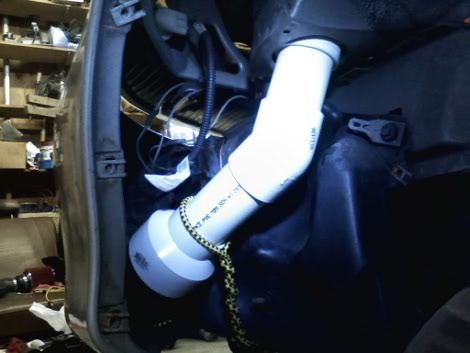
[Thomas] and a buddy were sucking down a few brews when they decided to hack their 2001 Chevy Cavalier for a bit better performance. If they could find a way to bring cooler air to the engine they speculated that they’d see an increase in efficiency. Instead of routing the air intake to a hood scoop, they took off the factory air filter and mounted a cold air filter in its place. PVC pipes were then used to create a delivery path from the front of the vehicle with the output in close proximity to the new filter. They tested their work and discovered a drop in intake temperature from 101 to 48 degrees Fahrenheit at 60 mph, and from 109 to 54 degrees Fahrenheit at 45 mph. Now the sedan runs better and generates more horsepower, all for around $35 in parts.


116 Responses to Adding an automotive cold air intake

  • Bob says:

    I like this modification, however I would like to see some measurements of the performance and efficieny with and without the hack.

  • Richard Nibbler says:

    PVC pipe?

  • flaggfox says:

    Seen it done with flexible dryer vent hose. Not exactly pretty, but effective.

  • thp777 says:

    did this to my 86 dodge truck made a noticable difference in performance.

  • Mike says:

    Yeah I’m with Bob on this one…

    I’d imagine that the turbulence that PVC creates in the intake voids all gain from the temp drop. But maybe not considering the PVC isn’t attached to the intake. Difficult to tell without actually putting the car on a dyno, or the intake on a flow bench.

  • Gilliam says:

    when i did CAI i wasnt checking on my milage, but it sounded good.

    required parts
    - 2002 ford focus zx3 w/ 2.0 zetec engine
    -fiberoptic protective tube(1.5in thick)
    tools: drill, cable tie.
    actions: drll a hole in the resonator, guide tube to lower grille, ziptie at grille, plug tube into hole in resonator.

  • Deadeye says:

    Bunch of morrons, this is nothing to do with temperature. It’s only becase of their air filter is one of those sporty-high speed air intake.

    Because it has less resistance to the air flow, it goes through the valves faster. With more air, more power to the pedal.

    Too bas for them this thing will increase noise, quicker valve wear, higher oil vapor inside the engine.
    Just let them think they are great, I dont care. ^^

  • Alex M. says:

    Oh look, a rock/bug vacuum! Seriously, bad idea mounting an air intake that low — you’re gonna make your air filter get dirty so fast.

  • ksmith says:

    Not true deadeye. Air density changes greatly with air temp. Going from 100 degrees to 50 will net you roughly 10% air per volume. The engine will have no problem delivering the extra 10% in fuel. If they took the time to dyno it, they should see just shy of 10% in hp gains. Next time you accuse someone of being morons, make sure it’s true. Just sayin’.

  • slade says:

    @Deadeye

    “Bunch of morrons…”
    “It’s only becase of their air filter is one of those sporty-high speed air intake.”
    “Too bas for them…”

    No, “too bas” for you. Your argument that these guys are morons would be much more compelling if you actually spelled the word “moron” correctly.

    Your post reminded me of this guy:

    http://poleblog.polemos.net/2007/12/dont-be-moran.html

  • Ho0d0o/Heatgap says:

    Yeah it’s one thing to criticize, but there’s no need to get all hostile over something like this…relax if you don’t think it’s a good idea say so, but don’t call them morons for trying something out.

  • Brock_Lee says:

    @Deadeye

    Not so fast. Colder air = more dense air thus more air molecules per given volume (volume is of course static). More air molecules = more fuel (pcm adjusts fuel in relation to total air MASS) and bingo, more power.

  • crispy says:

    Easy @deadeye, they probably did see some modest performance gains. Any MAF based system will register the higher air density and respond accordingly.

    My worry with the intake mounted low like that is the possibility of the engine taking a big gulp of water and hydro-locking. More likely hydro-exploding, watch out for puddles.

  • Turabaka says:

    I see nothing special about this at all. I wouldn’t even call it a hack since building one of these is extremely easy, and done every day for performance gains. It’s actually one of the first mods import car guys usually do.

    There is no increased wear on the engine, aside from choosing a less effective filter. Cone filters are not less effective than a normal square filter, but a k&n filter does filter less effectively than a paper filter. The benefit is that it flows more air than a paper filter.

    All this mod has done is make the intake flow more air at a colder temperature. Definitely a good mod if you’re looking for a minimal gain in power, but there are much better ways to do it.

    The correct way is to use mandrel bent aluminium pipe and an intermediate foam filter. That way when you hit a puddle you suck air through the foam filter instead of sucking water up your intake and into your motor.

  • Brock_Lee says:

    @Ksmith

    Sorry, guess I gotta be quicker with the submit button.

  • ksmith says:

    Then again, it is a Cavalier. Maybe they are trying to hydrolock the engine? I do have to worry a bit about how the PVC will hold up over time, but for pocket change you can rebuild it every year if you need to.

  • Scott says:

    Cold air is better. Cooling it reduces its volume so it can pack more air molecules into the cylinders and reduce the engine’s likelihood of detonation. There used to be an aftermarket kit for the M3 like that. It destroyed more than one or two cars because it would pick up the h2o from the ground spray and suck water into the engine. We used to call them puddle suckers.

  • brian says:

    Alex M is correct.
    We have been using cold air intakes on our custom builds for years and the dyno results suggest an increase in horsepower, amongst better throttle response. Cold air is especially on forced induction and turbocharged systems.

  • bootstrap says:

    Colder air = more fuel = more power = LESS efficiency. Can’t get everything you want sadly.

  • Charles says:

    I am with everyone else. This is the first mod teenage ricers do to their hondas. We were doing this back in the late 90s for christ sake. Come on HAD I miss the old days.

  • vonskippy says:

    I call hoax. There’s no way a Chevy Cavalier can go 60 mph (except maybe down a steep hill).

  • cpmike says:

    im sorry but i have to say this is not something i ever hope to see on had again.

    yes its a good mod, all it is is a pvc air scoop that throws fresh (cooler) air into the engine bay, which in turn has more cooler air available. but to say its a Cold Air Intake is misleading, and to post this up as a ‘hack’ is very discouraging… what will the next automotive hack be, a hacked-off exhaust being listed as ‘high flow’ ?

    i just never expected to see the same home depot cavalier mods that clutter up the rest of the net here on had…

  • dirk says:

    It’d be cooler if they had fabbed a shiny aluminum one.

  • Phil says:

    The bigger problem is that it’s going to suck in water. The factory box was designed to sift the water out. Water+engine=unhappy

  • taintedkernel says:

    @cpmike: agreed. this is not true had material. it makes the litany of arduino projects look like rocketscience.

  • mrgoogfan says:

    Chrome plated copper pipe is where it’s at.

  • cwh says:

    A motor is just a pump the more air in the more air you have to exhaust out. This means the better it will run. A cool motor always runs better.

  • Skitchin says:

    Was gonna comment earlier but now I have more points to make

    So the mod wasn’t the new filter, but the PVC redirecting air flow, right? It’s not clear through the few pictures. Dyno test won’t prove anything – this is a ghetto ram air setup so it relies on the wind coming at the car.

    Who knows maybe it increases drag enough to hurt the mileage.

    Everyone around here, myself included, used to do this to our cars when we were like 16.

    The next step up is that you can trick the car’s computer into thinking the intake air is colder by replacing the sensor with a resistor of the appropriate value, thereby making the engine run rich. I actually had a potentiometer hooked up way back when. Good ol’ days :P

  • reader says:

    This isn’t legal in CA, so make sure you know your laws before you get a nasty ticket or fail smog.

  • barry99705 says:

    For all the “it’ll suck water” people. I’d agree if the filter was directly attached to the pipe. As I see it, if the pipe got any water in the bottom then the engine will just pull air from the rest of the engine compartment. If the bottom was pointing straight out the front, then maybe, but probably not this setup.

  • barry99705 says:

    @ reader

    One more reason for Cali to fall off into the ocean….

  • cheese says:

    They won’t see an increase in performance or efficiency and now the car is susceptible to puddles.

  • Sam says:

    This is a pretty interesting hack.

    I’d be careful if anyone gets the idea that since a little more is better, a lot more should be fantastic. Many modern engines are often made up of multiple metals (usually an aluminum head with a cast iron block). Metals expand at a different rate based upon their temperature which is one of the reasons a thermostat keeps the engine at a specific temperature. Another big reason for the operating temperature is for the oil. The viscosity of oil changes with temperature. You don’t want the oil to cool too much or friction will increase, the engine will have lower output and a have lower lifespan as you put the block/head through a lot of mechanical torture.

    Just be mindful of these things if anyone decides to try to hack together something crazy like a liquid nitrogen chiller for the air intake in their car just to see how far they can push it. It’s not like overclocking a computer. Screw it up and you may end up walking. ;)

  • charlie says:

    if you’re making the the pipe running to the intake longer, you’re making it harder for the engine to breath, ie breath in, then try breathing throw a straw, join two straws together, its hard to suck the air in as it gets longer. an na engine is working on atmospheric pressure so its sucking in air as fast as the inlets allow it, in order to equalise out.

    If a CAI works, its because the old system wasn’t working properly in the first place, especially on an NA engine.

    Usually it just makes it louder, and that makes the butt dyno think its going faster.

  • Z WRight says:

    I’m a hot rodder at heart and use the tech information out here to cobble together a data logger / traction control, but leave the mechanical engine tweaks and ideas to the website specifically for them… Please don’t post a Home-Depot air spliter next…

  • Turabaka says:

    @sam

    they actually do have systems to cool the air charge even more. CO2 systems that spray the intercooler fins on turbo cars to cool the intake charge even more are available as kits already. There are nitrous kits that do something similar as well. Colder, denser air is always better than hot air. period. It will always produce the most horspower because a colder air charge equals more air and fuel in the combustion chamber.

  • xrazorwirex says:

    I did this to my zx2 when I was a kid with dryer hose and a K&N filter (I put a screen over the intake for bug protection though) and actually saw slightly better mileage.

    This is the most common car hack around, and if you spend some time on it there is definitely a return investment of some sort.

  • Derek says:

    Wouldn’t it have been better if they used aluminum or some better material that would cool the air a little more? I also think that if they were going to go through that much work they should have done a Ram air / cold air intake for a little extra!!!

  • xrazorwirex says:

    Note that you can also hook a pot up to your maf sensor to trick the computer into thinking you have colder air than is actually coming in to get a richer fuel mixture, although it’s kinda stupid to do it if you don’t know dick.

  • PhilKll says:

    It don’t even think this is a cold air intake, its more like a vent to the engine compartment. It just directs air towards the air filter, the stock airbox on my toyota truck is more cold air than this, as it pulls air from inside the fender, instead of inside the engine compartment. I don’t think this could even suck water into the airfilter, its not even sealed, to create a vacuum, that would suck enough water to hydrolock it, from a 3 inch or so pipe its not even directly connected to, seems impossible. Unless I didn’t see all the pictures.

  • The Hatchet says:

    File it in the >Ghetto hack< section

  • charlie says:

    colder air doesn’t always automatically mean more power, its the potential to make more power, power usually comes from spark advance. certainly any noticeable power over whats already going to be a close mix.

    the intake manifold is really hot especially at a power level where altering the amount of o2/fuel would even begin to do anything, taking in a slightly cooler charge ends up being even less slightly cooler by the time its gets to the combustion chamber. If the existing setup is pulling hot air in from the engine thats causes it to be significantly higher by the time it reaches the chamber, thats one thing, thats rare, measure the IAT on almost any car at WOT and you’ll see how fast it ramps up.

    the ecu runs the car for a given intake temperature at X spark and Y AFR, if its not optimium, it takes it away.

    cooler is better, but lengthing pipes, and getting air thats maybe only slightly cooler another.

    i’m sure people imagine some massively different explosion going on in the combustion chamber because the air intake is maybe slightly cooler.

    Calculate the change in air density and how much of a temperature change you’d need for a typical chamber vs how much extra fuel is added.

    maf’s measure air flow not density. tmaf’s measure temperature and airflow, if you tell a maf its flowing less air than you actually are, it could be all sorts of bad, you end up in the deceleration area of the maps and run nowhere near enough fuel and too much timing.

  • jh says:

    my CAI did improve my mileage. Not much, but it did help. It gave me 1 mpg on the low end (city) and about 2mpg on the top end (hwy). Now this is on an 88 Grand Marquis (not great gas mileage to begin with). To top it all off, mine is one of those dryer hose “Home Depot” specials. I did use a K&N Apollo as the filter since I wanted a completely enclosed system.

    http://blogs.myspace.com/index.cfm?fuseaction=blog.view&friendId=126778581&blogId=513659478

    yeah, I use myspace to host my blog… it’s free.

    Mine did cost well more than $35 though. The Apollo I found for about $120 and the rest was Home Depot parts and duck tape. I did have to saw the washer/coolant tank in half (left the washer half where it sat) to allow the hose out the front of the car and got an aftermarket tank at a local parts store for $10.

  • jeditalian says:

    people have been doing this shit for years. that’s not meant to be a negative comment, it’s good that a DIY cold air intake is finally in the HaD archives now. for more PVC fun, try mounting a potato gun on a jeep. ok thats a dumb idea because how you supposed to load it? but automate the loading process (beyond me), automate the filling of combustion chamber(much simpler), then wire the ignitor to the car horn switch :D
    now forget that i ever suggested such a destructive idea..

  • jeditalian says:

    weebly.com is also free

  • tbase says:

    I’ve got a K&N intake on my truck, and whenever we have a cold snap, I have a really hard time not peeling out everywhere. No need for PVC in my case, the kit creates a little compartment in the corner opposite the battery that’s shielded from the rest of the engine compartment, and it gets plenty of air directly from around the headlight.

    Speaking of air from around the headlights, this concept is really old- they did a much better job in 1964… http://www.crankshaftcoalition.com/wiki/Cold_air_intakes

  • PhilKll says:

    I have no hard numbers, other than the dyno sheet my K&N came with, and the rest of the engine is stock, so it doesn’t maximize any ability to suck more air. But I do know, it hardly costs anything to clean it, compared to buying a new filter, so I’m more likely to keep a clean filter in it, which is better all around for performance both power and efficiency.

  • M4CGYV3R says:

    I bought a machined aluminum Cold Air Intake from Matrix about 5 years ago for my ’95 Civic EX(VTEC).

    $50 for the intake, $15 for the high-flow air filter. Made a world of difference and I don’t have to worry about PVC melting all over my valve cover for only $35 more.

    There is a reason they don’t use PVC plumbing pipe for engine components, you know. There are specially made plastics and composites designed for high temperature and high-stress applications like in a car’s engine compartment.

  • tbase says:

    @PhilKll- good point- I try to clean mine before every trip. If I don’t, I usually drop 1 or 2 MPG. I also put on headers, high flow cats and y-pipe, and a high flow cat-back. I went with a single instead of double as I wanted performance, not noise. Then I added 10.4mm race wires, irridium plugs and a DiabloSport Predator tuner. I did it a while ago, so I need to upgrade the tuner so I can get custom programs via e-mail by sending data logging files to someone who does custom programs.

    The best increase in efficiency, though, was changing my driving habbits. I increased my gas mileage by 20% by keeping it under 70, dropping 10 MPH from the bottom of hills to the top, and accelerating very gently.

  • PhilKll says:

    “The best increase in efficiency, though, was changing my driving habbits. I increased my gas mileage by 20% by keeping it under 70, dropping 10 MPH from the bottom of hills to the top, and accelerating very gently.”

    Yeah, that does make a huge difference, learning how to use the gas pedal properly. Kind of like learning to use the brakes properly, they last a lot longer with nice smooth stops, instead of last second ones.

  • Sam says:

    Turabaka,

    I did not claim otherwise. The performance will improve, that wasn’t in question.

    >Colder, denser air is always better than hot air. period.

    And not all engines can handle that. NOS kits are an excellent example of what not to do with stock engines, they simply aren’t built to take it.

    You’re talking about performance parts built to run on performance engines that are designed to handle them. I am talking about ordinary people trying to hack their stock cars for more performance. There’s a BIG difference between the two. Which do you think there are more of on Hack a Day? (Hint: This isn’t a performance auto forum.)

    Someone who is serious about performance automotive work will meet others who know what they’re doing (when they go to buy the parts) and save them from costly mistakes. Someone who tries to bypass the parts market altogether and hack something together because they heard about it on the internet doesn’t have the benefit of that experience.

    Go back and carefully re-read what I said… or not. Mod the family car without understanding the ramifications of what you’re doing at your own peril. I honestly don’t care. I won’t be the one spending a few thousand replacing an engine trying to prove someone on the internet that I know better than they do.

  • sexiewasd says:

    @tbase I’m not saying that there are not gains to be had, but your problem with peeling out in cold weather probably has more to do with cold tar and cold tires than it does with the minor gains that you get from a less restrictive air filter.

  • Jake says:

    Good idea but I do agree with Turabaka there is a real danger of hydro-lock without a secondary form filter. AEM produces a Air Bypass Valve to eliminate the chance of your car hydro-locking if the filter were to be submerged. This is a good quick and dirty hack, although I would make an effort to add a secondary foam filter like AEM Air Bypass Valve to this build.

  • Zedd says:

    Thats a nice cold water intake.

  • octel says:

    @sexiewasd
    i was just about to post this. rubber stiffens in a cold environment, resulting in less grip.

    you get a squeal regardless of whether the loss of grip is from your souped-up engine or simply from the result of cold rubber :)

  • Ravant says:

    Not sure why this is on hackaday. This is the most basic of basic modifications car guys do. I’ll be impressed when they pull off an LNF engine swap. Or turbo that 2.2 engine reliably. Or crack the ECU and remap the air/fuel binaries. This is as much a “hack” as changing spark plugs. Give me a break.

  • Eddie says:

    CAI’s like this have been in use already for a while. This is nothing new, nor is this even remotely innovative. It’s the first mod most of us even do. They used PVC, which is alright, but more of a pain than using something like actual purpose-built, flexible, smooth-walled intake tubing.

    To those of you saying it’ll suck up rocks, bugs, water, etc.: Nope! The fender-well on most cars, such as these J-Body cars, or W-Bodies, and other unibody cars tend to be empty, but walled off from the environment. This creates pockets of cool, dry, relatively clean air. The only risk you take with a CAI that low is sucking in water if you try to enter a 6″ or deeper puddle. At that point, you’re flooding your interior. Or cracking an exhaust pipe. Or destroying the packs of glass in your muffler(s). Or worse.

    And to the nay-sayers of the performance improvements: It works. Short-ram intakes are those stupid filters you see that remain open under the hood. This sucks in hot air, decreasing the volumetric efficiency of your engine. These fender-well intakes take in air that’s 15-20 degrees cooler than what’s under your hood. Because of the CAI’s generally better flow, the air also is delivered from the cool location to the engine quicker, without picking up as much temperature. The drop in temperature increases the amount of air available to the engine. The ECU compensates for the newly created lean condition by adding fuel. The increased amount of air and fuel in the engine creates more power. You can gain even more power and efficiency from this simple modification with an ACTUAL HACK by cracking your Air/Fuel/Spark Timing tables and adjusting them to better suit your higher amount of air flow.

    Still not sure why this is here on Hackaday… it’s not really a hack. Look at those guys who cram LSx V8′s into cars like the Solstice or Fiero! The wiring, electronic control, and mechanical nightmare that would undoubtedly ensue would SURELY be a better hack than this…

  • sandalscout says:

    To further M4CGYV3R’s point, PVC has a tendency to harden and breakdown at higher temperatures, letting off potentially dangerous fumes. I’ve yet to see proof of anyone getting hurt by this, but PVC in the engine bay is generally frowned upon.

  • Still needs go-fast stripes and/or flame decals.

  • dorkin says:

    I like this I have done worse things to my car after a few brews. Such as writing turbo charged on the side of it with a permanent marker.

  • This is the trashiest CAI I have ever seen. Also kind of hilarious that I tried to talk with the guys here at Hackaday about the free speed density conversion for 1g DSM’s (www.ds-map.net btw) and they just ignored it… but they’ll post this air flow nightmare. Please people do not put plumbing parts on your car. It is not your bathroom sink. Literally you would have picked up more power just replacing the air filter with a velocity stack and leaving it in it’s stock location (provided it’s a speed density system).

  • Fallen says:

    :S Seems like a lot of people didn’t read the article(errr looked at the photobucket). The pipe just guides cold air into the engine compartment. It’s not connected to the air filter. So there is no chance of sucking up water, etc.

    That said, I put a K&N filter in my car a while back, but I went with a stock sized one and kept my airbox. I don’t see how the short ram is beneficial, it’s so close to the engine it’ll just pull in hot air. In my ’97 intrepid the air box pulls air from the fender, so it’s nice and cold already. What I would like is to be able to increase the amount of air it can draw from the fender, I think that’s where more gains are to be had, is having less restrictive flow.

    So I might just have to try, but with a dryer hose…Since the general consensus is PVC is a poor choice.

  • If what you’re after is efficiency — measured in increased MPG, then cooling the air is exactly wrong. Modern cars run hot on purpose. The engines are tuned to run hot and best burn the least total fuel.

    If bringing in cooler air could increase MPG (efficiency) at least one of the actual engineers at GM just may have considered something as inexpensive as ducting the air from a cooler place.

    If, on the other hand, you’re looking to improve the speed at which your car moves — the solution is to sell the GM Econobox, and buy something meant to be driven by someone other than an old mane with a hat.

  • Garreth says:

    They seem to have done a hell of a lot better than my SLA version. http://i45.tinypic.com/b5mlj5.jpg

  • Alan says:

    That intake now has almost exactly the same intake layout as my car had when it left the factory.

    Come on America, catch up.

  • Mr. Twister says:

    This reminds me of the diving helmet from last week. Does anyone else see the arm of a Rock-em-Sock-em-Robot?

  • Lame says:

    Fuel efficiency in MPG will decrease since there is more air to burn more fuel. Volumetric efficiency can increase significantly to produce a cleaner burn, with enough air to counter most factory ECU’s running engines pretty rich. Lowering the velocity of the intake air will decrease both efficiencies, due to the increased length of the intake pipe, which increases the friction the air must overcome and possibly choking the engine when it rains.

    A MAF system will benefit more than a MAP system, but still if you are going to modify the intake you should at least use an AFC (now you’re adding $100 easily) and set maps or at least thresholds.

    The PVC is probably the worst choice, the relative roughness is going to lead to turbulence which will negate any temp difference of the air at the outermost edge of the intake. Isolating the part of the intake still in the bay from the hot engine is going to net you with greater results.

    Finally, the best way to claim that lower temp air leads to greater power is to have it stay at low temperature in the intake manifold, mixed. This is the most difficult to achieve, but if it can be done (alcohol produces such high horsepower because the fuel keeps the charge at a low temp) then it is more of a significant step than any intake mods that are done.

  • D- says:

    No doubt modest performance where realized, as this is a time honored hot rodding mod. But by the seat of the pants data gathering is relative,and should be taken with a grain of salt. As always this could be refined, but if the car owner is happy, that’s all that matters isn’t?

  • nubie says:

    I have done similar things to my Rabbit and Rabbit GTi

    I used a (heavily cut up) 3″ elbow and JB weld at the stock airbox connected to a Plymouth Voyager phenolic intake tube, with a funnel from Kragens zip-tied to the end. Routed cool air from the passenger side of the radiator. I think it picked up some power at night in the cold.

    Either way you look at it, it is worth checking your stock intake tube/airbox to make sure a bunch of rodents haven’t made a nest in it ;)

  • nubie says:

    Wow, I took a look at this picture, this guy seriously needs to lose that last 90° bend and put a shield around that cone filter to get the engine bay heat away.

    Any decent cone air system has a custom heat sheild so you don’t lose power due to heat-soak under the hood.

    Simple works too, get a rubbermaid box and cut out the sides that lead to cold air.

    Most hot rodders would simply move the battery to the trunk and remove that headlight (or stealth mod it with a tube going through an unused high-beam area, or even divert some air that direction with a simple metal flap placed behind the grille).

    Good for a first attempt hack though, but he didn’t spend much time thinking about how real cold-air systems are designed, or how flow works.

  • ebola says:

    Ghetto… and trivial. Hardly hack-a-day worthy. At least find some inteesting hacks.

  • James says:

    There’s some seriously poor knowledge masquerading as detailed knowledge in this comments thread. It’s no wonder myths and misnomers about car tuning are rife on the internet.

    And all of that adds to the fact that, as mentioned, this is a bog standard schoolkid mod to help with a botched filter arrangement. No filter should be open in the engine bay in the first place, that’s the most ridiculous arrangement and I see it day after day as a “performance mod”. Filters, unless placed in front of the rads, in a well considered location, should be in a housing and fed from a cold location. Most stock boxes already do this, at least in european/japanese vehicles, and do this very well. Have any of you actually measured the pressure drop and intake temps across a stock intake setup – they’re actually pretty damn good on most cars. Usually the best solution possible, without completely re-building the intake, is to simply go for a lesser-filtering panel (K&N etc) to replace the stock one and lag the pipework.

    So many people assume that stock=compromise, or aftermarket=automatically better, without ever checking to see. The number of people I’ve had to break the news to about how their £100 “induction kit” is actually robbing them of hp (over stock) and then seen it proved on the rollers is quite frightening. I’m not saying stock is always good, or that stock will deal with a seriously modified engine, but at relatively lowly modification, the stock intake usually VERY well thought out and a team of very smart designers with CFD packages have optimised it to suit the engine, unlike the guys who’ll sell you a metre of stainless pipe and a sponge in a strainer.

  • fartface says:

    How cute, people who think they know about cars… CAI’s are a favorite of the honda wannabe kids. Unless your car is horribly designed by idiots a CAI will not help you. Just like how a K&N filter wont help you, or any miracles in a bottle, or any special sparkplugs….

    Hack a day is not the place to find REAL automotive information. Go find a website where real people are doing real stuff to their cars.

  • Hackineer says:

    I don’t know why a lot of people think this will improve gas mileage. Even with colder air, the engine will be still be pulling air mass in at the same rate for a given power output. The car’s computer will keep the air mass to fuel mass ratio where it should be, and the same amount of fuel will be burned.

  • jcg says:

    Route the airtake into the car and turn on the aircon. Extra cold air intake (i kid i kid)

  • strider_mt2k says:

    SLOW DOWN I’M WRITING!!

    Sponge and a strainer…DAMMIT

    ANYONE HAVE A PEN?????

  • AcMav says:

    I’d be a lot happier if Hackaday had posted Megasquirt or something similar for a car performance mod. I’d rather see some home tuning on a handmade ECU than someone taking 20 minutes to drill a hole in the fender and place a piece of PVC through. I considered doing this to my car but the performance gains weren’t worth it, the most you get at the wheels is 2-3 horsepower with only an intake mod because you’re still restricted by your exhaust backpressure in most cases. The air system on the car was designed to meet the demands of the engine, without remapping the ecu you won’t see any real significant gains. It’s like most automotive mods, they only work well with tuning and with other performance parts. And in response to the person who posted the hydrolock protection kit, do you think they’re going to spend 200 bucks on something AEM if they refused to buy an actual CAI? I doubt it

  • Jess says:

    Weak, on last years’ BABE rally our comrades in team epic fail were having tons of trouble getting their poor Toyota around the mountain roads. We ended up all stopping together to check out why the car was struggling horribly to discover…

    There was no air box. NONE no filters no box just a fitting with a few bolts sticking out of it where the motor was sucking in air, to top it off she was sucking hot air from right off the transmission!

    Thus ensued a massive cross team effort to empty any plastic bottles in our possessions, cut the tops and bottoms, down the length. some kind of horrible elbow fitting was fashioned, and an aluminum duct tape, plastic, and regular duct tape amalgamation took shape. We found a source of cool(er) air from the fender (likely where the stock air box was sucking from). still no air filter, I think somebody suggested putting a stocking over something..? We tactfully ignored the gravel-sucking design and nothing happened.

    Team epic fail had no further problems with the motor bogging down, the new intake took them from the mountains of TN to NO in the middle of the summer. THAT is a hack.

  • dnm says:

    I’ve done a lot of testing of these things, and found that sucking the air that close to the ground serves no purpose whatsoever. Once you remove the OEM black pipe that spends too much time routing towards the intake, and go to just a shorter intake (even if it sucks air from the middle of the engine bay), you’ll get the gains.

    Your idling air temp will be up a bit, but once you start cruising, within a second or two, the air you’re sucking in drops to the ambient temperature outside.

  • James says:

    “Your idling air temp will be up a bit, but once you start cruising, within a second or two, the air you’re sucking in drops to the ambient temperature outside.”

    Not in my several years of testing, and if it does your radiators are massively larger than required, but I suppose that depends on your airflow arrangements under the bonnet. In most situations you’ll be getting air from the coolant rad, which will be in the region of ambient+30C or so. The OEM pipe is generally perfectly good unless your car was designed by an idiot, and often are shared with the much higher powered variants of the same engine, so more than capable. Your gains from a shorter intake are rarely large enough to compensate for the losses of warmer intake temps, despite what the aftermarket industry will tell you. Sometimes you can place the filter inside the bay but directly behind a large frontal opening that isnt fed by through the rad, which is reasonable, but it still should be boxed in as at any speed where airflow is not appreciable you’re running on hot air.

    Such as here (this setup is proven to reduce power with hot underbonnet temps):
    http://www.brsf.net/cars/gt4/cel-intwr02.jpg
    this is the proper way:
    http://homepage.virgin.net/shalco.com/images/celica_eng.jpg

    Hackaday really isn’t the place for discussing car mods and thermodynamics.

  • James says:

    Though ultimately the best way to achieve cheap LARGE performance gains is to reduce weight, anyone serious about performance will head initially down that route to improve handling, stopping and going, before needing to add 5hp through intake mods.

  • @ whoever said to use an AFC up there:

    That is the most special needs hack of a pos excuse for a tuning device ever. Did you consider what it does to your ignition timing when the ecu is running in a different load cell because the afc LIED to it? I hope some of you geniuses put AFC’s on your cars because you’ll be the guys I’m spanking using only a stock turbo and a real tuning system.

  • David says:

    I did this years back on my 04 Scion xB. How ever I found that using couplings caused too much air turbulence in the system and had a dip in high end. So I made one by heating and flexing the pipe to make the bends. Went even further to add same cross sectional area but yet pinched corners. It’s a trick they use in super high end exhaust systems.

  • liebesiche says:

    And? Does it use less fuel? I doubt!

  • btlfed7 says:

    You can get the cheap eBay ricer one made specifically for the car so you can get your 1-2 hp and slightly better fuel economy for the same price shipped.

  • Hackineer says:

    @James

    “Hackaday really isn’t the place for discussing car mods and thermodynamics.”

    I’ve always been disappointed by the lack of ECU and vehicle control systems (how about ABS, traction control, and stability control?) hacking. Sure, there are plenty of commercially available products for ECU tuning, but I haven’t seen many hacks.

    I guess the consequences of damaging an ECU or power train (expensive and inconvenient) and possible safety issues (think runaway Toyotas) make this kind of hacking a little beyond Hack A Dayers.

  • Matt N says:

    How to increase performance of a Cavalier:

    * Take one(1) Chevy Cavalier
    * Open hood, doors, trunk
    * Remove everything of value
    * Sell said valuables on eBay
    * Use money to buy a Corvette
    * Place Cavalier badge in glove box of said Corvette

    (Note, humour, my wife had a Cav way-back-when, so no offense meant… but I stand by my accusation! :) )

  • pookey says:

    @Jess

    Your story reminds me of Apollo 13 ;)

  • Shutta says:

    While this isn’t a ” hack ” this is a great idea! I’ve done this way back in the day and there are noticeable gains. Since the air is colder the molecules cram together ( more air same space ) add fuel and in this case spark = more performance. This is a tried and trued method, look up performance CAI and you’ll see run after run on dynos of people with CAI and without. Chances are with this one, the guy is just running the PVC up to the filter box and not all the way to the engine…I hope not… there the temps exceed safe temps for PVC, PVC is good for burst and cold…not for hot…it lets off gasses that will kill

  • Yahoozie says:

    I’ve modded a few cars and been on other forums dedicated to this.

    The consensus is that PVC/Duct CAIs don’t work. And guess what, neither do K&N filters.

    You can get a high flow MAF and modify the ECM programming. This might give you some measurable gains. You’re better off ripping out your AC system than doing this.

    Most cars now are not limited by restricted airflow. Ditching your catalytic converters and a high flow exhaust would gain you HP in the double digits not double decimals.

  • You mean high flow exhaust like putting an exhaust tip from ebay on the end of your stock exhaust and some R Racing stickers?

    Run boost or nitrous if you want to be a man and impress the ladies.

  • Joe Bonasses says:

    “Yeah, I’m going to have to go ahead and, yeah, disagree with you there.”

    In theory the ECM is going to compensate for the air flow (map sensor) and temperature (intake air temp) and adjust the air/fuel ratio based on these conditions. I would expect the gain to be marginal if measurable at all. Speaking of which, where’s the A/B dyno test?

  • John R says:

    I heard it mentioned that PVC + hot engine bay = corrosive chlorine gas?

  • bob says:

    This hack puts my dual turbofan, bullet-proof Suburban Assault Vehicle to shame.

  • dumbfounded says:

    First of all, does everyone not see how absolutely BRILLIANT it was to post this pre teen caveman setup? Just look at the number of comments! Those are all site hits! Marketing GENIUS! Hats off to ya hackaday webmaster!
    Also OMG did someone say they need to take that 90 degree bend out of it? WTF.
    Where did YOU go to geometry class, Juarez?
    Thats clearly more like 20-25 degrees…
    But the airflow inside of that pipe Im telling you is AWFULL. Theres a reason ppl dont do crap like that and thats because inside that coupling theyres a sort of interior flange due to the fitting sliding OVER the pipes. On one inside surface if you could get your hand in there you would feel a huge U shape and that goes all the way around the interior circumfrence. Now you see just ONE flat surface inconsistency would cause what you would say ‘turbulence’. That is why Port Matching is done.(google port matching)
    When you have this square ravine on the ENTIRE inerior surface, at a BEND POINT no less, than the choke point you are creating goes way way beyond turbulence. Blissful ignorance?

    Also whats with the aftermarket cold air system sitting right there in the background?
    Am I the only one seeing this?

  • Einomies says:

    Lowering the intake temperature yields lower efficiency because the fuel charge then burns at a lower temperature.

    Efficiency of the engine, when other variables are removed, is determined by the average temperature in the cylider during power stroke, relative to the temperature of the ambient air around the exhaust. That is, the hotter your intake temperature is, the less fuel you need to use to make the mass of air hot. This is why things like microturbines or stirling engines use pre-heaters for the intake air. A good heat recuperator can double the efficiency of the engine by recycling lost exhaust heat back into the combustion chamber.

    Internal combustion engines use intercoolers and generally avoid pre-heating to improve volumetric efficiency, that is, how much air you can cram in the cylinder. It would be theoretically possible to increase the efficiency through pre-heating the air – a turbo does this to some extent – but heat it too much and you’ll burn a hole in the piston.

  • Robert says:

    That is good at autumn or spring temperatures but it’s no good at Christmas time. And how will the engine start in August. The air’s not dry and the engine would be too cold.

    It’s a good idea with future potential.

  • Shane says:

    ROFL look at all these experts in here, get over it. Its a piece of PVC

  • cromey says:

    never mind the PVC vents toxic gases.

  • Michael Irving says:

    Hi. Please, how about some math to figure the length of PVC per engine size? I believe this gives a better mod(Hack?), I’ve read something along the lines of 1 inch of pipe length per CC engine size. Obviously taking into account the diameter of the carb. Is this not how one calculates a Ram Air intake? Some maths on this would help. Length of pipe also has something to do with, Where in the power band, the improvement occurs. I think short pipe for low rev range and long pipe for higher. Googling doesn’t throw up much, especially if you don’t know how to ask. Air flow in is at most pressure at the front most point of the vehicle in question. I feel some bonnet scoops are in the wrong place, due to aero dynamics. What do you think?

    Cheers Mike

  • Leave a Reply

    XHTML: You can use these tags: <a href="" title="" rel=""> <abbr title=""> <acronym title=""> <b> <blockquote cite=""> <cite> <code> <pre> <del datetime=""> <em> <i> <q cite=""> <strike> <strong>

    Hack a Day serves up fresh hacks each day, every day from around the web as well as hacking related news.

    Send us your hacks


    Hacks

    Resources