
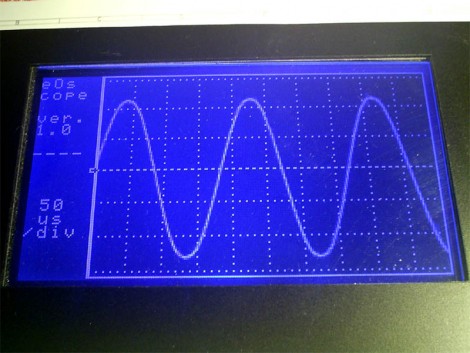
If you can fabricate single-sided circuit boards at home you can build this digital oscilloscope. It uses mostly through-hole components with just a couple of surface mount chips to contend with. An ATmega162 handles the hardware end of things with a CPLD used to manage the sampling rate. Data is displayed on a 240×128 LCD display which will be the most expensive component to acquire. It’s still a lot cheaper than buying a commercially available oscilloscope, even if you get a base model and hack it to unlock all the features.
[Thanks Juan]











Cool project, but the link is wrong – It goes to his monitor tester (which is equally useful)…
http://www.eosystems.ro/eoscope/eoscope_en.htm
Oops, wrong link. :(
Ahhh there we go.
Thanks lurker
whoa this is amazing
i think your link is wrong … or maybe you imply that you can make a scope with that XD
Does anyone have a projected cost for this o-scope? and where do you buy an lcd like the one he has?
A very nicely built project, but the 10K input impedance seems rather low to me..!
anyone know where to get a compatable screen,i cant seem to find one with the right controller
Neat but since I don’t know when to use an oscilloscope I guess it isn’t really for me.
What kind of voltages would something like this be able to handle? I have seen many Atmega, PC, and those other oscilloscopes but I somehow don’t think they were designed to handle very much power. I can see using it as a way to measure voltages like the pulses from a 555 so… I assume it would need to be able to handle some power.
This is really awesome except it’s only good for 5MHz; if this could do 20, or maybe even a solid 10 or 15 I’d start prepping a board this week.
For your average amateur / student or as a cool thing to show your friends or as a neat toy to keep on the side for when you don’t wanna bust our your big guns (or when you’re taking risks poking around a unit-gone-haywire) then this might be your piece of pie; still very cool.
There are many projects like this out on the ‘net. The problem is the painfully limited bandwidth, and the horribly low input impedance.
Yes, this is cheaper than getting a RIGOL and hacking it, but the RIGOL is infinitely better than this oscilloscope in every way. This is more of something that you show off to your fellow students to make them ooh and aah. It does look cool, but I can’t think of any practical use in an EE lab.
I suppose this would be good for audio-related uses, though :D
I just watched the EEVblog about hacking that other scope to 100MHz. Dave Jones seriously cracks me up. What a nutty aussie.
What I’d really like to see is a combination of the two projects: an oscilloscope driving a standard external monitor. Still quite neat though.
In reply to rachel:
What I’d really like to see is a combination
of the two projects: an oscilloscope driving
a standard external monitor. Still quite neat
though.
This has been done already, although just for audio, non the less pretty neat:
http://www.5volt.eu/archives/85
Jake, you are right, it is too limiting. Still, the most critical part of it, the ADC is rather cheap and easily available.
If somebody is skilled enough, the analog part may be modified for higher performance.I’d change the display for a Siemens S65 phone one(cheap, available, easy to connect).
The best way to make one using a normal monitor would be using an FPGA, but that complicates things.As for the Rigol scope, i am too a proud owner of the easily hackable one. Highly recommend it.