May the Phorse be with you

posted May 31st 2010 1:00pm by
filed under: led hacks

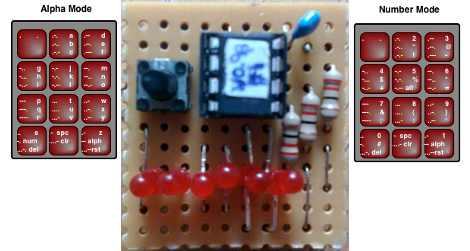
The PhorsePOV by [Julian Skidmore] almost slipped by, but we thought it was a nice easy hack for your Memorial Monday. The gadget uses an ATTINY25 to drive 6 LEDs aren’t standard characters 7 units high? Which when waved in the air produces a readable message. What we were really interested in is the use of a single button for text entry, called Phorse code, or an “easier to learn and remember” version of Morse code. While it seemed silly at first, most of us here could enter messages within a few minutes of trying.

Beginner Concepts: Cascading shift registers

posted May 31st 2010 12:00pm by
filed under: misc hacks

There’s a million tutorials out there describing how to use shift registers. If you’re just getting into embedded systems you should know how to use them as they allow you to take three microcontroller pins and expand them virtually without limits. This is due to the serial-in parallel-out nature of these integrated circuits. A key feature of these chips is the ability to overflow, or cascade to the next chip which is what provides the expansibility.

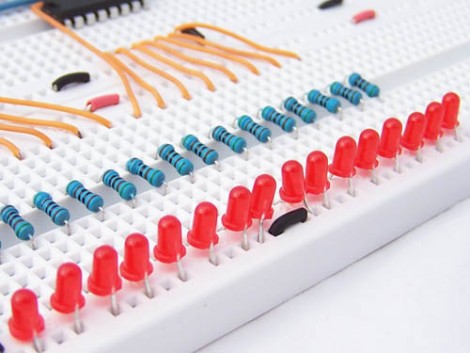
Protostack just published a tutorial that uses this hardware to interface sixteen LEDs using two shift registers. The explanation is short and to-the-point with easy to understand code examples. There’s also something to be said for their crisp and clean breadboarding work.

Take a look at how they do it and then use the concept to make a fancy clock or reduce the pins needed to drive a display.


Bluetooth boombox

posted May 31st 2010 11:00am by
filed under: digital audio hacks

[Nathan] took this boombox and outfitted it for Bluetooth streaming. He took a Motorola DC800, which is meant to make headphones wireless, and connected it to the stereo inputs. The controls for the Bluetooth module were routed to the stock tape deck controls and a little bit of frosted spray paint adds a blue glow to the cassette window. Now he can stream music from his phone, including internet radio, which he’s done in the video after the break.

Did he find the most annoying demo video music ever? You be the judge. Read the rest of this entry »

LEGO pick and place

posted May 31st 2010 9:28am by
filed under: robots hacks

Turn your volume down and take a look at the brick sorting robot in the video above. It’s built using LEGO and powered by four different NXT modules. It sorts differently colored bricks on the intake conveyor and places them on three output conveyors. The build is solid and was [Chris Shepherd's] impetus for starting a blog. We appreciate the pneumatic tricks that he detailed in some of his earlier posts such as a compressor, pressure switch, and air tank system. His advice is “build, build, build” and that’s what you’d have to do to perfect a monster of this size and scope.

Flight simulator but you’re the plane

posted May 31st 2010 7:38am by
filed under: wearable hacks

[Rafael Mizrahi] built a flight simulator that lets him fly like Ironman. As you can see in the video after the break, the hardware involves an automotive crane, hang gliding harness, plus the wings and tail from a UAV. A giant fan pointed at the wearer allows him to use the wings and tail to maneuver while the Wii remote strapped to his chest tracks the movement and feeds it to Google Earth Flight Simulator which is seen through the head-mounted display. We’re used to seeing intense flight simulators but this is something completely different.

Read the rest of this entry »


Child-sized cocktail cabinets

posted May 30th 2010 12:30pm by
filed under: home entertainment hacks, netbook hacks

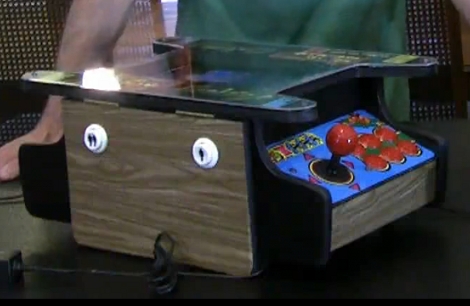
[Sam Seide] dropped us a line about his new arcade creation. We loved his Punch-Out build that used a punch dummy as a game controller. This time around he’s made some mini-cocktail style MAME cabinets. He removed the screen from a netbook and placed it face-up underneath the acrylic bezel. There are controls on either side for two players as we would expect from any quality cocktail cabinet. The control panels are interfaced through the now familiar iPac boards and are a bit unfinished on the underside but that doesn’t decrease our need to see one of these on the coffee table at home. Check out demo and an outline of the parts inside after the break.

Read the rest of this entry »

Crossfade curve tweaking

posted May 30th 2010 11:29am by
filed under: digital audio hacks

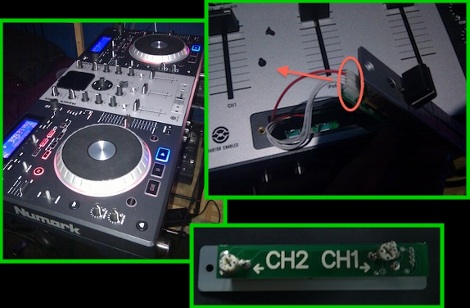
Tired of the disappointing performance from the crossfader on his Numark MIXDECK, [dj JD] cracked it open and made the crossfade curves adjustable. It’s a super-simple hack that just introduces two 100k trimpots to the crossfade slider. The change led to a higher volume level on the current channel until the slider was much nearer to the center. The added adjustment feature might be nice to have as two more knobs on the board but [JD's] method leaves his equipment with a stock appearance. Is this a more refined version of circuit bending?

Brighten up your PCB drilling station

posted May 30th 2010 10:03am by
filed under: tool hacks

Being able to see what you’re doing can be the hardest part of drilling the through holes in those freshly etched printed circuit boards. We don’t know why we didn’t come up with this, but [Markus Gebhard] solved his shadowy woes with his 20-LED Dremel light ring. Honestly, how many times have we seen lights rings in photography without putting it together that a light ring is perfect for this purpose. So kudos to [Markus], now we’ve got to go and dig up some surface mount LEDs and uncork the copper chloride.


Hack a Day serves up fresh hacks each day, every day from around the web as well as hacking related news.

Send us your hacks


Hacks

Resources