Embedding an accelerometer and XBee in a guitar

posted May 28th 2010 6:41am by
filed under: musical hacks

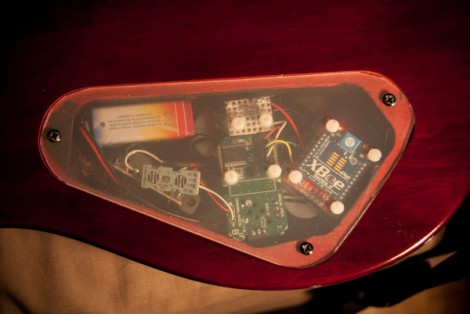
[JP Carrascal] hacked his guitar by adding motion control while removing the need for wires. He’s using a dual-Arduino system with an Mini Pro inside the guitar and a Duemilanova for the receiver connected to a computer. Wireless is provided by the XBee module seen above and a gutted Wii remote accelerometer is in there for motion sensing. Check out the artfully blurry demonstration of the motion effects after the break.

While he added some potentiometer-based controls there is also an automatic power-down feature. [JP] replaced the mono pickup with a stereo one and used the extra conductor as a switch to activate the additional electronics. We wonder if he also winds his own pickups or builds his own effects pedals.

Read the rest of this entry »

Adding SCART to a cheap CRT television

posted May 27th 2010 1:31pm by
filed under: classic hacks, home entertainment hacks

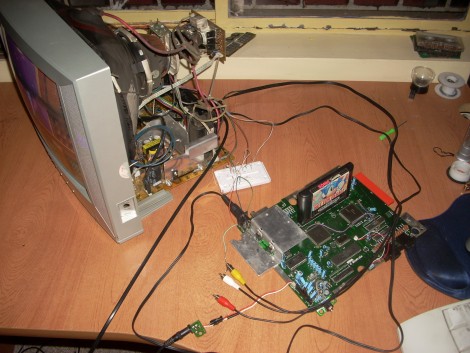
[133MHz] cracked open a cheap tube television to add a SCART connector. He knew he had a chance at success when he discovered all of the knock-outs on the back of the connector panel because one of them was exactly the right size for the connector. But it wasn’t quite as easy as soldering in one component. He ended up injecting his own RGB data from the SCART connector directly into the onscreen display, making an end run around the missing feature. [133MHz] removed some resistors in the circuit and used the empty lead holes to patch in his own circuit, feeding the RGB data from the SCART connector to the OSD chip in the format it needed.

This one takes you way down the rabbit hole. We’re glad he provided so much background about the hack but it’s going to take us a little while to fully wrap our heads around how he figured it out.

[Thanks Victor]


Commercial webcam multi-touch coming soon

posted May 27th 2010 12:31pm by
filed under: multitouch hacks

It looks like Toshiba has a webcam-based multi-touch display on the way. The video shows an iPod-esque photos album interface where the user stands in front of the display and manipulates it with both hands. The difference between this and some of the other multi-touch displays we’ve seen is that there is no touching necessary (goodbye fingerprints!). The user’s image is superimposed on the screen in a way that reminds us of the original Playstation Eye. Obviously this is much more refined, making us wonder if it’s the better camera, better processing, or both.

[Thanks Risingsun]

GSoC takes on XBMC on the Beagleboard

posted May 27th 2010 11:30am by
filed under: HackIt

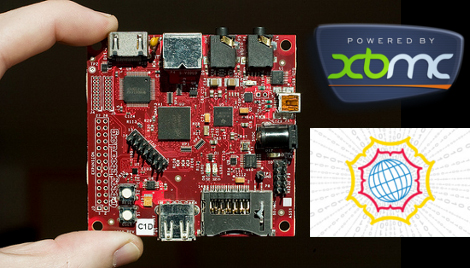
Imagine a tiny little device that you velcro to the back of your TV that delivers all of the media found on your home network. We’ve been dreaming about that since we saw early working examples of XBMC running on a Beagleboard. We’ve heard little about it since then but now there’s cause for hope. XBMC optimization for the Beagleboard has been approved as a Google Summer of Code project. The fruits of these projects tend to take a year or so to ripen, but we don’t mind the wait.

[Topfs2] is the student coder on the project and will be posting weekly updates as well as idling in IRC so if you’re interested in lending a hand with testing or words of support you should drop him a line.

[Beagleboard photo: Koenkooi]

BAMF2010: Look sir, droids!

posted May 27th 2010 10:00am by
filed under: cons, robots hacks, roundup

Ask any engineer what originally sparked their interest in technology, and almost universally the response will be a Hollywood film or TV robot — Star Wars’ R2-D2, the B9 robot from Lost in Space, or Short Circuit’s Johnny 5, to name a few. Engineers need a creative outlet too, and some pay homage to their inspirations by building elaborate reproductions. At this year’s Maker Faire, droid-builders had their own corner in the center hall, their work ranging from humble craft materials to ’bots surpassing their film counterparts in detail and workmanship.

Read the rest of this entry »


USB morse code keyboard

posted May 27th 2010 8:31am by
filed under: peripherals hacks

Looking for motivation to practice morse code [BenB] built this morse code keyboard. It uses USB and is recognized as a standard keyboard thanks to the V-USB stack running on the ATmega168. The project is rounded out with a clean look thanks to the chewing gum container that serves as an enclosure.

His design is simple enough that any morse key you have on hand can be used. You could even adapt that glove coder you built a couple of years back.

BAMF2010: DIY electroluminescent displays

posted May 27th 2010 6:32am by
filed under: classic hacks

In this video from Maker Faire, [Jon Beck] of CLUE — the Columbia Laboratory for Unconventional Electronics — demonstrates the unexpected ease of creating custom electroluminescent (EL) displays using materials from DuPont and common t-shirt screen printing tools. Eagle-eyed reader [ithon] recognized the Hack a Day logo among the custom shapes, which escaped our notice at the time. Sorry, Jon! Very cool project, even if the setup is a bit steep. You’ll find links to materials at the project site.

If the interviewer seems especially sharp, that’s because it’s none other than [Jeri “Circuit Girl” Ellsworth], who makes transistors from scratch and designed the C64 DTV. We’re not worthy!

Unlocking the crippled potential of an unmanaged switch

posted May 26th 2010 2:00pm by
filed under: misc hacks, news

[Sprite_TM] outgrew the features of the cheap unmanaged TL-SG1005D switch he was using on his home network. Instead of buying a new and much more costly switch he cracked the cheap one open and found that the RTL8366SB chip inside possessed the ability to work harder but was crippled for sale as a low-end model. It wasn’t as easy as that oscilloscope firmware upgrade we saw a while back. He had to add an AVR ATmega88 to send I2C commands to the switch. Turns out that the I2C protocol wasn’t standard and after much head scratching he found some Linux drivers for the chipset that gave him enough info to send the configuration commands he needed. Now he’s go the managed switch he needed for his VLAN for the cost of a microcontroller and some wire.


Hack a Day serves up fresh hacks each day, every day from around the web as well as hacking related news.

Send us your hacks


Hacks

Resources