Wristwatch board with throwback digits

posted Aug 25th 2010 1:00pm by
filed under: clock hacks

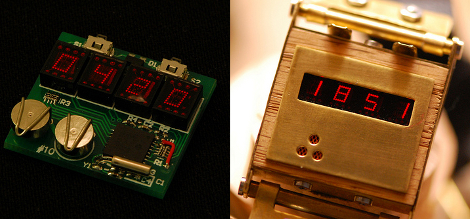
This wristwatch circuit board has some pretty interesting digits. They’re older components that give a classic look to your wristwatch display. On board you’ll find a PIC 16F628A running with an external clock crystal. The display isn’t always illuminated (kind of like Woz’s watch) in order to save the batteries, but can be woken up for a short time with the push of a button. The steam-punk-ish body seen to the left is the just first try. This guy has four more boards left so it should be fun to see what he comes up with.

[Via Hackaday Flickr Pool]

Modem used in an alarm system

posted Aug 25th 2010 12:02pm by
filed under: security hacks

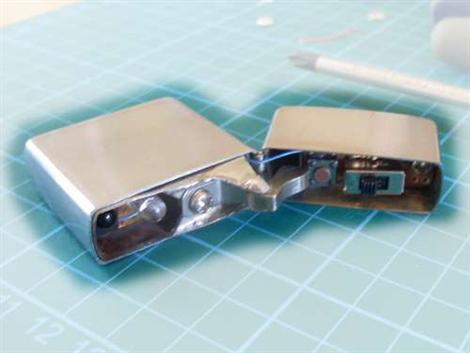
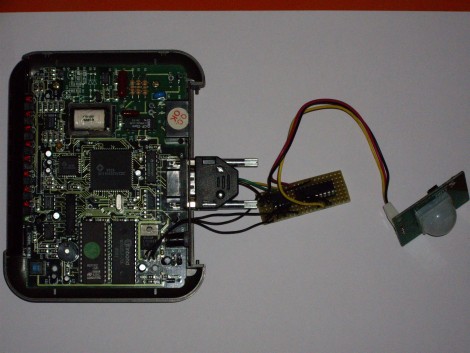
This alarm system senses motion and then alerts you by phone. [Oscar] had an old external modem sitting around and, with some wise hardware choices, he came up with a simple circuit to use it. First up is the PIC 16F628A chosen because it doesn’t require an external crystal. This connects with the modem via a DS275 RS232 transceiver because it requires no external parts for connection. The final portion of the puzzle is a PIR sensor that triggers a pin interrupt in the sleeping PIC, which then dials your number to alert you. It doesn’t look like anything happens other than your phone ringing, but that’s enough for a simple system. We’re just happy to see how easy it was to use that modem… time to go hunting for one in dreaded junk trunk. Don’t miss the clip after the break.

Read the rest of this entry »


EL Wire: make it, connect it, power it

posted Aug 25th 2010 7:59am by
filed under: chemistry hacks

[Jeri's] back with a series of videos that outlines the step-by-step electroluminescent wire manufacturing, making EL panels from PCBs, and assembling power supplies for EL hardware. These concepts are actually quite approachable, something we don’t expect from someone who makes their own integrated circuits at home.

The concept here is that an alternating current traveling through phosphors will excite them and produce light. You need two conductors separated by a dielectric to get the job done. For wire, [Jeri] uses one strand of enameled magnet wire and one strand of bare wire. The enamel insulates them, protecting against a short circuit.

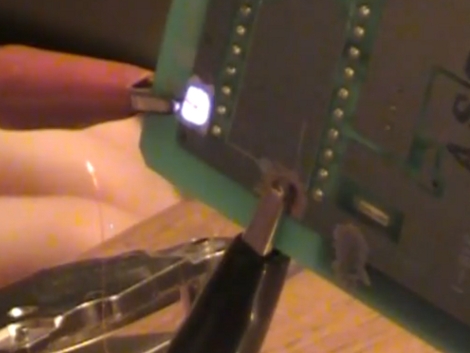
But that’s not all, she also tests using a circuit board as an EL panel. By repurposing the ground plane as one of the conductors, and using the solder mask as the dielectric she is able to paint on a phosphor product resulting in the glowing panel.

Finally, you’ve got to get juice to the circuit and that’s where her power supply video comes into the picture. We’ve embedded all three after the break. It’s possible that this is cooler than blinking LEDs and it’s fairly inexpensive to get started. The circuitry is forgiving, as long as you don’t zap yourself with that alternating current.

Read the rest of this entry »

Electric scooter sings as it travels

posted Aug 25th 2010 6:23am by
filed under: transportation hacks

This scooter has been fitted with a three-phase induction motor. It reminds us of the sound effects from vehicles in the Jetsons. Right now they’re using lead-acid batteries and get about 15 miles of range from one charge. Once they switch over to lithium polymer they calculate the range will be closer to 45 miles due to the reduced weight and increased capacity. Not bad for $600 in parts, and we’d bet it’s both faster and more stable than the one-wheeled-wonder we saw last week.

In-dash motorcycle display

posted Aug 24th 2010 2:49pm by
filed under: news, transportation hacks

[Muth] added an auxiliary display to his motorcycle instrument panel. He started out prototyping with a PIC 16F877A which he used to access information through the ECM diagnostic connection. Once he had that working he found this tiny display which fits perfectly between the speedometer and tachometer. There’s a short demo after the break where you can see a past-30-minute history of the Adaptive Fuel Value and the engine temperature as well as a secondary information screen.

This is another nice addition to our collection of vehicle displays, scooter controllers, gear indicators, and motorcycle computers.

Read the rest of this entry »


Adventures in Consumer Electronics Control (CEC)

posted Aug 24th 2010 12:24pm by
filed under: home entertainment hacks

[Valkyrie-MT] was frustrated by the inability to control TrueHD audio volume from his computer. That’s because digital audio passes through the cable to the receiver where the volume adjustments are done. This meant that his RF computer remote was no good because the receiver uses an IR remote. He set out to find a way to get around this and ended up working with the Consumer Electronics Control (CEC) protocol.

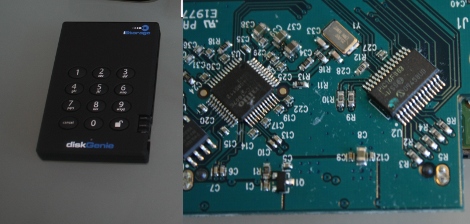
The CEC protocol is a 1-wire serial bus built into the HDMI standard. The solution he settled up required one solder connection on the motherboard as well as the internal USB translator module seen above. That translator box, called the RainShadow, is a PIC 18F87J50 controlled board that translates incoming commands from the USB connection and sends them out as CEC hex codes. A bit of code writing and [Valkyrie-MT] is in business. You can see in the video after the break that it’s not just controlling audio, he can now control the entire entertainment center including turning on the TV and setting it to the appropriate input.

Read the rest of this entry »

Digital View-Master

posted Aug 24th 2010 11:00am by
filed under: toy hacks

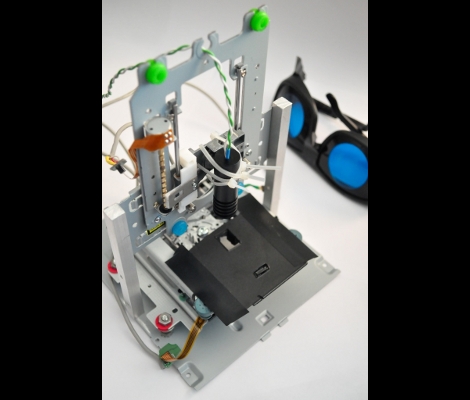
Who could forget the stereoscopic goodness of a View-Master? [Tuttle] put a modern flair on the classic optical device by adding two 1.5″ LCD screens. The screens replace the film disk of the original, showing slightly different images to produce a 3D effect. No word on a camera rig used to take the original images, but for our money this a great way to make something out of those useless key chain picture frames.

PET-Gaming Computer Module

posted Aug 24th 2010 9:58am by
filed under: led hacks

This 64×48 full color LED display goes much further than we expected at first glance. The display is actually a computer with a Zilog eZ80F91 core utilizing an FPGA for the hardware interface. Some nifty applications currently built include mostly games, but there is also visualizations, network file systems, video streaming, and even a MIDI synth.

It originally looked to be more of a console, with controllers, game pads, and cartridges, but the latter ended up not working out. What else would you do with a giant LED display?


Hack a Day serves up fresh hacks each day, every day from around the web as well as hacking related news.

Send us your hacks


Hacks

Resources