posted Jul 28th 2011 12:38pm by
Mike Szczys
filed under:
handhelds hacks

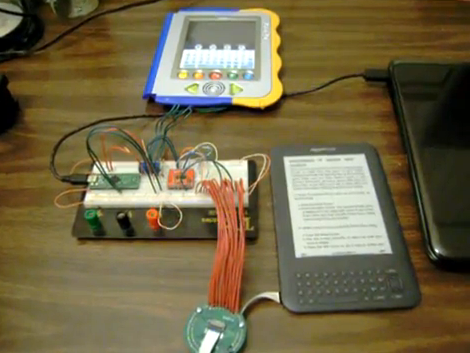
If you’ve ever thought the Kindle keyboard was a bit cramped you’re not alone. [Glenn's] been working on developing an external keyboard for the Kindle for quite some time. It may not make easier for everyone to use, but he’s motivated to improve usability for his sister who has Cerebral Palsy.
We see a lot of keyboard hacks that solder straight to the pads under the buttons, but for a compact device like the Kindle this would really mess things up. Instead of going that route, [Glenn] sourced a 20-pin Flexible Flat Cable and breakout board that match the internal Kindle connector. The prototype seen above uses a TS3A5017 serial multiplexer chip to simulate the keyboard button presses. That multiplexer is driven by a Teensy++ microcontroller board which is monitoring a larger set of buttons on the V.Reader seen above. Check out the video after the break for a brief demonstration, then look around at the rest of [Glenn's] blog posts to view different steps of the development cycle.
Read the rest of this entry »
posted Jul 28th 2011 11:38am by
Mike Szczys
filed under:
robots hacks

Here’s a rover project that has plenty of power (translated) to go places. This is true not only of its locomotive capability, but processing power as well.
The RC car used here (translated) is not overly expensive, but offers a lot of versatility. It’s got front and rear steering via two servo motors, as well as independent drive motors for each end. The frame also offers an advanced suspension system that lets the vehicle flex to keep as many wheels on the ground as possible. It’s a great find if you don’t want to start off your project bogged down in the hardware design.
On the control side of things a Beagle Board has been choosen. The demo after the break shows it controlling an added turret servo, as well as the drive mechanism controlled via a keyboard. These are driven through the embedded Ubuntu image running on the board. This should provide plenty of processing power to add obstacle avoidance and autonomy routines in future versions.
Read the rest of this entry »
posted Jul 28th 2011 9:32am by
Jeremy Cook
filed under:
handhelds hacks,
nintendo hacks

Although Hack A Day is no stranger to console conversions, this portable N64 build is worthy of note. The article itself is in Spanish, but for those that don’t speak the language, the steps and components necessary are well documented in pictures. There’s even a video of the finished product after the break.
What is especially interesting about this project is the professional looking build quality of the finished product. One might think it’s a custom injection molding job or possibly 3D printed, but everything is done with only glue, filler, and paint. A controller and console is hacked up to provide the raw materials for this build. An expansion pack is even attached to this console for good measure.
Power is provided by a 6800mA battery, and the console features a generous 7 inch display. A good wiring schematic is also provided in this article, so maybe it will inspire other quality console hacking in the future. Read the rest of this entry »
posted Jul 28th 2011 8:32am by
Mike Nathan
filed under:
Microcontrollers

[Scott] was driving in the pouring rain behind a car with its blinkers on when inspiration struck. He had previously created a simple communications system using his sound card that allowed him to send data to a microcontroller from his PC, but he thought that doing the same thing with light would be an interesting exercise.
He decided that the best way to go about building such a system would be to use a phototransistor along with his computer monitor to send data to his microcontroller. While he couldn’t really think of any practical application for the project, that didn’t stop him from putting it together just for grins.
[Scott] says the circuit is dead-simple, and includes a pair of phototransistors along with their required resistors. The receiver was tied into the ADC of his microcontroller, where he was easily able to pick up some simple light patterns. His ultimate goal is to put together a javascript application that sends data to his microcontroller, though he’s looking for a bit of assistance on the programming side of things – any takers?
While [Scott] couldn’t come up with any applications off the top of his head, we know of at least one. Anyone familiar with the Bloomberg financial application will likely have come across their “B-Unit”. This piece of hardware is about the size of a credit card, but thicker. Armed with a fingerprint scanner and a photodiode, it reads a series of flashing lights from your computer screen in order to ‘synchronize’ the unit for each login session that is not initiated with an official Bloomberg keyboard. So there’s one for you!
Continue reading to see a video of the system in action.
Read the rest of this entry »
posted Jul 28th 2011 7:29am by
Kevin Dady
filed under:
robots hacks

[William] Had originally built a little Security Bot to roam the halls of his house while he was not at home. He wanted a little bit more and started Security Bot 2 to include a good pile of sensors and add pan and tilt control to the onboard camera. Thanks to ordering pieces from a “who’s who” list of robotic and electronic hobby shops, the bits and pieces quickly arrived making assembly less tedious.
Packed on board of the 4WD platform are IR switches, IR distanace sensors, line sensors, Ultrasonic sensor, an Xbee (soon to be replaced with a WiFi Shield), pan/tilt brackets/servo, SpeakJet/TTS/Speakers, LCD, battery, serial motor controller, ICSP pocket programmer, Arduino Mega 2560, DSS Circuits Fuel Gauges, plus motors, batteries, camera, leds and a wiimote connection. (whew, that’s a mouth full)
All put together with some perfboards, breakout boards and a lot of jumper wire Security Bot2 is ready to patrol your premises!
posted Jul 28th 2011 6:29am by
Mike Szczys
filed under:
misc hacks,
news

[Andrew Ainsworth] has been making and selling costumes based on Star Wars character (some original, and some of his own creation) for several years. Lucasfilm sued him for $20 million back in 2004 claiming infringement of intellectual property rights. He stopped selling them in the US (as it was a US copyright) but now the UK Supreme Court has ruled in his favor, siding with his claim that the costumes are functional items and not works of art.
Good for him, but copyright issues aren’t what interests us here. The BBC clip showing him using a vacuum former to make the Stormtrooper helmet really caught our attention. A bit of further searching led us to find the thirteen minute video after the break showing the entire process, from sculpting the mold by hand, to forming the components, and the final assembly seen above. It’s a fascinating process that makes use want to build our own vacuum former (preferably on a larger scale than this one). It would come in handy whether it’s Star Wars, Daft Punk, or any number of other projects you’ve got in mind.
Read the rest of this entry »
posted Jul 28th 2011 5:28am by
Kevin Dady
filed under:
how-to

[desimon] had a wanted to use some accelerometer chips, but their 3x3mm 16-VFQFN packages made it pretty darn hard to solder by hand. While there are endless ways to approach this, we found this one peculiarity interesting from his use of a gas torch, though it is pretty much hot air reflow.
A PCB for the tiny devices is etched and tinned, the pads have a healthy but not overdone amount of solder applied to them. A liberal coat of flux, rough alignment of the chip and a few gentle passes from the torch and the hobby grade solder melts while the surface tension pulls everything into final alignment.
Having personally used a hot air gun a number of times (and also burning my hand about the same number of times) the localized heat of the torch does make more sense, and there is virtually no heat up time for it either, though it appears just as easy to scorch the board. It is a live flame so be careful!
posted Jul 28th 2011 4:28am by
Brian Benchoff
filed under:
robots hacks

[Silas] is a student at Olin College and came up with a platform using the singularity drive system in his spare time.
We covered a LEGO build of a singularity drive earlier this month. Instead of wheels, treads or legs, this drive system has a hemisphere spinning along its vertical axis. Interestingly, the robot does not change the speed or direction of its drive motor at all. IEEE is now calling this drive system a “singularity drive,” because math.
Read the rest of this entry »