
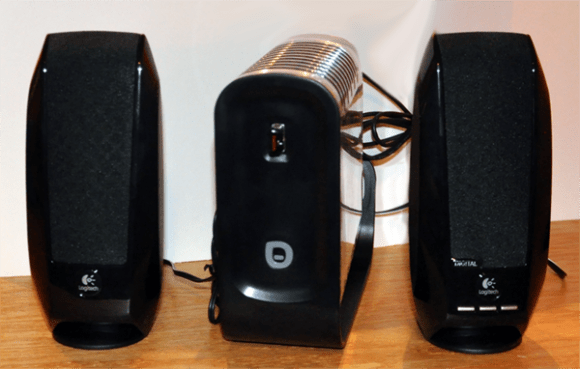
[Andrew] is a fan of the audio quality provided by the Squeezebox hardware. Like many he was unhappy to hear that the devices were being discontinued, but he figured out a way to build a Squeezebox client clone for less than he could have bought an original.
He set several goals for the build. Most notably he wanted the system to be low-power, noiseless, and to support audio quality of at least 96 kHz at 24 bits. What he came up with is the Pogoplug seen in between the two speakers above. It can be acquired for under $20 and it runs embedded Linux. Another member of the Squeezebox community had been working on a custom distro called SqueezePlug to turn these types of devices into Squeezebox clients. After flashing the distro and tweaking the settings [Andrew] has accomplished his goals. The one caveat is the lack of an audio out port. Above he’s using some cheap USB speakers, but higher-fidelity is possible by choosing a more expensive external USB device.
This will work nicely with that Squeezebox server you built from a Raspberry Pi.










Yeah, I totally get the idea of going for some specific audio quality, but with those speakers you could just settle for phone quality :]
Actually I’ve used those speakers, the sound is mighty good for the $12 they cost. Not *good* obviously but what I’d call comfortably usable, and I’m used to high end headphones. Sometimes a cheap product just surprises you.
How could you have *any* requirements for audio fidelity when you can’t use the onboard audio output? Any USB host with supported drivers would work as long as the USB adapter you used supported the fidelity you require.
Output depends on the input,you know. A high-quality sound card doesn’t make low-quality audio sound better.
So one has to wonder could you use a Pogo plug as the squeeze server as well?
those same speakers came free with a wifi keyboard…ironic that they are logitech
cool build, been thinking of ideas for a cheap network audio streamer…this looks good
there is no difference between sampling rate of 44,1kHz and 96kHz
Human audio range ends at 20kHz. Let’s consider sine wave at this frequenc. Using 44.1kHz sampling rate you get 3 samples per period. Good luck getting nice your signal back recognizable. At 96kHz you get 4.8 sample/period… Nyquist isn’t all
Nyquist isn’t all, indeed. http://people.xiph.org/~xiphmont/demo/neil-young.html
People dont seem to read the article before commening. Becus if you did you would se that those logitec speakers where only used as a test of the software and where later replaced.
One of the best features of the squeezebox is the Vacuum Fluorescent display. Those last nearly forever, unlike LCDs that quickly wear out. It was a major part of the SB’s cost. Logitech immediately eliminated that feature to boost profits two ways – by lowering costs and by LCD failures forcing replacements.
The other great feature of the squeezebox is really excellent audio quality. That includes the ability to directly drive an amp, without a preamp. There is risk in that, so the solution needs to be really solid.
These SB alternative projects are neat, but are hardly a replacement for an incredibly well engineered device.
Regarding the Display: I know VFDs that wear out (burn in) during only several years, if used continously. But I don’t know LCDs wear out on any regular base, at least not on equipment up to 30 years old. Though I have a sensor from a wireless weather station which has a defective LCD after hanging outdoors for >10yr.
A lot of older LCDs end up with burnt-out cold-cathode fluorescent tubes. And I have seen burn in before; it was at a bar and an inverse ‘station watermark’ or whatever it is called was extremely visible during commercials. Some models have a screensaver if the screen doesn’t change for a long time.
I’ve been using the squeezebox software on an O2 Joggler (http://en.wikipedia.org/wiki/O2_Joggler). Its perfect with the touchscreen
http://birdslikewires.co.uk/articles/squeezeplay-os
have a pogo plug EO2 model that will not validate on the official site even after multiple customer service requests. have any tutorials or general ideas on how to put this $130 worth of dead weight to use?
You can always try and connect via Jtag , and enable SSH from there.
Thanks, that’s exactly what I was looking for. They even have a version for *nix. Now time for tutorials [:
An even easier way.
Use a raspberry pi and burn the piCorePlayer to a SD-card.
Reboot and you have transformed your raspberry into a squeezebox player.
You can get audio out via:
external USB-DACs = excellent quality
HDMI = excellent quality
Audio out jack = OK quality.
piCorePlayer is very small (28 MB inclusive a small linux distro), is running entirely in RAM, so no risk of corruption of your SD-card. Boots in 15 sec.
Get it from here: https://sites.google.com/site/picoreplayer/home/news
I’m probably being dim here, but where is the actual article describing how to do it, or what was done? All I can see is the summary and I’m intrigued!
where is the orginal article –> links is gone?!<–