Lilypad bicycle computer reads back distance in beeps

posted Mar 7th 2011 1:01pm by
filed under: arduino hacks

[Mark Fickett] finished his own interesting take on a bicycle computer. These wristwatch-sized devices normally mount to the handlebars and give feedback for current speed, trip distance, and many have options like cadence and heart rate. [Mark's] has fewer features but it’s clean, simple, and does more than you’d think.

He used some denim to house the electronics which you can see mounted inside the frame of the bike. He’s chosen to use Lilypad components which are Arduino bits meant to be sewn into textiles. We’ve seen a Morse Code keyer using these components and this project is along the same lines. It reads wheel revolutions from a magnetic sensor mounted on the front fork. It has no LCD readout, but when you want to know how far you’ve traveled just press one button and the computer reads it back to in Morse Code played on a tiny piezo buzzer. This package hides one more nice option. Once you arrive home the trip data can be dumped onto a computer for easy graphing. Check out the video after the break to see these features in action.

Read the rest of this entry »

Jeep-uter adds push button control to your vehicle

posted Jan 25th 2011 9:00am by
filed under: transportation hacks

[Ed Zarick] built a module to control his vehicle which he calls the Jeeputer. The name’s a mash-up of Jeep and Computer; the device itself is a combination of Arduino, character LCD, and a collection of shift registers and relays for interfacing. Watch the video after the break to see what this can do. We were surprised in the beginning when he says that all he has left to do is remove the steering wheel lock and he’ll be able to drive using the interface, but we think he means type in a code to unlock the ignition, not remote control for his car. He then goes on to demonstrate garage door control, power cycling for CB radio, GPS, 110V power inverter, vehicle light control, and much more. This must be the most feature packed car computer we’ve seen so far.

Read the rest of this entry »


Electromechanical computer built from relays

posted Nov 18th 2010 8:28am by
filed under: classic hacks

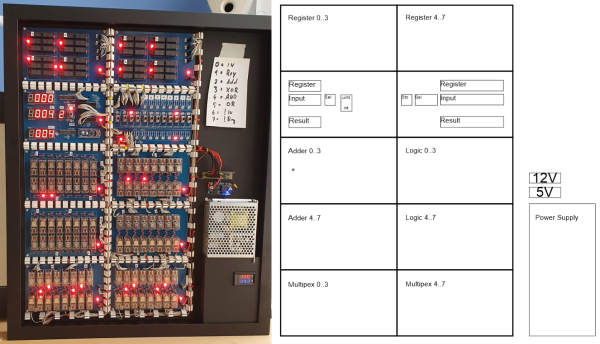
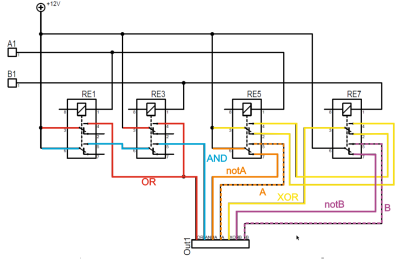
This is Zusie, a computer built out of electromechanical relays. [Fredrik Andersson] picked up a lot of about 100 telephone exchange circuit boards, each with about 16 relays on them. After getting to know a heat gun really well he ended up with 1500 working relays with which to play. The machine runs slowly, it iss noisy, but it definitely works. After the break you can see it running and assembly code program that he wrote.

The instruction set is based on boards running microcode. These store the operational commands for each instruction the processor has available to it and they run in parallel with the rest of the operations.

We’re always surprised to see that these home-built processors work. Mostly because of the complexity involved in assembling them. How hard is it to find a shorting connection or a malfunctioning relay? Those problems aren’t limited to this application either, what do you do if a transistor-logic CPU has a malfunctioning chip?

Read the rest of this entry »

Shiny motorcycle computer

posted Oct 16th 2010 1:51pm by
filed under: transportation hacks

We’re rather surprised at how popular it has become to build your own motorcycle computer. [Mario Mauerer] tipped us off about his shiny motorcycle computer (translated) for his Yamaha XTZ 750. It uses an ATmega644 microcontroller to pull a variety of data together and display it on this white LED backlit display. He connected a flow meter to the fuel line to monitor gas consumption. Oil temperature is captured by inserting a brass tube (containing the sensor) through a hole in the oil cap and soldering it in place. Water temperature is gathered by measuring the external temperature of one of the cooling lines. [Mario] uses a rotary encode with a click function as the control interface device, and a battery backed real time clock keeps time.

A quick look at the PCBs tells the tale of good circuit design. But we do wonder about catching the reflection of the sun in that shiny bezel.

2-bit paper processor teaches how they work

posted Sep 23rd 2010 9:47am by
filed under: misc hacks

Take a few minutes out of your day, grab your scissors, and learn how a simple processor works. [Saito Yutaka] put together an exercise to teach processor operations with paper. After downloading the PDF you can cut out the Address and Data pointer as well as two-bit data tokens for each. The processor has three instruction sets; Increment register by one, Jump if not over flow, and Halt wait for reset.

Once you’ve got your cutouts you can follow along as the program is executed. The INC operation is run, with the JNO used to loop the program. Once the register has reached an overflow the overflow counter halts the program.

One word of warning, we think there’s a typo in one of the captions.  Once the program starts running and gets to address 01(2) the caption still reads 00(2) for both address and data. As long as you compare the values in the picture along the way you should have no problem getting through execution. which has now been fixed.


Self playing Bayan built nearly 22 years ago

posted Sep 5th 2010 9:19am by
filed under: digital audio hacks, musical hacks

The year is 1988, where a Russian engineer [Vladimir Demin] has combined a Bayan, or button accordion, with several (we lost count at about 96) solenoids. If that alone doesn’t blow your mind the computer, also hand built by [Vladimir], controls the whole process leaving the operator to only work the bellows. Putting truth to the fact in Soviet Russia, accordion plays you. We wish we could find some more information about the instrument, but curse our inability to read Russian. Alas check after the break for a shorter version of the video in the link above.

Related: Electronic accordion doesn’t compare.

Read the rest of this entry »

Car computer requires PIN for ignition

posted Sep 2nd 2010 1:00pm by
filed under: transportation hacks

[Ben's] added some nice goodies to his Volvo in the form of an in-dash computer. The system monitors two pressure sensors for boost and vacuum, as well as reading RPM, O2, and exhaust directly. All of this is tied into the touch interface running on an eeePC 900A. But our favorite feature is that the system requires you to enter a PIN to start the ignition. The forum post linked above is short on details so we asked [Ben] if he could tell us more. Join us after the break for a demonstration video as well as [Ben's] rundown on the system.

Read the rest of this entry »

In-dash motorcycle display

posted Aug 24th 2010 2:49pm by
filed under: news, transportation hacks

[Muth] added an auxiliary display to his motorcycle instrument panel. He started out prototyping with a PIC 16F877A which he used to access information through the ECM diagnostic connection. Once he had that working he found this tiny display which fits perfectly between the speedometer and tachometer. There’s a short demo after the break where you can see a past-30-minute history of the Adaptive Fuel Value and the engine temperature as well as a secondary information screen.

This is another nice addition to our collection of vehicle displays, scooter controllers, gear indicators, and motorcycle computers.

Read the rest of this entry »


Hack a Day serves up fresh hacks each day, every day from around the web as well as hacking related news.

Send us your hacks


Hacks

Resources