LEGO barcode scanner

posted Nov 2nd 2010 11:00am by
filed under: toy hacks

Playing store just got really, really fun because you can now build your own LEGO barcode scanner. As you can see after the break, it works well and it’s fast like a real barcode scanner. Unfortunately it doesn’t scan real barcodes. Or at least not traditional ones. As we learned in the Barcode Challenge, standard barcodes are a set of white and black bars that make up the ones and zeros of the code. This system uses the same white and gray bar system but it seems that it’s only the number of bars that identify an item, not a code created by a particular combination of light and dark. The items above are all scannable because the scanner counts the 2, 3, 4, 5 or 6 white beams on the bottom of each package. Still, it’s incredibly clever and a great toy for the young hackers to build if they have a little help.

Read the rest of this entry »

3D printing with LEGO

posted Oct 18th 2010 12:00pm by
filed under: toy hacks

With 2400 LEGO bricks and a lot of patience, [Will Gorman] built a LEGO 3D printer. It’s similar to a RepRap or a Makerbot, but instead of extruding plastic, it uses pre-extruded building blocks (aka LEGO bricks).  The grey wall extending far above the unit itself is a feed magazine which holds the raw material. A Java application takes an MLCad file and translates it into building instructions for the printer. Those instructions are then sent to the device via USB. See it happen after the break.

Now this just needs to be combined with the LEGO sorting machine for an inexhaustible supply of bricks.

Read the rest of this entry »


Home claw game delights the little ones

posted Aug 16th 2010 12:00pm by
filed under: toy hacks

After seeing Toy Story [Will Gorman's] son wanted to play the Crane Game. Rather than hanging out in the lobby of the pizza parlor, [Will] built one at home using Lego. The skill crane as he calls it has a large gantry to travel over the top of the treasure box. The claw can move side to side on the gantry, dropping for a chance at some loot once it’s in the right place. See a successful run in the video after the break and if you can’t help yourself, there’s build instructions that will have you up and running in no time. But you don’t have to build it out of Lego, sometimes you just need some junk to pull one of these together. Read the rest of this entry »

Make your own Mindstorm sensors

posted Aug 6th 2010 6:29am by
filed under: peripherals hacks

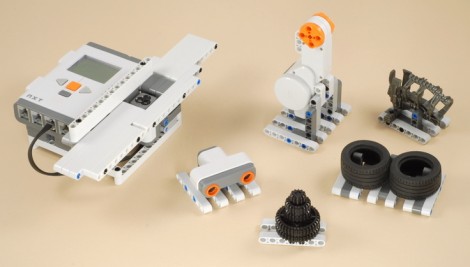
[Stewart Allen] acquired a Mindstorm kit about a month ago and he’s already building his own sensors for it. He wanted a more accurate range finder with a narrower measurement field than the stock sensor. Mindstorm has the option to communicate with sensors via an I2C bus. [Stewart] set up an ATtiny45 to act as a the slave on the bus, facilitating the analog measurement of the distance voltage by using and lookup table, and handling the data transfer with the NXT brick. His testing setup is pictured above, with an AVR Dragon for programming the tiny45 and a Bus Pirate for sniffing the I2C data during the development process. The sensor, looking great on a professionally made PCB he ordered, requires a simple driver that [Stewart] hammered out for use with leJOS, the alternative Mindstorm firmware we’ve seen before.

Android controlling Mindstorms NXT

posted Aug 2nd 2010 4:24pm by
filed under: news, robots hacks

Here’s an Android device controlling a LEGO Mindstorms robot. [Josh] and a couple of his colleagues developed software to get both Android 2.1 (video above) and Android 1.6 (video) to work as Bluetooth control devices. The NXT cube is running leJOS, a Java virtual machine, allowing you to program Mindstorms using Java. Although their code is at an early Alpha stage, this shows that it works and is a very welcomed tool for NXT development once they get to a more stable point and release it to the masses.


Great ball contraption

posted Jun 15th 2010 12:00pm by
filed under: toy hacks

The idea of the Great Ball Contraption is to take modules from many builders and combine them into one large machine. The modules need to find some way of moving LEGO soccer balls and basketballs from an input point to an exit are that passes them onto the next module. Some of them sort the balls, but in the end the eight-and-a-half-minute video above shows the orbs going around and around. That’s just fine with us, it’s no secret that we love machines that are overly complicated and may be completely useless.

Report from ESC Silicon Valley 2010

posted Apr 28th 2010 9:00am by
filed under: android hacks, classic hacks, cons, hardware, iphone hacks, ipod hacks, led hacks, linux hacks, news, robots hacks

Ah, the heady aroma of damp engineers! It’s raining in Silicon Valley, where the 2010 Embedded Systems Conference is getting off the ground at San Jose’s McEnery Convention Center.

ESC is primarily an industry event. In the past there’s been some lighter fare such as Parallax, Inc. representing the hobbyist market and giant robot giraffes walking the expo. With the economy now turned sour, the show floor lately is just a bit smaller and the focus more businesslike. Still, nestled between components intended to sell by the millions and oscilloscopes costing more than some cars, one can still find a few nifty technology products well within the budget of most Hack a Day readers, along with a few good classic hacks and tech demos…

Read the rest of this entry »

NXT hacks: tanks and heaters

posted Jan 20th 2010 11:48am by
filed under: toy hacks

Here’s a double-dose of Lego NXT goodness; a robotic tank and an automatic aquarium heater.

The image to the left is a robotic tank powered by the popular Lego Mindstorms NXT kit. The brains rest inside of a tube, including the controller brick, ultrasonic range finder, a gyroscope, and a compass. Two sets of treads surround each edge of the tube making us wonder which end is up? We’ve embedded a video of this beast after the break. You’ll see that the tank is incredibly agile in this configuration.

To the right is an aquarium heater. [Dave's] kid were growing some tiny water dwellers which we’ve always know as Sea-Monkeys. The problem is that the tank needs to be between 72-80 degrees Fahrenheit for the little shrimp to thrive. He dug out his NXT controller and paired it up with the Lego temperature sensor and a dSwitch relay. This setup monitors the Aquarium for temperatures between 72-78 degrees and switches a lamp on an off to regulate the temperature. This keeps his kids and the stagnant pool happy.

Now that we’ve whet your appetite for NXT check out the wiimote operated NXT Segway and the NXT Sudoku solver.

Read the rest of this entry »


Hack a Day serves up fresh hacks each day, every day from around the web as well as hacking related news.

Send us your hacks


Hacks

Resources