Building A Media Player With An MSP430

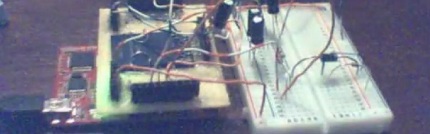
A media player based on an Arduino and SD card has been done to death several times over, but that doesn’t mean we can’t appreciate [Matt]’s MSP430 audio player. It’s a very nice piece of work that supports a FAT16 file system and only takes up 54 bytes of RAM.

To make his dream of a 430 media player a reality, [Matt] based his work on the DIY Life Talking MSP430 project. Unlike this previous attempt to play music with a ‘430 and SD card, [Matt] threw in a full FAT16 file system, allowing him to drag and drop audio files on his computer to the SD card.

Right now [Matt]’s build can play a stereo audio file through its speakers, but the sound quality over a mono file is greatly reduced. The maximum sample rate is 16kHz; a ‘good enough’ sample rate if you’re listening with terrible headphones. In the video after the break, [Matt] plays this awesome Symphony of Science on his homebrew media player. We’re guessing his camera doesn’t do his project justice, but it’s still impressive nonetheless.

Continue reading “Building A Media Player With An MSP430”

Open Source Tracking System Gets A Kickstarter

open-source-tracker

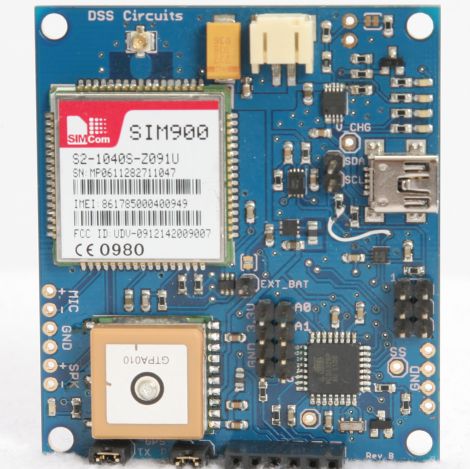
Many of the hacks featured here inspire others to build on the creator’s work, and on occasion the positive feedback brings the hack to market. Last year we told you about [Wayne’s] creation, a system aimed at tracking down would-be game console thieves. He received a bunch of requests to document the tracker in full, so he decided to revise his creation and release it as Open Source Hardware.

As you might remember, his original tracking device was powered by an Arduino, which monitored an accelerometer and GPS sensor, reporting coordinates and movements to his mobile phone on demand. He combined the disparate components together on a single board, and started a Kickstarter for the project.

Aside from his original purpose of tracking stolen goods, he lists off an array of other uses, such as tracking the driving habits of your newly licensed teen, geofencing objects in certain areas and more.

If an SMS controlled all-in-one tracking system is something you might be interested in, check out his Kickstarter, or take a look at the documentation and build one of your own.

We Don’t Need No Stinkin’ Packages!

DIP, SOIC, BGA, MLF or QFP?  None, so it seems.

This morning I received an email from Texas Instruments. Normally, these things go right into the spambox but this one was a bit unique. You can now buy some of TI’s IC’s without any packaging. Yup, just trays full of silicon squares. From TI’s point of view miniaturization has reached a point where that extra 0.1″ of PCB space is now too valuable to give to a piece of worthless plastic, and bonding micro-small wires to a silicon die is a feat that any manufacturer can preform with great accuracy, reliability and speed.

Whether this is a new paradigm in manufacturing or a premature April fool’s joke, if this process catches on smartphones just went from being almost unrepairable to 100% unrepairable, and ipod nanos might just start playing back 1080p video. It’s awesome and scary at the same time.

Now, are they crazy, or just ahead of their time? Tell us what you think.

Soccer Simulator Rules A Child’s Birthday Party

[youtube=http://www.youtube.com/watch?v=gKACRU4LKfM&w=470]

Being a dedicated father, soccer coach, general tinkerer, and electrical engineer, [Dave] decided to build a soccer simulator video game for his son’s 6th birthday party. The concept behind the game is to put a soccer ball on a tee and have an eager line of six-year-olds kick the ball into the goal. A video of a goalie is projected behind the net, and sensors in the goal will determine if the player scored a goal or not.

The first part of [Dave]’s project was getting footage of a goalie diving for a soccer ball. Luckily, [Dave] is friends with [Mark Macdonald], a former NCAA goalie. After 10 minutes in the park with [Mark] and a 720p camera, [Dave] had all the footage needed to build his video game.

To detect where the soccer ball passed into the goal, [Dave] built a small soccer goal studded with infrared LEDs and infrared beam break sensors. Combined with a small switch underneath the ball tee, the software knows the time of flight and where the ball crossed into the goal. The game processes these two numbers to determine if it’s a goal, or was caught by the retired pro goalie.

The kids at the birthday party lined up to play [Dave]’s soccer game – a huge achievement getting 6-year-olds to wait their turn. We admit that we’d like to have a go at this game, although we’re pretty sure we saw an arcade version of this game years and years ago.

Build An Elevator Controller, Gain A Friend For Life

diy-elevator-controller

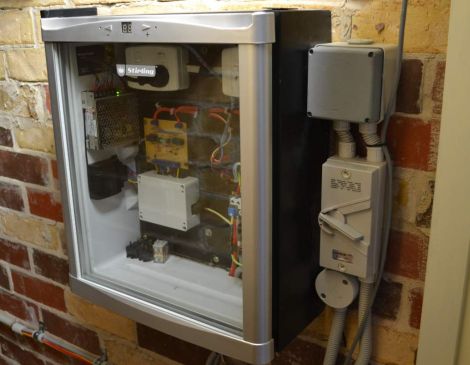
[Michael Ruppe] was working one day when a man named [Kevin] approached him for a bit of help with a project. It just so happened that [Kevin] was in the middle of constructing a DIY residential elevator and he needed assistance putting a control board together.

[Kevin] had no problem casting a forklift ram into his basement slab, nor installing a submersible pump in a custom-made hydraulic pit, but wiring up the controls for the device was just not something he was comfortable with. [Michael] was more than happy to lend a hand, and over the next couple of months the pair got things running nicely.

Instead of relying on a microcontroller, [Michael] built a control board that uses little more than a handful of relays and microswitches to get the job done – It’s certainly not hard to appreciate the controller’s simplicity.

It’s stories like these that remind us just how much the hacker community is willing to help out complete strangers with any task, big or small – you guys rock!

Stick around to see a short demo video [Michael] shot, showing the elevator in action.

Continue reading “Build An Elevator Controller, Gain A Friend For Life”

Powering A Robot With A Macbook Battery

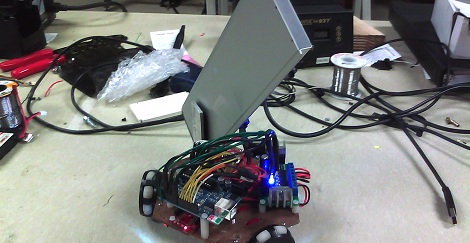
When [Soo-Hyun]’s friend had an Apple Macbook Pro battery that began to swell, his friend did the reasonable thing and donated it to be used in a robot. Now [Soo-Hyun]’s kiwi drive robot is powered by a gigantic LiPo battery, giving it a huge range and a very fast top speed.

The defunct laptop battery that formerly powered a 15″ macbook pro is three battery packs of two cells in parallel, delivering 12.6 Volts. To get the power to the robot, [Soo-Hyun] etched a simple PCB that fit into the slot in the battery. A little bit of soldering later, and mounting the battery as a shark fin because of the 8×8 inch limitation of maze-solving robots, the power plant was complete.

Using a bulging LiPo battery probably isn’t the smartest idea (listen for the great line, “it got the camera and my face” at 4:08), but as long as [Soo-Hyun] keeps an eye on the battery as it’s charging, it should be alright.

Check out the video of the robot zipping around on 12.6 Volts after the break.

Continue reading “Powering A Robot With A Macbook Battery”

A Little Geneva Drive Made Of Wood

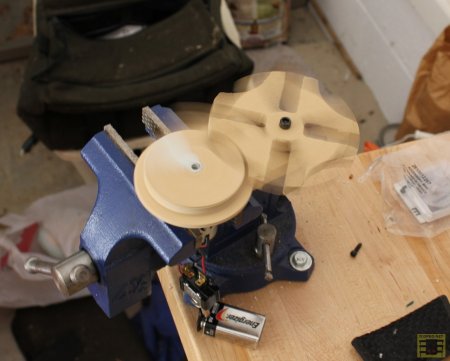
MDF Geneva drive in action

Long ago, before servo motors and linear actuators were common, clever mechanical devices were what engineers used to produce the needed motion for their processes. The CNC-cut Geneva Drive may not be fit for industrial use, but this type of device has been used in everything from film projectors to rotating assembly tables. The constant rotation of the driving wheel is translated into intermittent motion by the [Maltese cross] driven wheel.

The drive and Maltese cross section of this particular drive are made out of MDF with the exception of a putty material that the motor shaft press-fits into. The article claims that this is the only Geneva drive in existence made out of MDF, however, we’d love to see that proven wrong in the comments!

If you’d like to make one of these yourself, CAD and G-code files are given for the hand-cranked version that this Drive is based off of in a separate post.  If you’re not familiar with how a drive like this works, or would just like to see everything in action, be sure to check out the video of it after the break! Continue reading “A Little Geneva Drive Made Of Wood”