
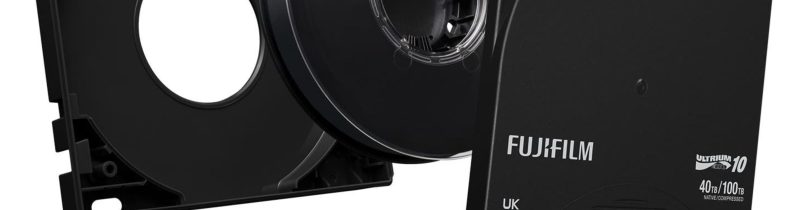
One of the interesting things about the slow-moving AI apocalypse we seem to be trapped in is watching the knock-on effects reverberate through communities and economies. We’ve seen how — and lamented that — the LLM-driven datacenter build up has increased demand for GPUs, RAM and SSDs directly, and we watched that in turn increase demand for traditional, spinning rust hard drives. Perhaps it was only a matter of time before demand came for the tapes, too. Yes, tapes: good old fashioned “sticky tape and rust”. With AI increasing demand for archival material, Fujifilm has announced they’ll be increasing production by 5x through 2028.
This production increase is specifically targeting about the latest and greatest 10th generation of Linear Tape, Open (LTO) which Fujifilm has produced since its inception. Indeed, Fujifilm has been in the tape storage business for almost as long as we’ve been storing data on magnetic tape, with their first forays into the field dating to the 1950s. The Ultrium10 tapes are available in 30 TB and 40 TB standard sizes, which are advertised as 75 TB and 100 TB based on a perhaps-optimistic 2.5:1 compression ratio. Given it’s already a linear standard and not exactly blazing fast at 400 uncompressed MB/s, there’s no reason not to compress the heck out of data being sent to cold-storage on tape. While not great by modern SSD or HDD standards, those are dizzying numbers if the last tape drive you used was a Datasette.
Still, it shows that the industry is reacting to the same trends that have hackers bringing surplus tape drives into their homelabs. This isn’t a small bet by Fujifilm, with 10 billion yen (about $63 million) at stake.
While some of us have been making more use of optical media these days, it looks like Sony isn’t reversing course on getting out of the Blu-ray business, so don’t expect to see giant disk changers coming to a server room near you. Tape bots are apparently a different story.
Header image: Fujifilm.












Maybe Fuji should restart those chinese factories making Fuji DR-II audio cassettes, while at it. Toshiba, get ready to resume making analog boomboxes (Akai already did, though, unsure if those are true Akai, but good enough, sell reasonably well) : ] Who knows.
Physical media deserves its come-back.
This is really no more of a physical media than a hard drive.
What are some examples of non-physical media?
“Physical media” just means “local media”
I feel like it’s standard to backup multiple copies across tapes. Also I’m not sure the built in compression that it does would be resistant to that issue either.
LTO-10 goes a very long way to protect the data with error correction, data spreading over the tape and read after write. The bit error rate is better than 1 error per 10¹⁹ bits transferred or around 1 error per 100 exabytes transferred.
Not error free, obviously, but really, really good. And by organising data in blocks, the effect of any errors can be minimised.
Anyone storing data to tape should be doing their own erasure coding or mirroring or backing up anyway on top of whatever the tape is doing, after whatever compression you might personally choose to use.
In reality there’s no reason not to write it all uncompressed multiple times to enable data reconstruction later. It’s tape. It’s extremely cheap per bit, no need to be stingy.
This is why I don’t use the LTO-s compression and encryption. First I compress the data, then encrypt, then I add ECC bits. For ECC protection you can use the rsbep tool in linux bit there are a patched version with improved features: https://www.thanassis.space/rsbep.html
Er, 100TB compressed down to 40TB, is that not a compression ratio of 2.5:1 instead of 1.5:1?
I pity the fool who made that typo, but ’tis fixed now.
Now if only they could get the price down to something reasonable for consumers. I’d love if it was cheap to backup everything to a few tapes that I could store in a few places for resiliency.
Last, I checked it’s still incredibly expensive unless you get something absolutely ancient.
Big too.
Maybe now would be the right time to try cheap optical tape archive again? On the roll, not those silly squares trying to compete with thumbdrives like last time.
Many years ago they said that they had massive storage in 3D ‘holographic’ cubes as good as done, and they showed samples too.
So where are they? It’s not like there is no market at the moment. nor is there a problem with those being expensive to produce right now, you can ask insane amounts for storage, especially if it’s fast.
Every time I’ve done the math on an LTO5 or LTO6 installation the total cost (including drive, tapes, library, etc) has always come out very close to that of just building the same storage out of used hard drives. Maybe with the current doubling/tripling of hard drive prices that would become viable, but it’s probably easier and more cost effective to just wait for hard drive prices to come down. Especially if tape prices go up too in reaction.
Depends how much data you want to store. Once you’re over the hump, it becomes cheaper.
Someone needs to work on a homebrew version of LTO thats affordable
Or bring back ZIP drives?
I’m both joking as well as predicting what will happen, I mean they bring back so much retro stuff, I saw a headline of trains that run on steam.. I mean, yeah, we’ll probably see zip drives.
I wonder if they will still be 750MB or something like that though, but beggars can’t be choosers, no doubt Apple will say people need only 100MB and that’s enough and then everybody will repeat that and Sam will say ordinary people should not have storage when that could be used for AI instead.