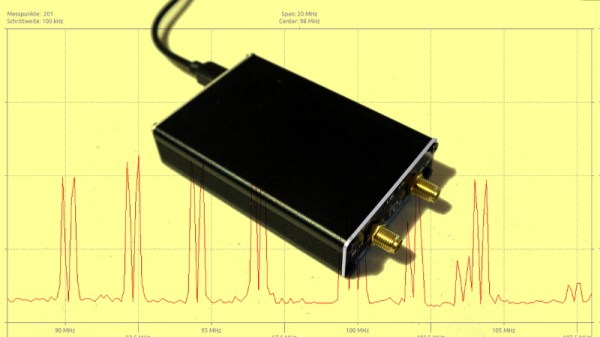
As mildly exotic silicon has become cheaper and the ingenuity of hardware hackers has been unleashed upon it, it’s inevitable that some once-unattainably expensive instruments will appear as cheap modules from China. The LTDZ spectrum analyser on the bench today covers 35 MHz to 4.4 GHz, and has a USB interface and tracking source. It has been available from all the usual outlets for a while now either as a bare PCB or in a metal box about the size of a pack of cards.
We’ve already taken a look at the $50 VNA, and this time it’s the turn of the $30 spectrum analyser, in the form of a little device that I succumbed to while browsing Banggood.
I ordered one, along with an attenuator and RF bridge for SWR measurements, and after the usual wait for postage my anonymous grey package arrived and it was time to give it a look and consider its usefulness. It’s a design derived from one published in Germany’s Funkamateur (“amateur radio”) magazine early in the last decade, and unscrewing the end plate to slide out the board from its extruded enclosure we can see what makes it tick. Continue reading “What Can A $30 USB Spectrum Analyser Do For Me?”→
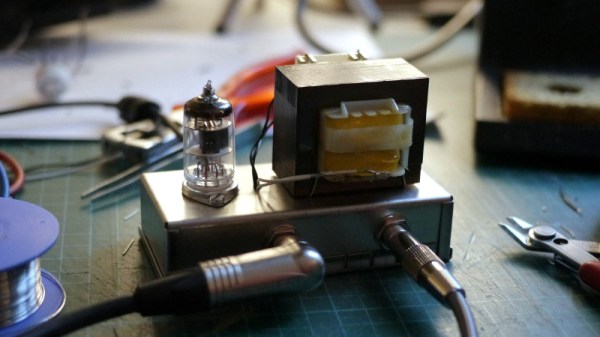
At the extreme budget end of tube audio lie single-tube amplifiers usually using very cheap small-signal pentodes. They’ve appeared here before in various guises, and a fitting addition to those previous projects comes from [Kris Slyka]. It’s a classic circuit with a transformer output, and it provides enough amplification to drive a pair of headphones or even a speaker at low levels.
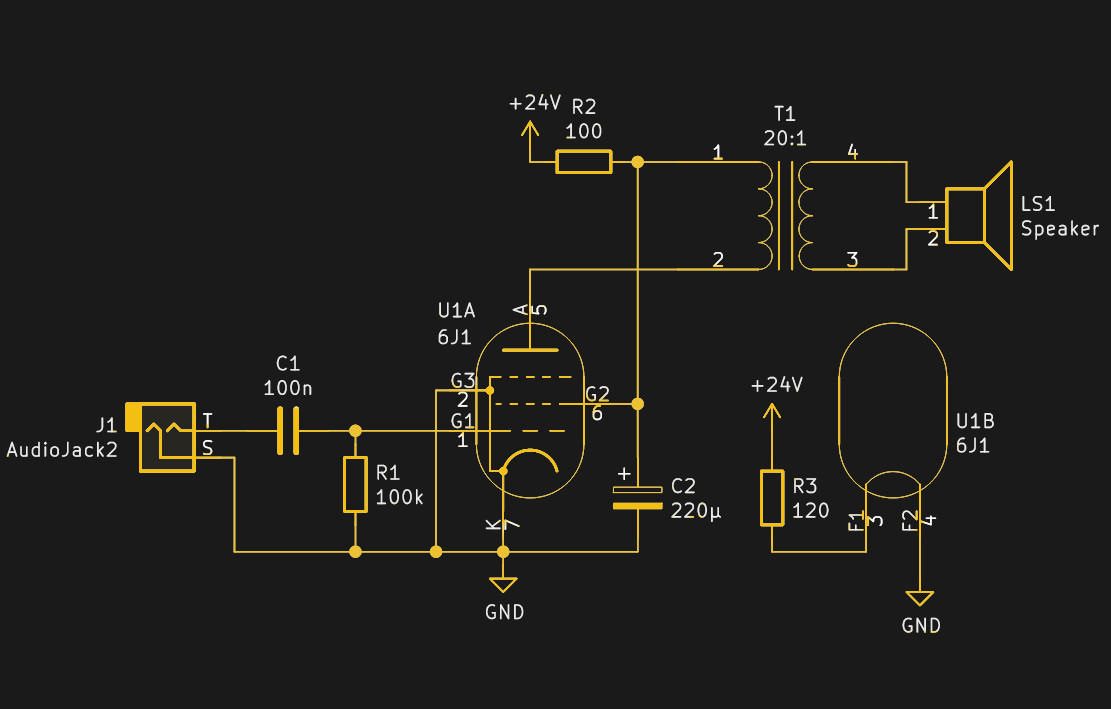
The fairly conventional circuit of the tube amplifier.
Most tube enthusiasts will instantly recognize the anode follower circuit with a transformer in the anode feed through which the output is taken. The tube works in Class A, which means that it’s in its least efficient mode but the one with the least distortion. The transformer itself isn’t an audio part, but a small mains transformer taken from a scrap wall wart. It serves not only for isolation, but also to transform the high impedance output from the tube into a low impedance suitable for driving a headphone or speaker.
The HT voltage is a relatively low 24 V, but it still manages to drive headphones acceptably. Speaker levels require a pre-amp, but even then it’s likely that this circuit is pushing the tube beyond what it’s capable of with a speaker. The more it operates towards the edge of its performance envelope the more distortion it will generate and the worse a sound it will produce. This isn’t such a problem in a guitar application as here, but hi-fi enthusiasts may find it to be too much. It would be interesting to subject it as a headphone amplifier to a series of audio tests to evaluate the effect of a mains transformer over a dedicated audio one.
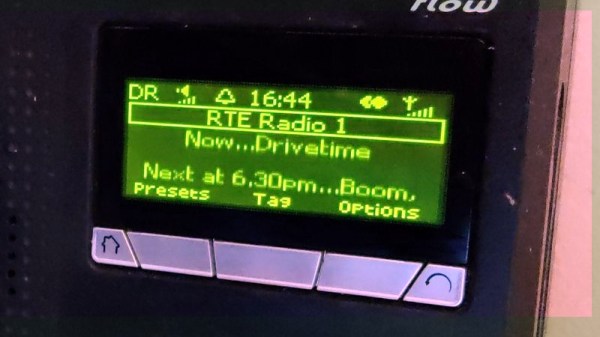
It’s commonly agreed that the future of broadcast radio lies in the eventual replacement of AM and FM analogue transmissions with digital services. A wide range of technologies exist to service this change-over, and for much of the world the most visible of them has been Digital Audio Broadcasting, or DAB. This VHF service has slowly increased in popularity to the extent that in some countries the FM or AM switch-off process has already happened or is well under way. It’s thus a surprise to hear a piece of news from a country that’s going the other way, as the Irish broadcaster RTÉ is about to turn off its national DAB multiplex.
The reason cited is cost-effectiveness, the take up of DAB in the Republic by listeners is low (Northern Ireland having the UK multiplexes instead), and that the broadcaster is the only one maintaining a national multiplex. Our Irish friends tell us that as in other parts of the world the rural coverage can be patchy, and with only RTÉ and no commercial stations on offer it’s easy to see why the allure of a DAB set is lacking.
In case anyone is tempted to prophecy the demise of digital broadcasting from this news, that’s not the real story. This is simply an abandonment of DAB. Plenty of Irish people listen to the radio through digital media just as anywhere else, this is simply an indication that they’re choosing not to do so via DAB. The Irish DVB television multiplexes carry the same stations and more, and meanwhile, the inexorable rise of online listening through smart speakers and mobile phones has eaten DAB’s lunch. But it does raise the point for other places: when your mobile phone delivers any radio station or streaming service you desire and is always in your pocket, why would you want a radio?
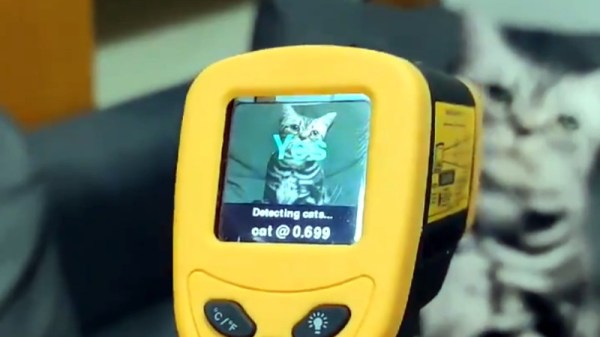
Pandemic induced boredom takes people in many different ways. Some of us go for long walks, others learn to speak a new language, while yet more unleash their inner gaming streamer. [Niklas Fauth] has taken a break from his other projects by creating a very special project indeed. A cat detector! No longer shall you ponder whether or not the object or creature before you is a cat, now that existential question can be answered by a gadget.
This is more of a novelty project than one of special new tech, he’s taken what looks to be the shell from a cheap infra-red thermometer and put a Raspberry Pi Zero with camera and a small screen into it. This in turn runs Tensorflow with the COCO-SSD object identification model. The device has a trigger, and when it’s pressed to photograph an image it applies the model to detect whether the subject is a cat or not. The video posted to Twitter is below the break, and we can’t dispute its usefulness in the feline-spotting department.
Over recent years we’ve been treated to a series of fascinating advances in the world of x-ray imaging, as researchers have developed their x-ray microtomography techniques and equipment to the point at which they can probe and then computationally reconstruct written material within objects such as letters or scrolls in museum collections whose value or fragility means they can’t be opened and read conventionally. There is more to this challenge than simply extracting the writing though, in addition to detecting the ink the researchers also have to unpick the structure of whatever it was written upon. A particular challenge comes from letterpackets, the art of folding a letter into its own envelope, and a newly-published Nature Communications paper details work from a team of academics in the USA, the UK, and the Netherlands in tackling it.
Letterpackets were more than a practical method of packaging a missive for the mail, they also had a security function often called Letterlocking. A packet would be folded in such a way as to ensure it was impossible to open without tearing or otherwise damaging the paper, and their structure is of especial interest to historians. The researchers had a unique resource with which to work; the Brienne collection is a trunk full of undeliverable mail amassed by a 17th century postmaster couple in Den Haag in the Netherlands, and now in the possession of the Beeld en Geluid museum in that city. In it were a cache of letters including 577 never-opened letterpackets, and the x-ray technique promised a means to analyse these without compromising them.
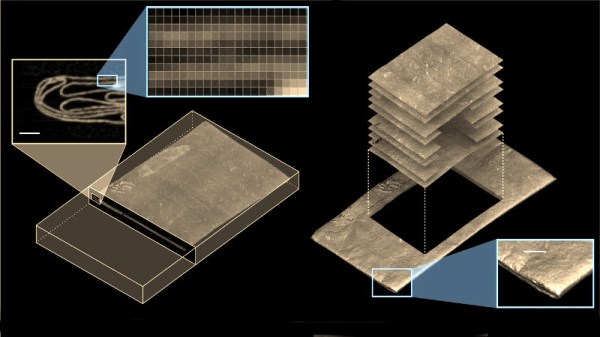
A letter imaged using the technique.
The researchers have developed an entirely computational technique for the virtual unfolding process. Starting with a 3D volumetric x-ray scan of the unopened packet they then identify the various layers of paper and the bright spots which denote the ink. Their algorithm has to cope with areas in which two or more layers are tightly in contact, for example when multiple levels are folded, and then unpick the resulting 3-dimensional mesh into a 2-dimensional sheet. Their process for mapping the crease pattern involves applying a colour map representing the mean curve radius at a given point. The final section of the paper looks at the multiple different methods of letterlocking, and attempts to categorise them all including a security rating for each. It’s evident that this could be a highly personalised process, indeed they give as an example a letter from Mary Queen of Scots that used an intricate spiral folding technique to identify its sender.
It’s clear that this technique will reveal many more fascinating historical documents as it is both refined and extended across the many more collections of further artefacts that have lain waiting for it. As they say, individual letters do not necessarily contain earth-shattering historical discoveries, but taken together they shed an important light on the social history of past centuries.
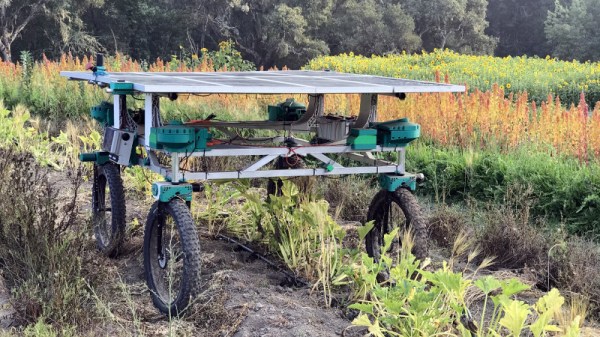
The world of automated farming may be an unglamorous one to those not invested in its attractions, but like the robots themselves that quietly get on in the background with tending crops, those who follow that path spend many seasons refining their designs. The Acorn is a newly-open-sourced robot from Twisted Fields, a Californian research farm, and it provides a fascinating look at the progress of a farming robot design from germination onwards.
The Acorn is not a CNC gantry for small intensive gardens in the manner of designs such as the Farmbot, instead it’s an autonomous solar-powered rover intended for larger farms which will cruise the fields continuously tending to the plants in its patch. It’s a work in progress, so what we see is the completed rover with the tools and machine vision to follow. It pursues the course of a low-cost lightweight platform, an aluminium chassis surmounted by the solar panel, with mountain bike front fork derived wheels at each corner. It has four wheel drive and four wheel steering, meaning that it can traverse the roughest of farmland. We can see its progress since a 2019 prototype, and while it seems as slow as the seasons themselves to mature, we can see that the final version could be a significantly useful machine on a small farm.
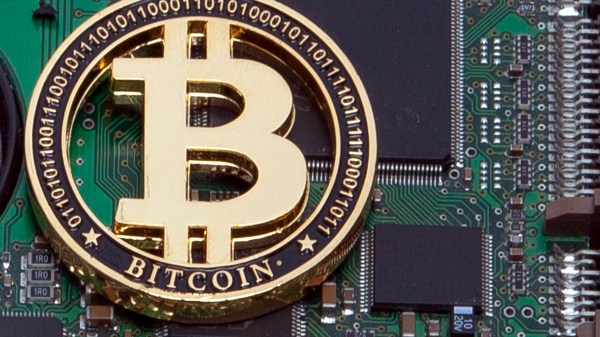
There’s been a constant over the last few weeks’ news, thanks to Elon Musk we’re in another Bitcoin hype cycle. The cryptocurrency soared after the billionaire endorsed it, at one point coming close to $60k, before falling back to its current position at time of writing of around $47k. The usual tide of cryptocurrency enthusiasts high on their Kool-Aid hailed the dawn of their new tomorrow, while a fresh cesspool of cryptocurrency scam emails and social media posts lapped around the recesses of the Internet.
This Time It’s Different!
The worst phrase that anyone can normally say about a financial bubble is the dreaded phrase “This time it’s different“, but there is something different about this Bitcoin hype cycle. It’s usual to hear criticism of Bitcoin for its volatility or its sometime association with shady deals, but what’s different this time is that the primary criticism is of its environmental credentials. The Bitcoin network, we are told, uses more electricity than the Netherlands, more than Argentina, and in an age where global warming has started to exert an uncomfortable influence over our lives, we can’t afford such extravagance and the emissions associated with them.
Here at Hackaday we are more concerned with figures than arguments over the future of currency, so the angle we take away from it all lies with those power stats. How much energy does Argentina use, and is the claim about Bitcoin credible?