Retrotechtacular: Learning The Slide Rule The New Old Fashioned Way

Learning something on YouTube seems kind of modern. But if you are watching a 1957 instructional film about slide rules, it also seems old-fashioned. But Encyclopædia Britannica has a complete 30-minute training film, which, what it lacks in glitz, it makes up for in mathematical rigor.

We appreciated that it started out talking about numbers and significant figures instead of jumping right into the slide rule. One thing about the slide rule is that you have to sort of understand roughly what the answer is. So, on a rule, 2×3, 20×30, 20×3, and 0.2×300 are all the same operation.

You don’t actually get to the slide rule part for about seven minutes, but it is a good idea to watch the introductory part. The lecturer, [Dr. Havery E. White] shows a fifty-cent plastic rule and some larger ones, including a classroom demonstration model. We were a bit surprised that the prestigious Britannica wouldn’t have a bit better production values, but it is clear. Perhaps we are just spoiled by modern productions.

We love our slide rules. Maybe we are ready for the collapse of civilization and the need for advanced math with no computers. If you prefer reading something more modern, try this post. Our favorites, though, are the cylindrical ones that work the same, but have more digits.

Continue reading “Retrotechtacular: Learning The Slide Rule The New Old Fashioned Way”

Jerry Seinfeld dressed up as a honey bee promoting his film Bee Movie.

Retrotechtacular: The $550K Video Conferencing System Used To Make Bee Movie

The modern office environment has shifted in recent years. Employees are routinely asked to collaborate with co-workers half way around the globe and be camera ready, or whatever passes for webcam ready, in order to telecommute when they are out of office. Every office laptop, tablet, or cell phone these days comes equipped with some sort of camera sensor capable of recording at HD resolution. Twenty years ago, that was not the case. Though tech conglomerates like HP had a different idea of teleconferencing to sell back in 2005 dubbed the Halo Collaboration Studio.

The Halo Studio was a collaboration between HP and Dreamworks that was used during the production of Bee Movie. Studio heads at Dreamworks thought it necessary to install the HP teleconferencing solution inside the New York office of Jerry Seinfeld, the writer of the film, as to allow him to avoid long trips to Dreamworks production offices in Los Angeles. According to the HP Halo Collaboration Studio brochure, “Halo actually pays for itself, not only by reducing travel costs, but also by encouraging higher productivity and stronger employee loyalty.” Certainly Dreamworks believed in that sales pitch for Bee Movie, because the upfront asking price left a bit of a sting.

Less of a singular machine, more of an entire dedicated room, the Halo Studio had a $550,000 asking price. It utilized three 1280×960 resolution plasma screens each fitted with a 720p broadcast camera and even included an “executive” table for six. The room lighting solution was also part of the package as the intent was to have all participants appear true to life size on the monitors. The system ran on a dedicated T3 fiber optic connection rated at 45 Mbps that connected to the proprietary Halo Video Exchange Network that gave customers access to 24×7 tech support for the small sum of $30,000 a month.

For more Retrotechtacular stories, check out Dan’s post on the Surveyor 1 documentary. It’s out of this world.

Continue reading “Retrotechtacular: The $550K Video Conferencing System Used To Make Bee Movie

Retrotechtacular: Computers In Schools? 1979 Says Yes

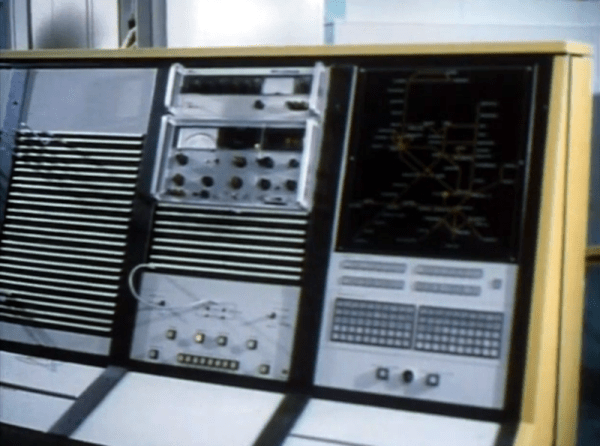
The BBC wanted to show everyone how a computer might be used in schools. A program aired in 1979 asks, “Will Computers Revolutionise Education?” There’s vintage hardware and an appearance of PILOT, made for computer instructions.

Using PILOT looks suspiciously like working with a modern chatbot without as much AI noise. The French teacher in the video likes that schoolboys were practicing their French verb conjugation on the computer instead of playing football.

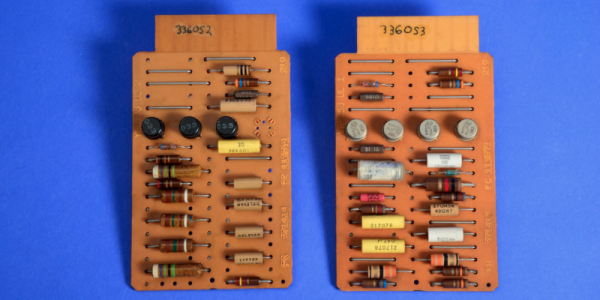
If you want a better look at hardware, around the five-minute mark, you see schoolkids making printed circuit boards, and some truly vintage oscilloscope close-ups. There are plenty of tiny monitors and large, noisy printing terminals.

You have to wonder where the eight-year-olds who learned about computers in the video are today, and what kind of computer they have. They learned binary and the Towers of Hanoi. Their teacher said the kids now knew more about computers than their parents did.

As a future prediction, [James Bellini] did pretty well. Like many forecasters, he almost didn’t go far enough, as we look back almost 50 years. Sure, Prestel didn’t work out as well as they thought, dying in 1994. But he shouldn’t feel bad. Predicting the future is tough. Unless, of course,  you are [Arthur C. Clarke].

Continue reading “Retrotechtacular: Computers In Schools? 1979 Says Yes”

Retrotechtacular: The Ferguson System

Of the many great technological leaps made in the middle of the 20th century, one of the ones with perhaps the greatest impact on our modern life takes a back seat behind the more glamorous worlds of electronics, aeronautics, or computing. But the ancestor of the modern tractor has arguably had more of an impact on the human condition in 2025 than that of the modern computer, and if you’d been down on the farm in the 1940s you might have seen one.

The Ferguson system refers to the three-point implement linkage you’ll find on all modern tractors, the brainchild of the Irish engineer Harry Ferguson. The film below the break is a marketing production for American farmers, and it features the Ford-built American version of the tractor known to Brits and Europeans as the Ferguson TE20.

Ferguson TE20 2006” by [Malcolmxl5]
The evolution of the tractor started as a mechanisation of horse-drawn agriculture, using either horse-drawn implements or ones derived from them. While the basic shape of a modern tractor as a four wheel machine with large driving wheels at the rear evolved during this period, other types of tractor could be found such as rein-operated machines intended to directly replace the horse, or two-wheeled machines with their own ecosystem of attachments.

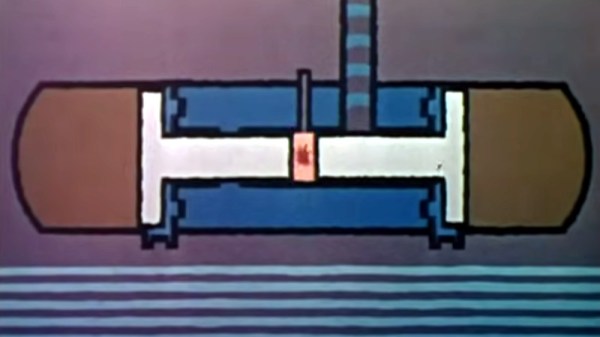
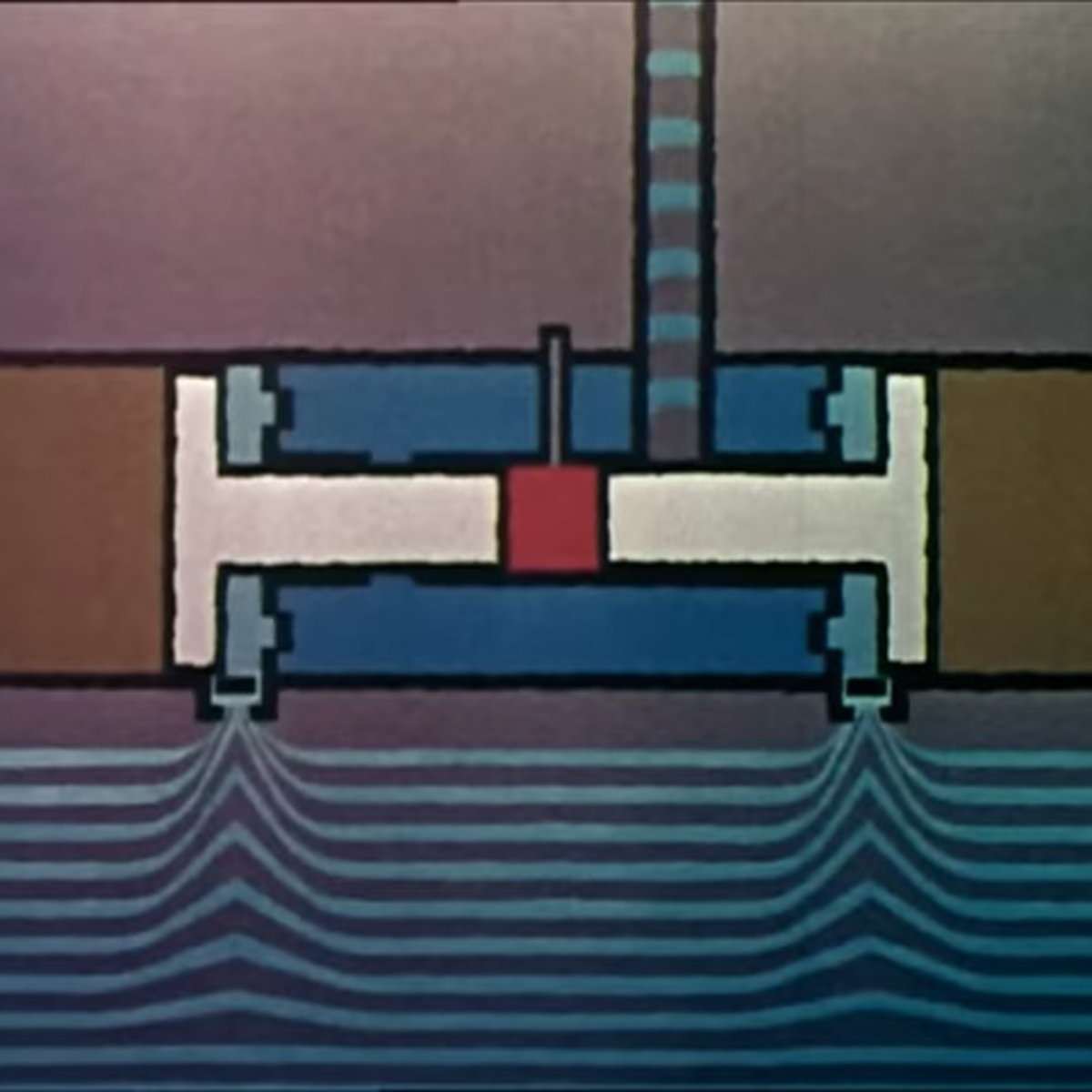
As the four-wheeled machines grew in size and their implements moved beyond the size of their horse-drawn originals, they started to encounter a new set of problems which the film below demonstrates in detail. In short, a plough simply dragged by a tractor exerts a turning force on the machine, giving the front a tendency to lift and the rear a lack of traction. The farmers of the 1920s and 1930s attempted to counter this by loading their tractors with extra weights, at the expense of encumbering them and compromising their usefulness. Ferguson solved this problem by rigidly attaching the plough to the tractor through his three-point linkage while still allowing for flexibility in its height. The film demonstrates this in great detail, showing the hydraulic control and the feedback provided through a valve connected to the centre linkage spring. Continue reading “Retrotechtacular: The Ferguson System”

Retrotechtacular: The Noisy Home Computer From 1967

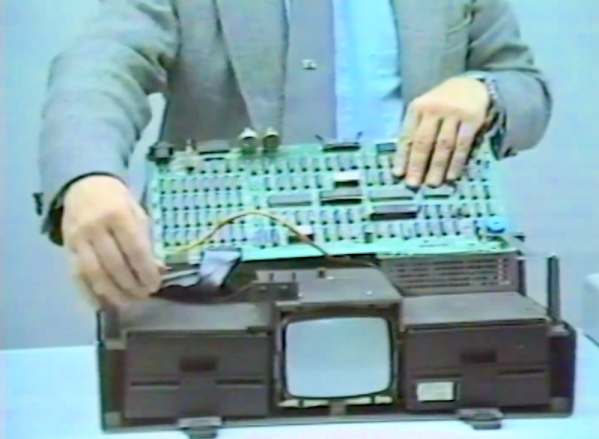
[Rex Malik] didn’t need an alarm clock. That’s because he had one of two “home computer terminals” next to his bed and, as you can see in the video below, it made quite a racket. The terminal looks like an ASR33 with some modifications. In 1967, it was quite a novelty and, of course, it didn’t have any real processing power. It connected to an “invisible brain” ten miles away.

What do you do with a computer in 1967? Well, it looks like you could trade stocks. It also apparently managed his shopping list and calendar. His young son also learned some letters and numbers. We’d love to hear from the young [Mr. Malik] today to find out what kind of computer he’s using now.

Continue reading “Retrotechtacular: The Noisy Home Computer From 1967”

Retrotechtacular: Exploring The Moon On Surveyor 1

Aside from a few stand-out programs — looking at you, Star Trek — by the late 1960s, TV had already become the “vast wasteland” predicted almost a decade earlier by Newton Minnow. But for the technically inclined, the period offered no end of engaging content in the form of wall-to-wall coverage of anything and everything to do with the run-up to the Apollo moon landings. It was the best thing on TV, and even the endless press conferences beat watching a rerun of Gilligan’s Island.

At the time, most of the attention landed on the manned missions, with the photogenic and courageous astronauts of the Mercury, Gemini, and Apollo programs very much in the limelight. But for our money, it was the unmanned missions where the real heroics were on display, starring the less-photogenic but arguably vastly more important engineers and scientists who made it all possible. It probably didn’t do much for the general public, but it sure inspired a generation of future scientists and engineers.

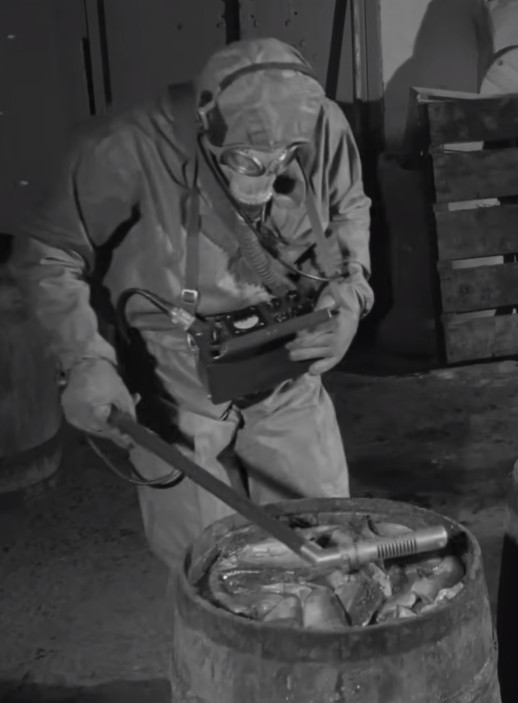
With that in mind, we were pleased to see this Surveyor 1 documentary from Retro Space HD pop up in our feed the other day. It appears to be a compilation of news coverage and documentaries about the mission, which took place in the summer of 1966 and became the first lunar lander to set down softly on the Moon’s surface. The rationale of the mission boiled down to one simple fact: we had no idea what the properties of the lunar surface were. The Surveyor program was designed to take the lay of the land, and Surveyor 1 in particular was tasked with exploring the mechanical properties of the lunar regolith, primarily to make sure that the Apollo astronauts wouldn’t be swallowed whole when they eventually made the trip President Kennedy had mandated back in 1961.

The video below really captures the spirit of these early missions, a time when there were far more unknowns than knowns, and disaster always seemed to be right around the corner. Even the launch system for Surveyor, the Atlas-Centaur booster, was a wild card, having only recently emerged from an accelerated testing program that was rife with spectacular failures. The other thing the film captures well is the spacecraft’s nail-biting descent and landing, attended not only by the short-sleeved and skinny-tied engineers but by a large number of obvious civilians, including a few lucky children. They were all there to witness history and see the first grainy but glorious pictures from the Moon, captured by a craft that seemed to have only just barely gotten there in one piece.

The film is loaded with vintage tech gems, of course, along with classic examples of the animations used at the time to illustrate the abstract concepts of spaceflight to the general public. These sequences really bring back the excitement of the time, at least for those of us whose imaginations were captured by the space program and the deeds of these nervous men and women.

NASA wants to return to the moon. They also want you to help. Turns out making a good landing on the moon is harder than you might think.

Continue reading “Retrotechtacular: Exploring The Moon On Surveyor 1

Retrotechtacular: 1970s Radio

Before YouTube, you had to watch your educational videos on film. In the 1970s, if you studied radio, you might have seen the video from Universal Education and Visual Arts, titled Understanding Electronics Basic Radio Circuitry. The video’s been restored, and it appears on the [CHAP] YouTube channel.

The video starts with a good history lesson that even covers Fessenden, which you rarely hear about. The video is full of old components that you may or may not remember, depending on your age. There’s a classic crystal radio at the start and it quickly moves to active receivers. There’s probably nothing in here you don’t already know. On the other hand, radios work about the same today as they did in the 1970s, unless you count software-defined varieties.

We expect this was produced for the “trade school” market or, maybe, a super advanced high school shop class. There were more in the series, apparently, including ones on vacuum tubes, the transistor, and the principles of television.

We were sad that the credits don’t mention the narrator. He sounded familiar. Maybe Robert Vaughn? Maybe not. A little research indicates the company was a division of Universal Studios, although the Library of Congress says it was actually produced by  Moreland-Latchford Productions in Toronto.

Maybe these videos were the next step in becoming a child radio engineer. If you like old radio videos, this one is even older.

Continue reading “Retrotechtacular: 1970s Radio”