SMT Part Counter Aims To Ease Taking Inventory

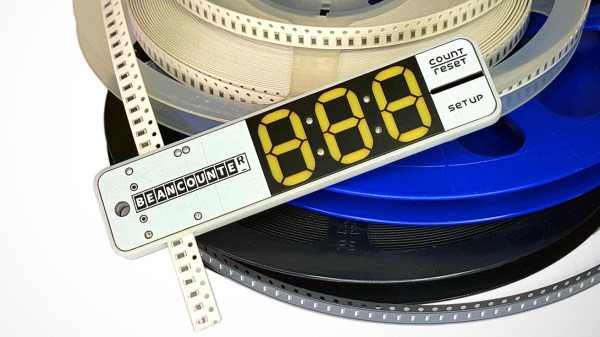
[Nick Poole] has an interesting idea for a new tool, one that has the simple goal of making accurate part counts of SMT reels as easy as pulling tape through a device. That device is the BeanCounter, an upcoming small handheld unit of his own design that counts parts as quickly as one can pull tape through a slot. The device is powered by a CR2032 cell and and works with 8 mm wide tapes up to 2 mm in height, which [Nick] says covers most 0805 or smaller sized parts, as well as things like SOT-23 transistors.
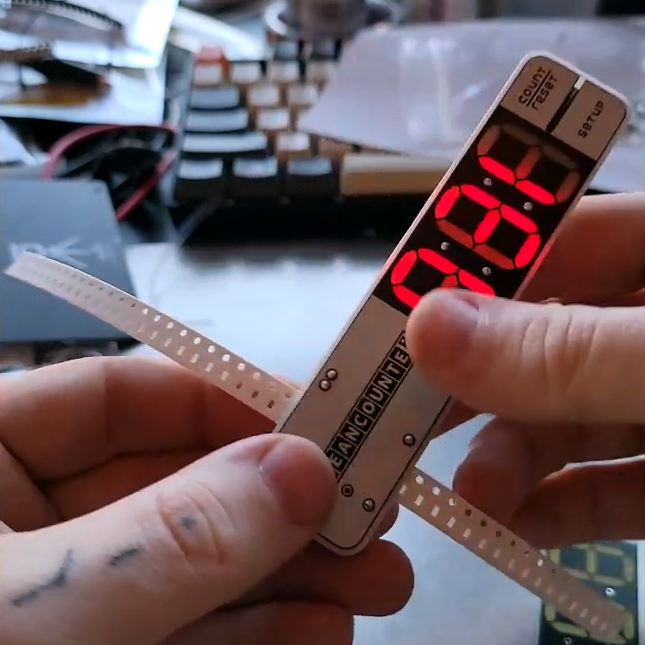
Why would one want to make such a task easier? Two compelling reasons for such a tool include: taking inventory of parts on partial reels or cut tape, and creating segments that contain a known number of parts.

The first is handy for obvious reasons, and the second is useful for things like creating kits. In fact, the usefulness of this tool for creating tape segments of fixed length is perhaps not obvious to anyone who hasn’t done it by hand. Sure, one can measure SMT tape with a ruler or a reference mark to yield a segment containing a fixed number of parts, but that involves a lot of handling and doesn’t scale up very well. In fact, the hassle of cutting tape segments accurately and repeatedly is a common pain point, so making the job easier has value.

If you looked at the photos and suspected that the big, 7-segment numeric display is done with clever PCB fabrication options (making segments by shining LEDs through PCB layers, a trick we always like to see) you’re not alone. After all, [Nick] has a lot of experience in getting clever with board fabrication, and eagle-eyed readers may even suspect that the reset and setup buttons on the edge of the tool are created by using flex PCB segments as switches. Want the nitty-gritty details? Visit the GitHub repository for the project and see it all for yourself at the CAD level.

Hackaday Podcast 164: Vintage NASA Soldering, Mouse Bites, ATTiny85 Graphics, And PVC Pontoons

Join Hackaday Editor-in-Chief Elliot Williams and Managing Editor Tom Nardi as they review the most interesting hacks and stories of the previous week. This time we’ll start things off by talking about the return of in-person events, and go over several major conventions and festivals that you should add to your calendar now. Then we’ll look at a NASA training film from the Space Race, an interesting radio-controlled quirk that Tesla has built into their cars for some reason, a very promising autonomous boat platform, and some high performance visuals generated by an ATtiny85. Stick around to find out what happens with an interplanetary probe looses its ride to space, and why the best new enclosure for your Raspberry Pi 4 might be a surveillance camera.

Check out the links below if you want to follow along, and as always, tell us what you think about this episode in the comments below!

Direct Download

Continue reading “Hackaday Podcast 164: Vintage NASA Soldering, Mouse Bites, ATTiny85 Graphics, And PVC Pontoons” →

Best Ways To Make PCB Breakaway Tabs, Revealed

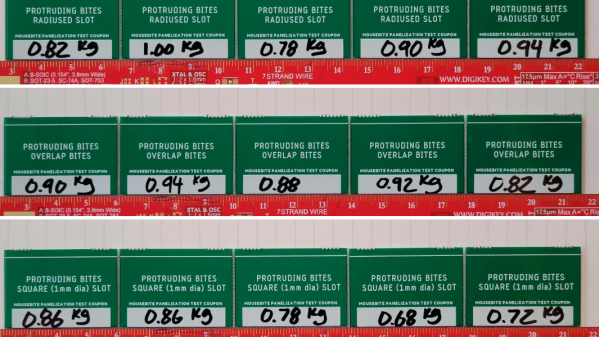
Most of us are familiar with the concept of producing PCBs in a panel, and snapping them apart afterwards. V-grooves that go most of the way through a PCB are one way to go about this, but a line of perforations along which to snap a tab is another. But what’s the best size and spacing of holes to use? Sparkfun’s [Nick Poole] spent some $400 on PCBs to get some solid answers by snapping each of them apart, and judging the results.

The nice thing about creating a perforation line (or “mouse bites”) is that drill hits are a very normal thing in PCB production, which makes creating this kind of breakaway tab a very straightforward and flexible method. However, it can be tricky to get results that are just right. Too sturdy, and breaking apart is a hassle. Too weak, and the board may break or twist before its time. On top of that, edges must also break cleanly. We’ve covered panelizing PCBs in this way before, but this is the first time we’ve seen someone seriously look into how to create optimal breakaway tabs.

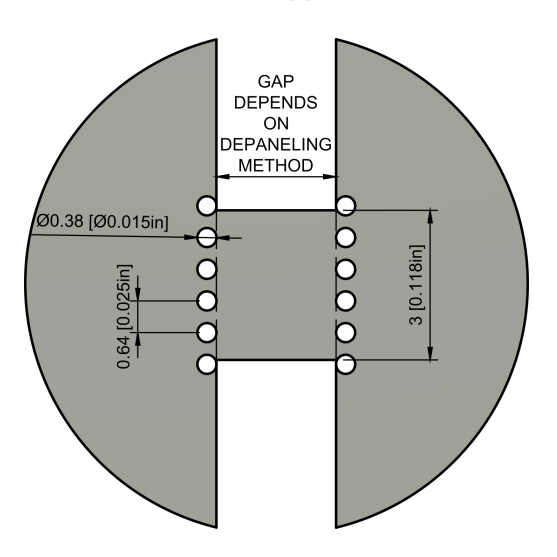
Placing holes tangent to the board edge (as shown above) isn’t the prettiest, but keeps PCB edges free from protrusions. This is best for boards that are rail-mounted, or have tight enclosures.

Data on designing mouse bites was sparse and a bit inconsistent, so [Nick] decided to figure it out empirically and share the results. The full details are available in Building a Better Mousebite (PDF download) but the essence of the recommendations are: 0.015″ unplated holes, spaced 0.025″ apart (center-to-center), tabs a maximum of 0.118″ wide (so as to be compatible with depanelizing tools), and holes that extend into the corners of the breakaway tab to avoid sharp edges. Holes should be placed slightly differently depending on whether one wishes to optimize the cosmetic appearance versus the physical smoothness of the board edge, but those numbers are the core of the guidelines.

To fine tune, [Nick] suggests increasing the spacing between holes to add strength, or just adding additional tabs. What about thickness of PCB? [Nick] tested boards both 0.8 mm and 1.6 mm thick, and while different amounts of torque were needed to snap the boards apart, things still worked as expected regardless of PCB thickness.

When it comes down to it, the best numbers will ultimately be the ones that your process or fab house can most efficiently handle, but [Nick]’s numbers should not steer anyone wrong, and it’s fantastic to see this kind of work go into refining such a common PCB feature.

Homebrew Grain Synth Has A Rad Step Sequencer

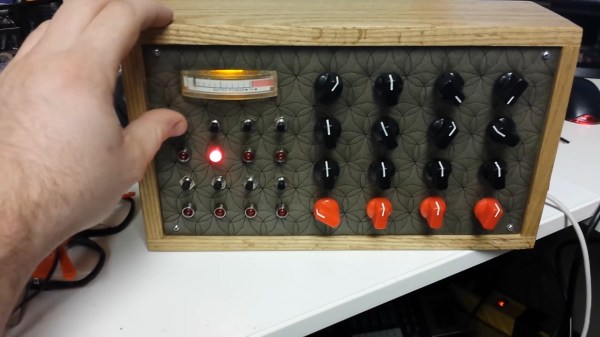
In the world of homebrew synthesizers, there are plenty of noiseboxes and grooveboxes that make all kinds of wacky and wild noises. However, common projects like the Auduino and Atari Punk Console are often limited in that they can’t readily be programmed to play multiple notes or any sort of discernable rhythm. [Nick Poole] changes this with his Auduino step sequencer build.

The build takes the Auduino grain synthesizer, and modifies it by adding a step sequencer. This is possible as the Auduino code, which runs on the old-school ATMEGA-based Arduinos, is incredibly fast, leaving plenty of processing time for extra features to be added. [Nick] adds eight LEDs and eight buttons to the build, allowing the user to select one of eight steps to modify. Then, the sound parameters for the step can be altered with the standard Auduino controls. This lets the user quickly and easily build up 8-step melodies, something that was previously impossible with the Auduino.

It’s a fun build, and one that makes a great intro into the world of DIY synth builds. The techniques learned here will serve any aspiring maker well if they dive further into the world of modular synthesis and associated arcana. Video after the break.

Continue reading “Homebrew Grain Synth Has A Rad Step Sequencer” →

New Part Day: LED Driver Is FPGA Dev Board In Disguise

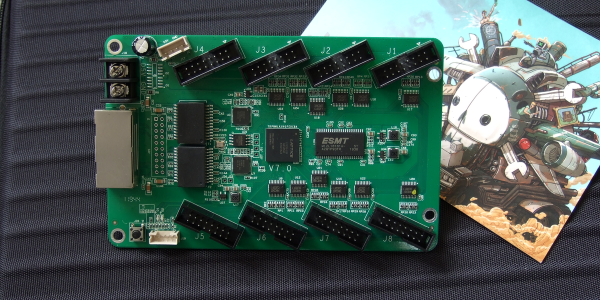
Our new part of the day is the ColorLight 5A-75B, a board that’s meant to drive eight of those ubiquitous high-density color LED panels over gigabit Ethernet. If you were building a commercial LED wall, you’d screw a bunch of the LED panels together, daisy-chain a bunch of these boards to drive them, supply power, and you’d be done. Because of that high-volume application, these boards are inexpensive, around $15 each, and available as quickly as you can get stuff shipped from China.

But we’re not here to talk commercial applications. Managing fast Ethernet and pushing so many pixels in real time is a task best handled by an FPGA, and [Tom Verbeure] noticed that these things were essentially amazing FPGA development boards and started hacking on them. [q3k] put it up on GitHub, and you can follow along with the chubby75 reverse engineering project to dig into their secrets.

While the first generations of these boards used the old-standby Spartan 6, things got interesting for fans of open FPGA tools when newer versions were found using the Lattice ECP5-25 chips, the little brother of the stonking big chip [Sprite_TM] used on the 2019 Hackaday Supercon badge. If you want to grab one you’re looking for ColorLight boards marked with revision 6 or 7 as of this writing.

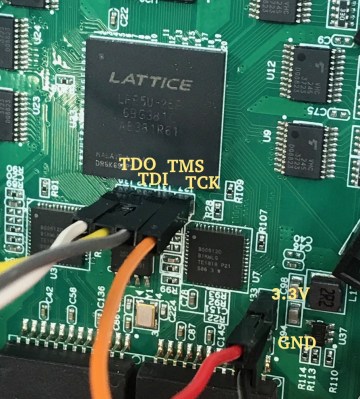
What does this mean? For the price of a gourmet hamburger, you get an FPGA that’s big enough to run a RISC-V softcore, two 166 MHz, 2 MB SDRAMS, flash for the FPGA bitstream, a bazillion digital outputs on 5 V level shifters, and two gigabit Ethernet ports. The JTAG port is broken out in 0.1″ headers, and it works with OpenOCD, which is ridiculously convenient. How’s that for a well-stocked budget FPGA dev board that’s served by a completely open toolchain? Continue reading “New Part Day: LED Driver Is FPGA Dev Board In Disguise” →

Hackaday Podcast 047: Prusa Controversy, Bottle Organ Breakdown, PCBs Bending Backwards, And Listen To Your LED

Hackaday editors Mike Szczys and Elliot Williams get together for the 47th and final Hackaday Podcast of 2019. We dive into the removable appendix on Prusa’s new “Buddy” control board, get excited over the world’s largest grid-backup battery, and commiserate about the folly of designing enclosures as an afterthought. There’s some great research into which threaded-inserts perform best for 3D-printed parts, how LEDs everywhere should be broadcasting data, and an acoustic organ that’s one-ups the traditional jug band.

Take a look at the links below if you want to follow along, and as always tell us what you think about this episode in the comments!

Take a look at the links below if you want to follow along, and as always, tell us what you think about this episode in the comments!

Direct download (60 MB or so.)

Continue reading “Hackaday Podcast 047: Prusa Controversy, Bottle Organ Breakdown, PCBs Bending Backwards, And Listen To Your LED” →

Speakers Taking The Stage At Supercon Plus A Hint Of The Hacking To Come

Four weeks from today the Hackaday Superconference comes alive for the fifth year. From engineering in challenging environments to elevating the art form of electronics, here are nine more talks that will make this a year to remember.

In addition to the slate of speakers below there are three other announcements, plus workshops. Jeroen Domburg (aka Sprite_TM) is designing this year’s badge based around a beefy FPGA running a RISC-V core and using open source synthesis tools. We’ll have more on that soon, but if you just can’t wait, check out the expansion board spec he just published, and join the conference chat room for the inside track. Badge hacking is sure to be the liveliest we’ve ever seen.

Tickets are sold out but you can still get on the waiting list and hope that one becomes available. If you are holding onto one of these hot commodities but are unable to use it, please return your ticket so that we can get it to someone waiting with their fingers crossed.

The Talks (Part Four of Many)


  • Laurel Cummings

    When it Rains, It Pours

    Over the last two years my work has been beyond ordinary, building and prototyping in strange locations like being stranded on a sailboat in the Atlantic Ocean, teaching US Marines in Kuwait, and building fuel gauge sensors for generators for vital systems in North Carolina post hurricane Florence. Some of the big lessons I’ve learned are about how to source materials and supplies in weird places, like finding potentiometers in the backwoods of North Carolina when Amazon cannot physically deliver across flooded highways, how to find welding gas in Kuwait City (and how a local chef could possibly be your best bet), or how far you can get with an O’Reilly’s Auto Parts store near the city docks. These situations help you really see the “engineer creep” that can happen to a project. I’ve learned that when you’re in high-risk situations, you really should stop caring about whether the edges of your 3D print are chamfered. In fact, version 1 of the hurricane fuel gauge sensor was demonstrated while being housed inside an elegant, tasteful sandwich baggie.


  • Angela Sheehan

    Building Whimsical Wearables: Leveling Up Through Playful Prototyping

    Whether it’s for a theme party, Halloween, cosplay, or That Thing in The Desert, designing wearables for whimsical self expression presents a great opportunity to challenge yourself as a maker, wearer, and collaborator. As an artist and designer who crash landed into a career in tech, I’ve found that imposter syndrome can often place limits on what feels personally achievable from an electronics and programming standpoint. Recontextualizing a project to shift the focus from ‘wearable tech hardware endeavor’ to ‘quirky mixed media experiment in personal styling’, I’ve created a safe space to play and try new things just outside my skill set and produced some of my most technically complex and polished personal work. Take a journey with me through the process of conceptualizing and building my Color Stealing Fairy project, an exercise in iterative design and upgrading an interactive wearable project over the course of two years and counting.


  • Michael Ossmann and Kate Temkin

    Software-Defined Everything

    The popularity of Software-Defined Radio (SDR) has led to the emergence of powerful open source software tools such as GNU Radio that enable rapid development of real-time Digital Signal Processing (DSP) techniques. We’ve used these tools for both radio and non-radio applications such as audio and infrared, and now we are finding them tremendously useful for diverse sensors and actuators that can benefit from DSP. In this talk we’ll show how we use the open source GreatFET platform to rapidly develop an SDR-like approach to just about anything.


  • Kelly Heaton

    “Hacking Nature’s Musicians” (or, “The Art of Electronic Naturalism”)

    The general lack of acceptance of electronic art results from a scarcity of critics, curators, collectors, and grantors who understand electronic media, compounded by a cultural gap between the artistic and engineering communities. In order to solve this problem, we must stretch our comfort zone and vocabularies to have a respectful, enlightening conversation with people with different educational backgrounds. In this talk I’ll discuss my wonderment at the simple, analog circuit designs that mimic life-like behavior such as chirping crickets and singing birds. This will include discussion of various schematics and demonstrations of a small. along with an abbreviated survey of my work to-date.


  • Jasmine Brackett

    Setting your Electronics Free

    In this panel we’ll discuss the key ways to get your projects from your workshop into the hands of the first few users, and what you can do to scale up from there. We’ll talk about common pitfalls, and also what are the best resources to draw upon.


  • David Williams

    MicroFPGA – The Coming Revolution in Small Electronics

    Big FPGA’s are awesome. They’re doing what they’ve always done, enabling AI, signal processing, military applications etc. However, there is a new possibility emerging – FPGA’s for small applications – which is quite possibly even more significant. Using open source tools, cheap flexible development boards, and new libraries, designers have a whole new set of options, creating incredibly high performance, flexible, low power projects and products.


  • Nick Poole

    Boggling the Boardhouse: Designing 3D Structures, Circuits, and Sensors from PCBs

    The presentation will be a series of design features or techniques with a few minutes of exploration into the ‘gotchas’ of each, as well as example layouts in EAGLE and physical examples. I’d like to cover as many different techniques as I can cram into 30 minutes, including bringing weird shapes into EDA, the inside corner problem caused by tab and slot, fillet soldering, stacking boards, imitating model sprues with mouse bites, manipulating the mask layer for custom displays, bendy tab buttons, working rotary encoder, and ergonomic design for handheld PCBs.


  • Ted Yapo

    Towards an Open-Source Multi-GHz Sampling Oscilloscope

    Tektronix designed a 14.5 GHz sampling oscilloscope in 1968. With the easy multi-layer PCB designs, tiny surface-mount parts, blazingly fast semiconductors, and computer horsepower available to the individual designer today, can a similar sampling head be re-created inexpensively with common, off-the-shelf components? Should be easy, right? It’s not. In this talk, I’ll discuss progress towards an open-source GHz+ sampling oscilloscope, including a lot of dead ends, plus some very promising leads.


  • Jeroen Domburg

    Building the Hackaday Superconference Badge

    The tradition of the Hackaday Supercon badge is to build something unlike any Supercon badge that came before. This year’s badge has an FPGA as its central component, and this comes with some extra challenges: the FPGA only comes in a BGA package with a whopping 381 pads to solder, and instead of just referring to the datasheet of the SoC to write the badge software, the SoC itself had to be written first.  I will discuss the development process of the badge, as well as the many challenges encountered along the way.


Keep Your Eye on Hackaday for the Livestream

The speakers you’ll see at Supercon have an amazing wealth of experience and we can’t wait to see their talks. But even if you couldn’t get a ticket, that doesn’t mean you have to miss out. Keep your eye on Hackaday for a link to the livestream which will begin on Saturday, November 16th.