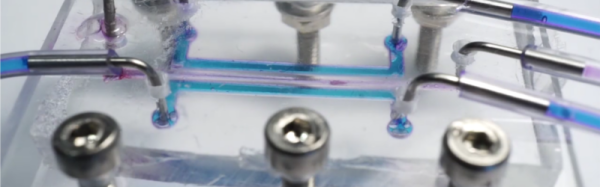
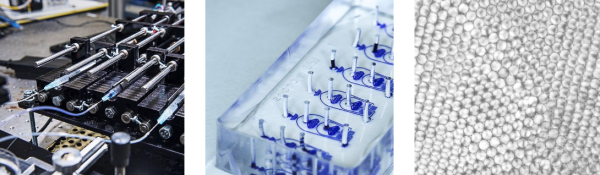
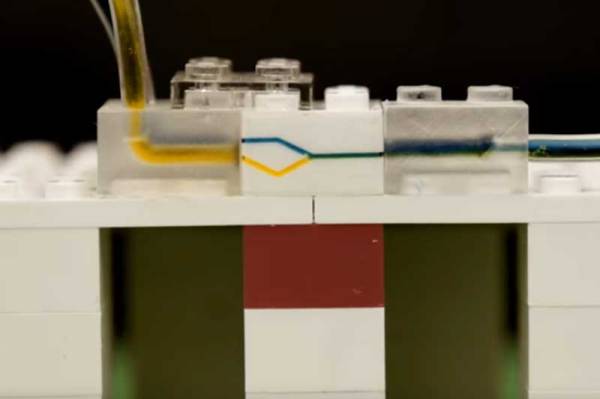
As any good hacker (or scientist) knows, sometimes you find the tools you need in unexpected places. For one group of MIT scientists, that place is a box of Lego. Graduate student [Crystal Owens] was looking for new ways to make a cheap, simple microfluidics kit. This technique uses the flow of small amounts of liquid to do things like sort cells, test the purity of liquids and much more. The existing lab tools aren’t cheap, but [Crystal] realized that Lego could do the same thing. By cutting channels into the flat surface of a Lego brick with a precise CNC machine and covering the side of the brick with glass, she was able to create microfluidic tools like mixers, drop makers and others. To create a fluid resistor, she made the channel smaller. To create a larger microfluidic system, she mounted the blocks next to each other so the channels connected. The tiny gap between blocks (about 100 to 500 microns) was dealt with by adding an O-ring to the end of each of channel. Line up several of these bricks, and you have a complete microfluidic system in a few blocks, and a lab that only costs a few dollars.
Hackaday Prize Entry: Microfluidics Control System
Microfluidics is the fine art of moving tiny amounts of liquid around and is increasingly used in fields such as biology and chemistry. By miniaturizing experiments, it’s possible to run many experiments in parallel and have tighter control over experimental conditions. Unfortunately, the hardware to run these microfluidic experiments is expensive.
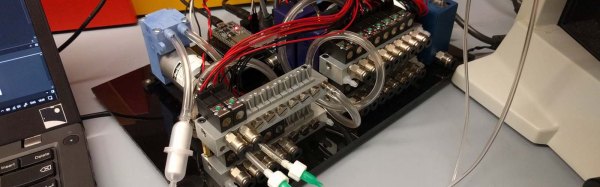
[Craig]’s 2017 Hackaday Prize entry involves creating a microfluidics control system for use by researchers and students. This device allows for miniaturized experiments to be run. This allows more projects to be run in parallel and far more cheaply, as they don’t use as many resources like reagents.
[Craig]’s rig consists of an ESP32, a 40-channel IO expander, 3 pressure regulators tuned to different pressures, and around 2 dozen solenoid valves mounted to manifolds. Solutions are moved around with a combination of two pumps, with one providing positive pressure and one serving as a vacuum pump.
Far cheaper than professional microfluidics systems, [Craig]’s project aims to assist biohackers and underfunded researchers in their pursuits.
Easy DIY Microfluidics
Microfluidics, the precise control and manipulation of small volumes of liquids, is heavily used in any field that does small-scale experiments with expensive reagents (We’re looking at you, natural sciences.) However, the process commonly used to create microfluidic devices is time and experience intensive. But, worry not: the Uppsala iGEM team has created Chipgineering: A manual for manufacturing a microfluidic chip.
Used while developing everything from inkjet print heads to micro-thermal technologies, microfluidic systems are generally useful. Specifically, Uppsala’s microfluidic device performs a simple biological procedure, a heat-shock transformation, as a proof of concept. Moreover, Uppsala uses commonly available materials: ready to pour PDMS (a biologically compatible silicon) and a 3D printed mold. Additionally, while the team used a resin 3D printer, there seems to be little reason that a fused deposition modeling (FDM) printer wouldn’t work just as well. Particularly interesting is how they sandwich their PDMS between two plates, potentially allowing easy removal and replacement of reagents without external mechanisms. And, to put the cherry on top, Uppsala’s well-illustrated documentation is a joy to read.
This isn’t the first time we’ve covered microfluidic devices, and if you’re still in the prototyping phase, these microfluidic LEGO-like blocks might be what you need. But, if you prefer macrofluidics, this waste shark that aims to clean our oceans might be more your style.
Microfluidics “Frogger” Is A Game Changer For DIY Biology
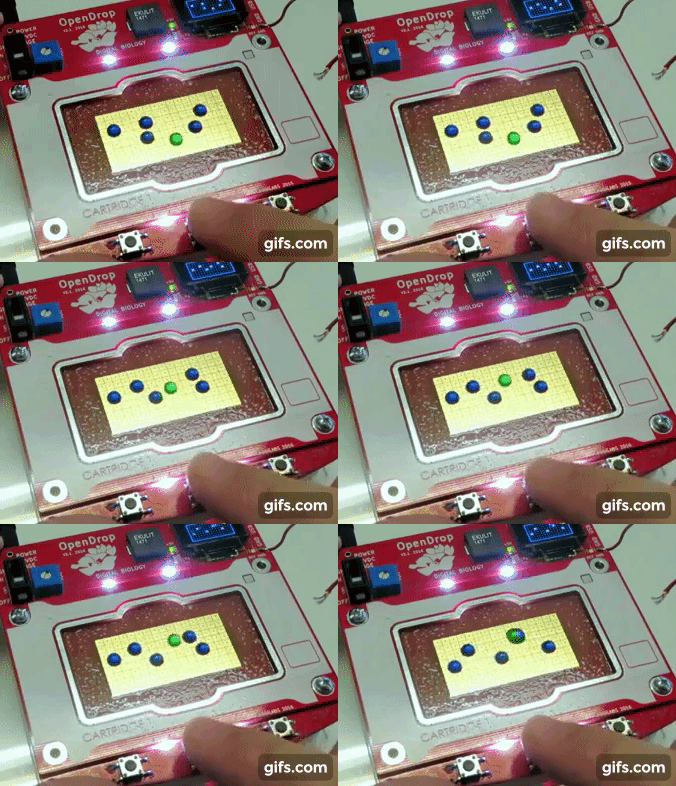
See those blue and green dots in the GIF? Those aren’t pixels on an LCD display. Those are actual drops of liquid moving across a special PCB. The fact that the droplets are being manipulated to play a microfluidics game of “Frogger” only makes OpenDrop v 2.0 even cooler.
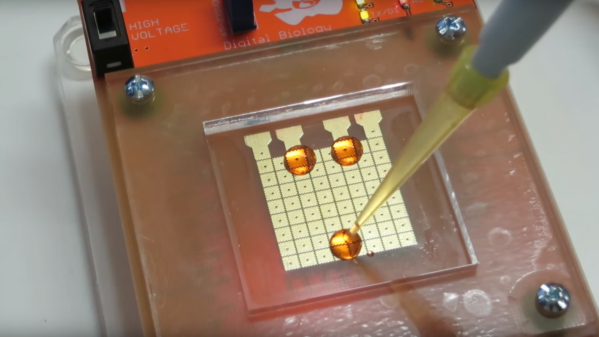
Lab biology is mainly an exercise in liquid handling – transferring a little of solution X into some of solution Y with a pipette. Manual pipetting is tedious, error prone, and very low throughput, but automated liquid handling workstations run into the hundreds of thousands of dollars. This makes [Urs Gaudenz]’s “OpenDrop” microfluidics project a potential game changer for the nascent biohacking movement by offering cheap and easy desktop liquid handling.
Details are scarce on the OpenDrop website as to exactly how this works, but diving into the literature cited reveals that the pads on the PCB are driven to high voltages to attract the droplets. The PCB itself is covered with a hydrophobic film – Saran wrap that has been treated with either peanut oil or Rain-X. Moving the droplets is a simple matter of controlling which pads are charged. Splitting drops is possible, as is combining them – witness the “frog” getting run over by the blue car.
There is a lot of cool work being done in microfluidics, and we’re looking forward to see what comes out of this open effort. We’ve covered other open source efforts in microfluidics before, but this one seems so approachable that it’s sure to capture someone’s imagination.
Continue reading “Microfluidics “Frogger” Is A Game Changer For DIY Biology”
Open Microfluidics Instrumentation Playset
Micro-what? Microfluidics! It’s the field of dealing with tiny, tiny bits of fluids, and there are some very interesting applications in engineering, biology, and chemistry. [Martin Fischlechner], [Jonathan West], and [Klaus-Peter Zauner] are academic scientists who were working on microfluidics and made their own apparatus, initially because money was tight. Now they’ve stuck to the DIY approach because they can get custom machinery that simply doesn’t exist.
In addition to their collaboration, and to spread the ideas to other labs, they formed DropletKitchen to help advance the state of the art. And you, budding DIY biohacker, can reap the rewards.
In particular, the group is focused on droplet microfluidics. Keeping a biological or chemical reaction confined to its own tiny droplet is like running it inside its own test-tube, but because of the high rate at which the droplets can be pumped out, literally millions of these test-tubes are available. Want to grow hundreds of thousands of single cells, each in their own environment? Done.
The DropletKitchen kit includes an accurate pump system, along with high-speed camera and flash setups to verify that everything’s working as it should. Everything is open-source, and a lot of it is 3D-printable and written in OpenSCAD so that it’s even easy to modify to fit your exact needs. You just need to bring the science.
This is a professional-grade open source project, and we’re excited to see it when academics take a turn toward the open. Bringing cutting edge processing technologies within reach of the biohacker community is a huge multiplier. We can’t wait to see what comes out of this.
Bring Doping, Microfluidics, Photovoltaics, And More Into The Home
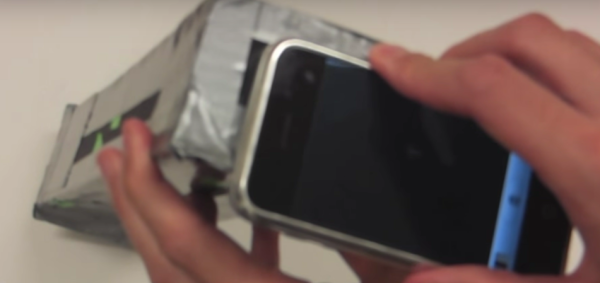
Can you make a spectrometer for your home lab all from materials you have sitting around? We might not believe it from a less credible source, but this MIT course does indeed build a spectrometer from foam board using two razor blades as the silt cover and a writable CD as the diffraction grating. The coolest part is removing the metal backing of the CD.
Hackaday reader [gratian] tipped us off about the course available from MIT courseware called Nanomaker. It boils down some fairly complicated experiments to the kind one can do in the home lab without involving thousands of dollars of lab equipment. The whole point is to demystify what we think of as complicated devices and topics surrounding photovoltaics, organic photovoltaics, piezoelectricity and thermoelectricity.
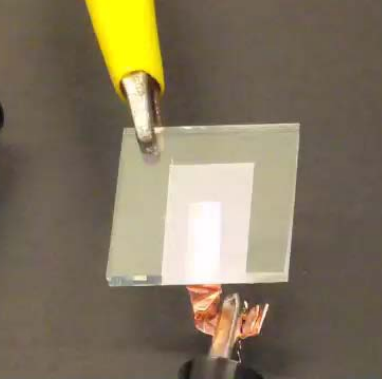
Spectrometers are used to analyze the wavelengths of a light source. Now that you have a measurement tool in hand it’s time to build and experiment with some light sources of your own. Here you can see an LED that is the topic of one of the course labs.
If you have a bit of background in chemistry this is a good step-by-step guide for getting into these types of experiments at home. It reminds us of some of the really cool stuff [Jeri Ellsworth] was doing in her garage lab, like making her own EL panels.
Continue reading “Bring Doping, Microfluidics, Photovoltaics, And More Into The Home”
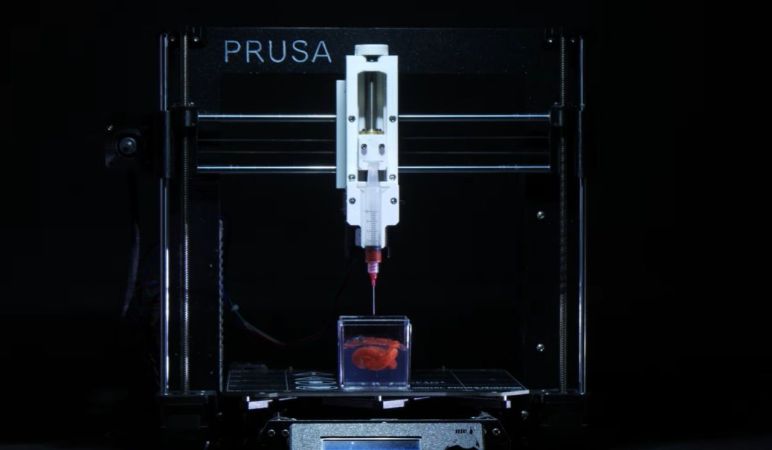
Embedded 3D Printing With Liquids On A Bricked Prusa FDM Printer
Recently [Riley] got his paws on an old Prusa i3 FDM printer that had clearly seen better days, with a hot-end that had suffered an explosive blow-out. For the project he had in mind this was of course perfect, as his intention was to replace the hot-end with a syringe system for embedded 3D printing (E3DP), which uses a supportive medium to allow for the printing of materials and structures that would be impossible with just air.
Generally in additive manufacturing (AM) methods like fused deposition modelling (FDM) the material is extruded onto a build plate or a previous layer where it solidifies. This works great for materials like thermoplastics, but for other materials having only the surrounding air as support is just a recipe for a big mess. With E3DP the liquid is instead extruded into a supportive material at a selectable depth and volume, opening up a whole range of possibilities.
Continue reading “Embedded 3D Printing With Liquids On A Bricked Prusa FDM Printer”