Universal music translation network

Hiding Data In Music Might Be The Key To Ditching Coffee Shop WiFi Passwords

In a move guaranteed to send audiophiles recoiling back into their sonically pristine caves, two doctoral students at ETH Zurich have come up with an interesting way to embed information into music. What sounds crazy about this is that they’re hiding data firmly in the audible spectrum from 9.8 kHz to 10 kHz. The question is, does it actually sound crazy? Not to our ears, playback remains surprisingly ok.

You can listen to a clip with and without the data on ETH’s site and see for yourself. As a brief example, here’s twelve seconds of the audio presenting two versions of the same clip. The first riff has no data, and the second riff has the encoded data.

You can probably convince yourself that there’s a difference, but it’s negligible. Even if we use a janky bandpass filter over the 8 kHz -10 kHz range to make the differences stand out, it’s not easy to differentiate what you’re hearing:

After many years of performing live music and dabbling in the recording studio, I’d describe the data-encoded clip as having a tinny feedback or a weird reverb effect. However, you wouldn’t notice this in a track playing on the grocery store’s speaker. Continue reading “Hiding Data In Music Might Be The Key To Ditching Coffee Shop WiFi Passwords”
The Trials And Tribulations Of Building An IOT Garage Door Opener

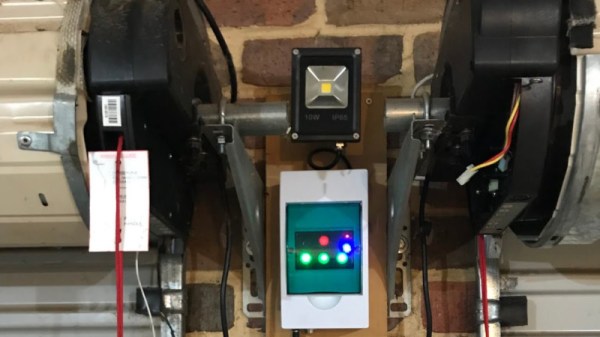
Garage doors can be frustrating things, being a chore to open manually and all. Many people opt to install a motorized opener, but for some, even this isn’t enough. Hooking up a garage door to the Internet of Things has long been a popular project, and [Simon Ludborzs] decided to give it a shot. Naturally, there were some obstacles to be overcome along the way.

[Simon]’s build is relatively straight down the lines, using an ESP-12 as the brains of the operation, which connects to the internet over WiFi. However, robustness was a major goal of the project, and being reliant on shaky cloud-based services wouldn’t do. This opener is set up to work independently of an internet connection, too. There’s a nifty control panel with glowing buttons to operate the opener, in addition to the webpage served up on the network.

During the development, [Simon] ran into several roadblocks. A set of roller door motors were inadvertently killed, and there were issues in getting the web interface working as expected. None of these were showstoppers, though, and with a little work and some new parts, everything came together in the end. The project was then given a proper commercial-grade case, sourced from AliBaba. This is a great step to take for a project expected to hold up to daily use for years on end. He also took the time to document his tips for easier ESP8266 development, which may prove useful to those just getting started with the platform.

Garage door openers remain a common theme around here, but every project has its own story to tell. If you’ve developed a particularly unique solution to your garage access problems, you know who to call.

Arduboy In A Dreamcast VMU

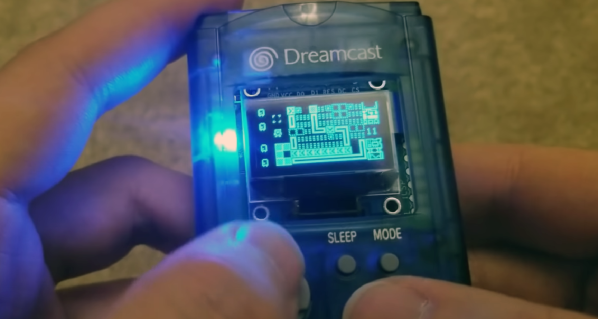
The Arduboy is a tiny, credit-card sized sized video game console that you can build yourself. The Dreamcast VMU was also a tiny, pocketable video game system, but really that’s just where we stored our saves for Crazy Taxi. What do you get when you combine the two? [sjm] did just that, giving us an Arduboy tucked into a Dreamcast VMU.

The guts of the Arduboy is simply an ATMega32u4, the same chip found in many Arduinos, an I2C OLED, and a few other various electronics for USB, power, and battery protection. In short, it’s an easy circuit, and something just about anyone with the skills can build themselves. Since just anyone can get a PCB fabbed, and the Dreamcast already has nice silicone buttons built into the enclosure, it was a simple matter for [sjm] to create a Dreamcast VMU-shaped PCB with all the guts of an Arduboy. The only real difference is the size of the OLED — this one uses a 0.96″ 128×64 OLED, where the original used one with the same resolution but with a significantly larger size.

Yes, we’ve seen this same project before, but now thanks to the magic of the Hackaday Prize, it’s now in the running for the greatest hardware competition on the planet. You can check out the entire build video and a short demo after the break. Of course, this isn’t the first repurposing of the Arduboy circuit, we’ve seen a flex circuit version, and a version with a crank like the Playdate developed by Teenage Engineering and Panic.

Continue reading “Arduboy In A Dreamcast VMU”

Low-Level Analog Measurement Hack Chat

Join us on Wednesday 17 July 2019 at noon Pacific for the Low-Level Analog Measurement Hack Chat with Chris Gammell!

A lot of electronics enthusiasts gravitate to the digital side of the hobby, at least at first. It’s understandable – an Arduino, a few jumpers, and a bit of code can accomplish a lot. But in the final analysis, digital circuits are just analog circuits with the mystery abstracted away, and understanding the analog side opens up a fascinating window on the world of electronics.

Chris Gammell is well-known around hacker circles thanks to his Amp Hour Podcast with Dave Jones, his KiCad tutorials, and his general hacker chops. He’s also got a thing for the analog world, and wants to share some of the tips and tricks he’s developed over his two decades as an electrical engineer. In the next Hack Chat, we’ll be joining Chris down in the weeds to learn the ins and outs of low-level analog measurements. Join us with your questions and insights, or just come along to peel back some of the mysteries of the analog world.

join-hack-chatOur Hack Chats are live community events in the Hackaday.io Hack Chat group messaging. This week we’ll be sitting down on Wednesday July 17 at 12:00 PM Pacific time. If time zones have got you down, we have a handy time zone converter.

Click that speech bubble to the right, and you’ll be taken directly to the Hack Chat group on Hackaday.io. You don’t have to wait until Wednesday; join whenever you want and you can see what the community is talking about.

Review: Shi Yi Tool Sy365-8 Desoldering Iron, Second Cheapest You Can Find

Is the second cheapest tool you can find any better than the cheapest one?

Readers with long memories will recall there was a time when I amused myself by tacking inexpensive tools or electronic devices to my various orders from the Chinese electronic Aladdin’s Cave. Often these inexpensive purchases proved to be as disastrous or ineffective as you might expect, but sometimes they show unexpected promise, true diamonds in the rough. It’s been a while and life has intervened over the last year, but it’s time to resume this harmless diversion.

Memories Of An Explosive Conclusion

A particularly memorable review came in April 2018, when I bought a five pound ($6.30) desoldering iron. I described it then as an “unholy lovechild of a cheap solder sucker and an even cheaper soldering iron“, and while that was an accurate portrayal it also showed promise as a useful tool that would fill a niche in my requirements. Desoldering is always slightly annoying, and a heated desolder pump genuinely does make a difference. Unfortunately for me, the cheap desoldering tool was not a product I’d recommend that anyone try for themselves. A combination of questionable electrical safety and a propensity to explosively deconstruct itself meant it has languished unused in my big box of cheap junk, and I’m still without a decent desoldering solution. It is time to buy something better, and in the rich tradition of reviewing inexpensive stuff I decided to pick up the next cheapest desoldering iron I could find. Eight pounds ($10) secured me a Shi Yi Tool Sy365-8, and I set to on this review. Continue reading “Review: Shi Yi Tool Sy365-8 Desoldering Iron, Second Cheapest You Can Find”

Alan Turing To Be The Face Of Fifty Quid

The Bank of England has announced that the new face of the £50 note is to be Alan Turing. This news follows a round of public nominations for a scientist to fill the space, and Turing was in the running with some stiff competition from the likes of Stephen Hawking and Ada, Countess Lovelace.

The fifty is not a note you’ll see very often even if you’re a Brit, it’s the one you’ll usually only come into contact with if you’ve bought a second-hand car, but the importance of this move goes beyond whether or not the note will be proffered at the bar for a foaming pint of mild ale. It’s not an honour that is handed out lightly, and it is particularly poignant in the case of Turing who despite his wartime codebreaking and genesis of the discipline of computer science was disgraced and pushed to suicide in the 1950s when he was discovered to be gay.

Will Hardware Pictured on the Bill Be as Famous as Turing Himself?

The bank has not yet set the engravers to work, but they have generated this mock-up that features alongside Turing himself a table from a Turing machine example superimposed on a picture of an early computer rack. We don’t think it’s EDSAC or Manchester Baby, it’s not a Bombe and it definitely shouldn’t be Colossus as he had little to do with it, but we are sure that among our readers will be someone who can provide a positive identification. We hope that whatever the final design may be, it does justice to Turing’s legacy.

Continue reading “Alan Turing To Be The Face Of Fifty Quid”

Project Egress: A Bracket And A Bell Crank For The Latches

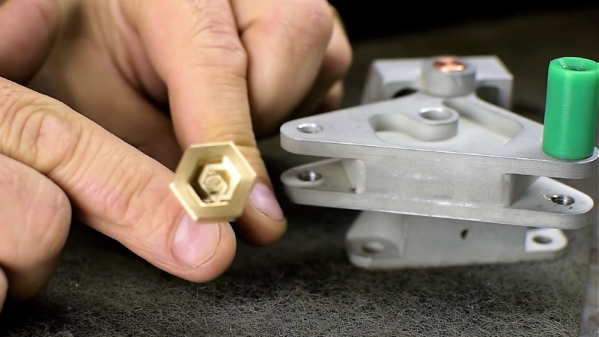
Put yourself in [This Old Tony]’s shoes: you get an email out of the blue asking you to take part in making a replica of a 50-year-old spacecraft. Would you believe it? He didn’t, at least not at first, but in the end it proved to be true enough that he made these two assemblies for Project Egress in his own unique style.

If you haven’t heard of Project Egress, check out our coverage of the initial announcement. The idea is to build a replica of the crew hatch from the Apollo 11 Command Module Columbia, as part of the 50th anniversary of the Apollo 11 landing next week. [Adam Savage] at Tested has enlisted 44 hackers and makers to help, spreading the work out among the group and letting everyone work in whatever materials and with whatever methods they feel like. [Old Tony], perhaps unsurprisingly, chose mainly Apollo-era dehydrated space-grade aluminum, machined using a combination of manual and CNC machining. We really like the finish he chose – a combination of sandblasting and manual distressing to give it a mission-worn look.

As for exactly what the parts themselves are, the best [Old Tony] could come up with to call them is a bracket and a bell crank. From the original hatch drawings, it looks like there were two bell cranks, which will transmit force around the hatch to the latches that [Fran Blanche], [Joel] and [Bob], and no doubt others have contributed to the build.

We’re eagerly anticipating the final assembly, to be executed by [Adam] live at the Smithsonian’s National Air and Space Museum on July 18. Project Egress is as much a celebration of the maker movement as it is a commemoration of Apollo, and we’re pleased that people will get a chance to see the fruits of the labors of all these hackers in so public a forum.

Continue reading “Project Egress: A Bracket And A Bell Crank For The Latches”