A No-Cost, Heavy Metal Lathe From Junkyard Parts

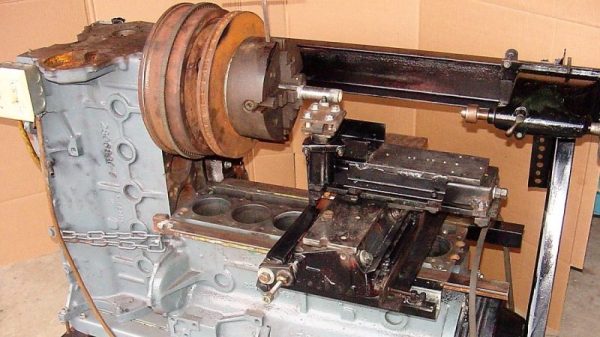
We have to admit that our first thought on seeing a Frankenlathe made from old engine blocks was that it was a set piece from a movie like The Road Warrior. And when you think about it, the ability to cobble together such a machine tool would probably make you pretty handy to have around in an apocalypse.

Sadly, surviving the zombie mutant biker uprising seemed not to be the incentive for [Paul Kuphaldt]’s version of the [Pat Delany] “Multimachine”. He seemed to be in it for the money, or more precisely from the lack of it. He was shooting for a zero-dollar build, and although he doesn’t state how close he came, we’re going to guess it was pretty close. The trick is to find big castings for the bed and headstock – Mopar slant 6 blocks in this case. The blocks are already precision machined dead flat and square, and the cylinder bores provide ample opportunities for stitching the castings together. The drivetrain comes from a 3-speed manual transmission, a 3/4-ton Chevy truck axle donated the spindle, and a V8 cylinder head was used for the cross slide. The tailstock seems to be the only non-automotive part on the machine.

We’d love to see a video of it in action, but there are ample pictures on [Paul]’s website to suggest that the heavy castings really make a difference in keeping vibration down. Don’t get us wrong – we love cast aluminum Gingery lathes too. But there’s something substantial about this build that makes us feel like a trip to the boneyard.

[via r/homemadetools]

Polygonia Helps You Laser Cut Beautiful Patterns

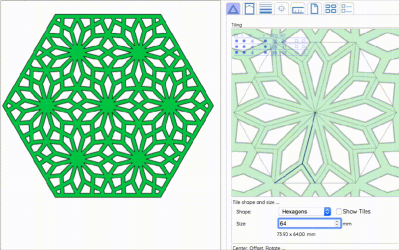
Lasercutters are amazingly versatile tools that can help you build all manner of complicated structures if you can break them down into a series of planar parts. [David] had spotted artworks at the Smithsonian which caught his eye, using planar shapes with interesting repeating patterns. Wanting to make similar works himself, he set out to create software to help make it possible. 

The tool makes it easy to generate complex profiles and export them for lasercutting.

The result of [David]’s work is the Polygonia Design Suite. It’s a tool that aims to make creating geometric patterns for lasercutting easy and simple. The web interface designer has a wide variety of options for drawing shapes and patterns, and the frame size can also be controlled. [David] demonstrates these features with all manner of creations. The project’s Instagram page features basic rectangular panels with inset cubic and triangular motifs, all the way up to an ornate octahedron built from many panels held together with 3D printed clips.

It’s all whipped up in Javascript, handrolled CSS and HTML. Cloud storage and authentication is all handled via Amazon Web Services, which makes handling such features easy. [David] made a special effort to create a separate test site so code experiments won’t effect the live site – crucial for any commercial endeavor.

If you’re in the mood to create some geometric lasercut artworks, check out the tool online. The first 3 exports are free, with a variety of subscription models available for heavy users. We fully expect to see an explosion in fancy lasercut homewares at the weekend markets in years to come.

If your thirst for lasercut art isn’t yet satiated, check out this colorful edgelit acrylic technique.

Saving Your Vision From Super Glue In The Eyes

Super glue, or cyanoacrylate as it is formally known, is one heck of a useful adhesive. Developed in the 20th century as a result of a program to create plastic gun sights, it is loved for its ability to bond all manner of materials quickly and effectively. Wood, metal, a wide variety of plastics — super glue will stick ’em all together in a flash.

It’s also particularly good at sticking to human skin, and therein lies a problem. It’s bad enough when it gets on your fingers. What happens when you get super glue in your eyes?

Today, we’ll answer that. First, with the story of how I caught an eyeful of glue. Following that, I’ll share some general tips for when you find yourself in a sticky situation.

Continue reading “Saving Your Vision From Super Glue In The Eyes”

Hackaday Podcast 009: On The Edge Of AI, Comment Your Code, Big Big Wheels, And Makers Of Munich

Catch up on the past week of hacks with Hackaday Editors Elliot Williams and Mike Szczys. “AI on the Edge” is the buzzword of choice lately, with hardware offerings from BeagleBone and Google to satiate your thirst. We take on spotty data from Tesla, driving around on four bouncy-houses, reverse engineering a keytar, unearthing a gem of a dinosaur computer, and MIPI DSI display hacking. There are tips for getting better at commenting code, and making your computer do your algebra homework.

Links for all discussed on the show are found below. As always, join in the comments as we’ll be watching those as we work on next week’s episode!

Take a look at the links below if you want to follow along, and as always, tell us what you think about this episode in the comments!

Direct download (60 MB or so.)

Continue reading “Hackaday Podcast 009: On The Edge Of AI, Comment Your Code, Big Big Wheels, And Makers Of Munich”

Car Alarm Hacks 3 Million Vehicles

Pen testing isn’t about evaluating inks. It is short for penetration testing — someone ensuring a system’s security by trying to break in or otherwise attack it. A company called Pen Test Partners made the news last week by announcing that high-end car alarm systems made by several vendors have a critical security flaw that could make the vehicles less secure. They claim about three million vehicles are affected.

The video below shows how alarms from Viper/Clifford and Pandora have a simple way to hijack the application. Once they have access, they can find the car in real time, control the door locks, and start or stop the car engine. They speculate a hacker could set off the alarm from a nearby chase car. You’d probably pull over if your alarm started going off. They can then lock you in your car, approach, and then force you out of the car.

Continue reading “Car Alarm Hacks 3 Million Vehicles”

The $50 Ham: Getting Your Ticket Punched

Today we start a new series dedicated to amateur radio for cheapskates. Ham radio has a reputation as a “rich old guy” hobby, a reputation that it probably deserves to some degree. Pick up a glossy catalog from DX Engineering or cruise their website, and you’ll see that getting into the latest and greatest gear is not an exercise for the financially challenged. And thus the image persists of the recent retiree, long past the expense and time required to raise a family and suddenly with time on his hands, gleefully adding just one more piece of expensive gear to an already well-appointed ham shack to “chew the rag” with his “OMs”.

Not a $50 ham. W9EVT’s shack. Source: QRZ.com

As I pointed out a few years back in “My Beef With Ham Radio”, I’m an inactive ham. My main reason for not practicing is that I’m not a fan of talking to strangers, but there’s a financial component to my reticence as well – it’s hard to spend a lot of money on gear when you don’t have a lot to talk about. I suspect that there are a lot of would-be hams out there who are turned off from the hobby by its perceived expense, and perhaps a few like me who are on the mic-shy side.

This series is aimed at dispelling the myth that one needs buckets of money to be a ham, and that jawboning is the only thing one does on the air. Each installment will feature a project that will move you further along your ham journey that can be completed for no more than $50 or so. Wherever possible, I’ll be building the project or testing the activity myself so I can pursue my own goal of actually using my license for a change.

Continue reading “The $50 Ham: Getting Your Ticket Punched”

Uncertain Future Of Orphaned Jibo Robots Presents Opportunities

In our modern connected age, our devices have become far more powerful and useful when they could draw upon resources of a global data network. The downside of a cloud-connected device is the risk of being over-reliant on computers outside of our own control. The people who brought a Jibo into their home got a stark reminder of this fact when some (but not all) Jibo robots gave their owners a farewell message as their servers are shut down, leaving behind little more than a piece of desktop sculpture.

Jibo launched their Indiegogo crowdfunding campaign with the tagline “The World’s First Social Robot For The Home.” Full of promises of how Jibo will be an intelligent addition to a high tech household, it has always struggled to justify its price tag. It cost as much as a high end robot vacuum, but without the house cleaning utility. Many demonstrations of a Jibo’s capabilities centered around its voice control, which an Amazon Echo or Google Home could match at a fraction of the price.

By the end of 2018, all assets and intellectual property have been sold to SQN Venture Partners. They have said little about what they planned to do with their acquisition. Some Jibo owner still hold hope that there’s still a bright future ahead. Both on the official forums (for however long that will stay running) and on unofficial channels like Reddit. Other owners have given up and unplugged their participation in this social home robotics experiment.

If you see one of these orphans in your local thrift store for a few bucks, consider adopting it. You could join the group hoping for something interesting down the line, but you’re probably more interested in its hacking potential: there is a Nvidia Jetson inside good for running neural networks. Probably a Tegra K1 variant, because Jibo used the Jetson TK1 to develop the robot before launch. Jibo has always promised a developer SDK for the rest of us to extend Jibo’s capabilities, but it never really materialized. The inactive Github repo mainly consists of code talking to servers that are now offline, not much dealing directly with the hardware.

Jibo claimed thousands were sold and, if they start becoming widely available inexpensively, we look forward to a community working to give new purpose to these poor abandoned robots. If you know of anyone who has done a teardown to see exactly what’s inside, or if someone has examined upgrade files to create custom Jibo firmware, feel free to put a link in the comments and help keep these robots out of e-waste.

If you want to experiment with power efficient neural network accelerators but rather work with an officially supported development platform, we’ve looked at the Jetson TK1 successors TX1 and TX2. And more recently, Google has launched one of their own, as has our friends at Beaglebone.