“Unnecessary” Automation Of A DIY Star Lamp Build

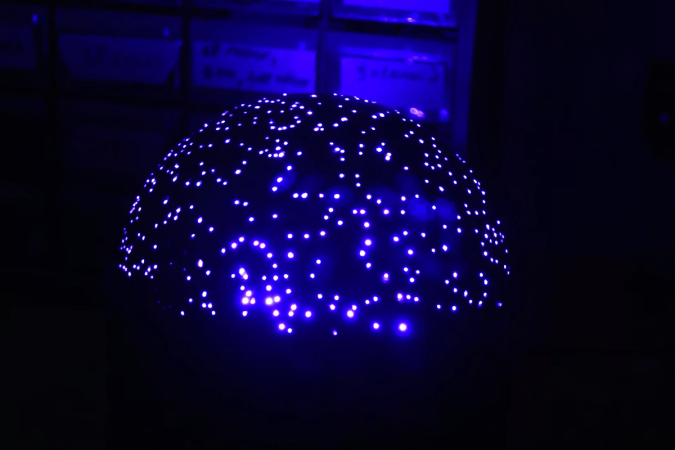
It all started with a gift idea: a star-field lamp in the form of a concrete sphere with lightpipes poking out where the stars are, lit up from the inside by LEDs. When you’re making one of these, maybe-just-maybe you’d be willing to drill a thousand holes and fit a thousand little plastic rods, but by the time you’re making a second, it’s time to build a machine to do the work for you.

So maybe we quibble with the channel name “Unnecessary Automation,” but we won’t quibble with the results. It’s a machine that orients a sphere, drills the hole, inserts the plastic wire, glues it together with a UV-curing glue, and then trims the end off. And if you like crazy machines, it’s a beauty.

The video goes through all of the design thoughts in detail, but it’s when it comes time to build the machine that the extra-clever bits emerge. For instance, [UA] used a custom 3D-printed peristaltic pump to push the glue out. Taking the disadvantage of peristaltic pumps – that they pulse – as an advantage, a custom housing was designed that dispensed the right amount between the rollers. The rolling glue dispenser mechanism tips up and back to prevent drips.

There are tons of other project-specific hacks here, from the form on the inside of the sphere that simplifies optic bundling and routing to the clever use of a razor blade as a spring. Give it a watch if you find yourself designing your own wacky machines. We think Rube Goldberg would approve. Check out this video for a more software-orientated take on fiber-optic displays.

Continue reading ““Unnecessary” Automation Of A DIY Star Lamp Build” →
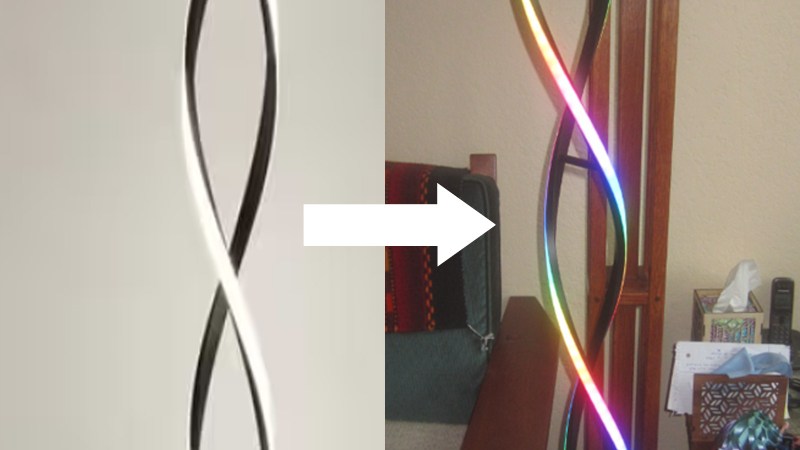
Home Depot Lamp Gets A Rainbow Upgrade

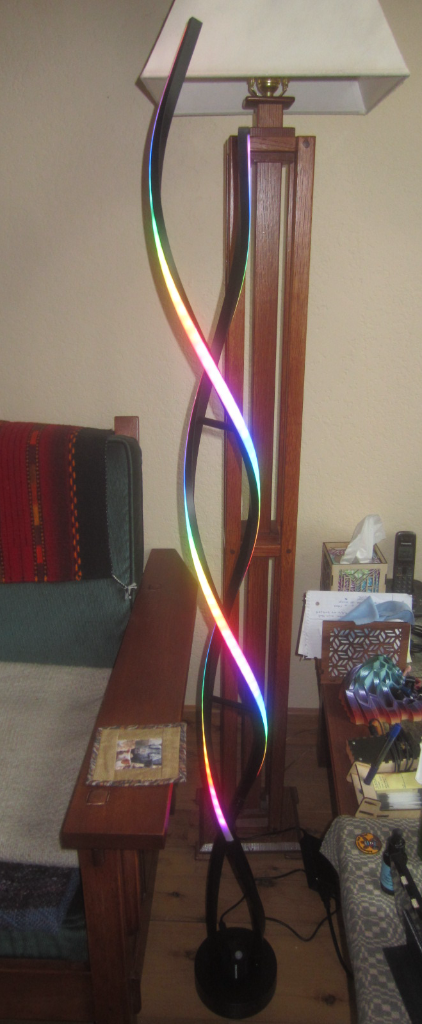
Home Depot has at times sold a neat spiral lamp that relies on LEDs to supply its soothing white glow. When [Craig Lindley] saw some modified versions on YouTube he decided he had to build one himself. The result is a charming rainbow lamp that really lights up a room (pardon the pun).

[Craig] first set about stripping the lamp of its white LED strips, replacing them with addressable WS2812B LEDs. No more would the lamp just output white light—any color in the RGB gamut was now on the table.

A powerful 10 amp 5 volt power supply was then installed to provide the necessary juice. A Wemos D1 Mini was pressed into service as the controller, which was also hooked up to an HC-SR04 infrared motion sensor. This provided the capacity to trigger the lamp when it detects someone moving nearby.

Alternatively, the lamp was given a time-activated mode as well. Either way, when activated, the lamp displays a range of colorful patterns on its elegant spirals, all with the aid of the popular FastLED library.

The final result is impressive—it looks almost stock, except it’s far more colorful and interesting to look at than the original. It’s also amusingly hard to display in our usual image formats because it’s so tall and narrow. In any case, we’ve seen some great lamp builds before, too. If you’re working on your own charming illuminations, don’t hesitate to drop us a line!

Is Fire Conductive Enough To Power A Lamp?

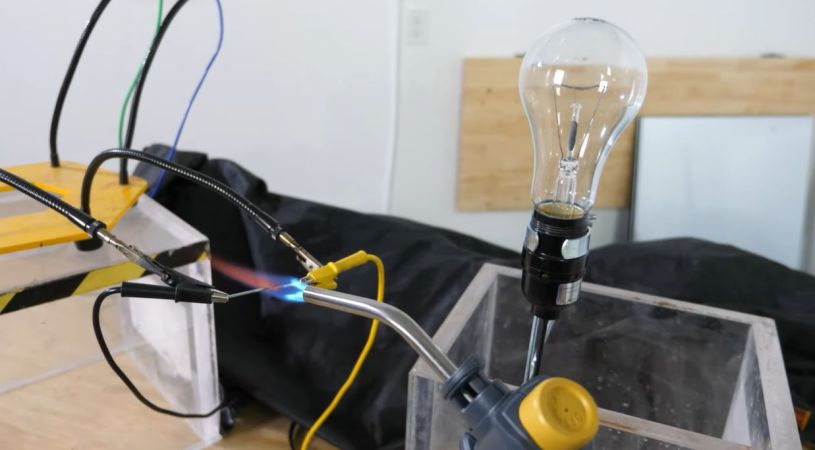
Is fire conductive? As ridiculous that may sound at first glance, from a physics perspective the rapid oxidation process we call ‘fire’ produces a lot of substances that can reduce the electrical insulating (dielectric) properties of air. Is this change enough to allow for significant current to pass? To test this, [The Action Lab] on YouTube ran some experiments after being called out on this apparent fact in the comments to an earlier video.

Ultimately what you need to make ‘fire’ conductive is to have an appreciable amount of plasma to reduce the dielectric constant, which means that you cannot just use any rapid oxidation process. In the demonstration with lights and what appears to be a (relatively clean-burning) butane torch, the current conducted is not enough to light up an incandescent or LED light bulb, but can light up a 5 mm LED. When using his arm as a de-facto sensor, it does not conduct enough current to be noticeable.

The more interesting experiment here demonstrates the difference in dielectric breakdown of air at different temperatures. As the dielectric constant for hot air is much lower than for room temperature air, even a clean burning torch is enough to register on a multimeter. Ultimately this seems to be the biggest hazard with fire around exposed (HV) electrical systems, as the ionic density of most types of fire just isn’t high enough.

To reliably strike a conductive plasma arc, you’d need something like explosive (copper) wire and a few thousand joules to pump through it.

Continue reading “Is Fire Conductive Enough To Power A Lamp?” →

DIY Probe Clamps To Ease Your PCB Work

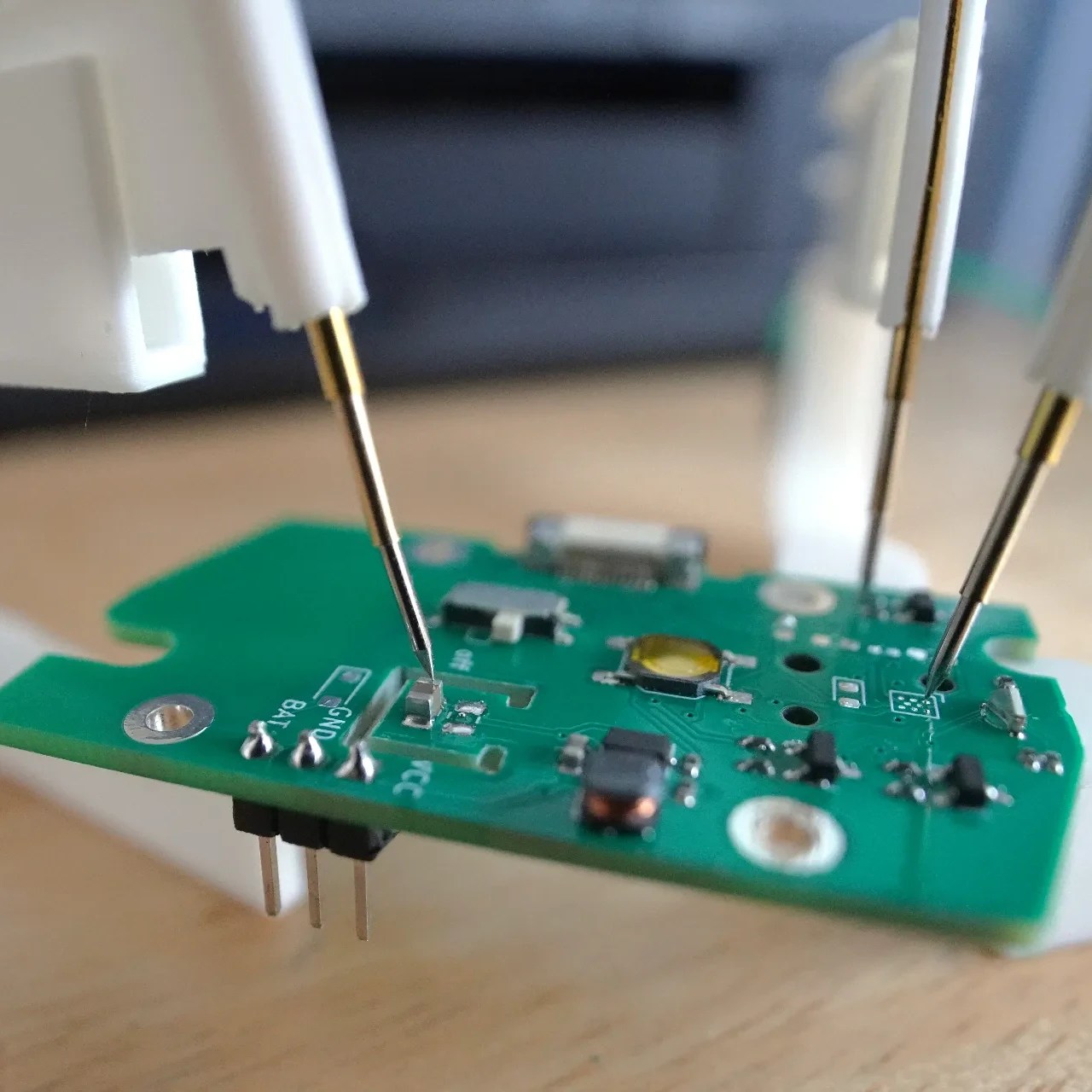
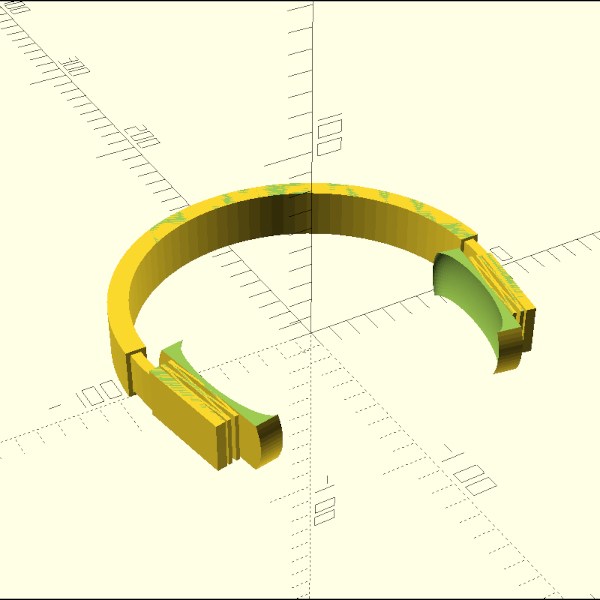
Those of us familiar with PCB work would agree that anything that helps hold probes secure and hands-free to components, traces, or test points is worth looking at. That’s where [2048bits]’ snap probe design comes in. With a little additional and inexpensive hardware, one can have all the hands-free probe clamps one’s workbench can fit!

That first link is where you’ll find a list of required hardware and the CAD files (in .step format) for the probe itself. The obvious approach to making the pieces would be to 3D print them, but we notice the design — while attractive — looks like a challenging print due to the features. We’re not the only ones to see that, and happily there’s already a remix by [user_2299476772] aimed at keeping the essential features while making them easier to print.

If you’re taking a DIY approach to PCB probes, we’d like to remind you that one of our readers discovered dental burrs make absolutely fantastic, non-slip probe tips. This seems like a good opportunity to combine two ideas, and having the CAD files for the probe clamp means modification is straightforward. Let us know on the tips line if you get something working!

[via Hackster]

Broken USB Lamp Saved With A Bit Of Woodworking

For many of us, when we think of creating a custom enclosure, our minds immediately go towards our 3D printer. A bit of time in your CAD program of choice, and in an hour (or several), you’ve got a bespoke plastic box. A hacker’s dream come true.

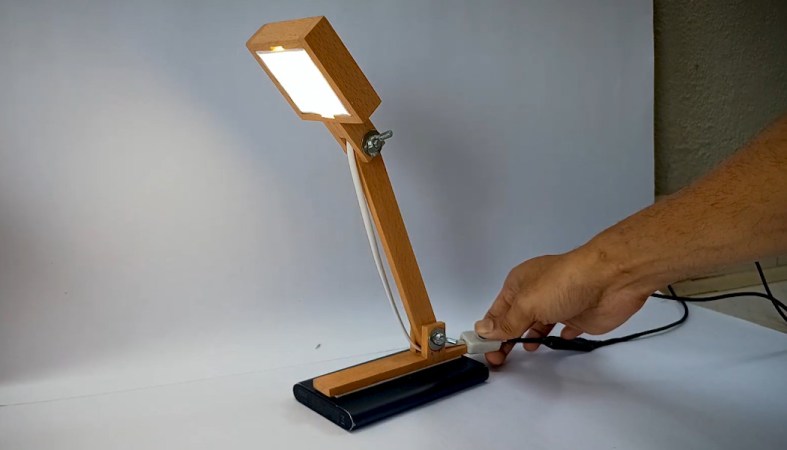
But extruded plastic is hardly perfect. For one thing, you might want a finished piece that looks a little more attractive on your desk. Which is why we appreciate this quick hack from [Tilma]. When faced with a broken LED light and minimal equipment, he decided to transplant the repaired electronics into a scratch-built wooden frame that not only looks better than the original, but is more functional.

Continue reading “Broken USB Lamp Saved With A Bit Of Woodworking” →

Small Volumetric Lamp Spins At 6000 RPM

Volumetric displays are simply cool. Throw some LEDs together, take advantage of persistence of vision, and you’ve really got something. [Nick Electronics] shows us how its done with his neat little volumetric lamp build.

The concept is simple. [Nick] built a little device to spin a little rectangular array of LEDs. A small motor in the base provides the requisite rotational motion at a speed of roughly 6000 rpm. To get power to the LEDs while they’re spinning, the build relies on wire coils for power transmission, instead of the more traditional technique of using slip rings.

The build doesn’t do anything particularly fancy—it just turns on the whole LED array and spins it. That’s why it’s a lamp, rather than any sort of special volumetric display. Still, the visual effect is nice. We’ve seen some other highly capable volumetric displays before, though. Video after the break.
Continue reading “Small Volumetric Lamp Spins At 6000 RPM” →

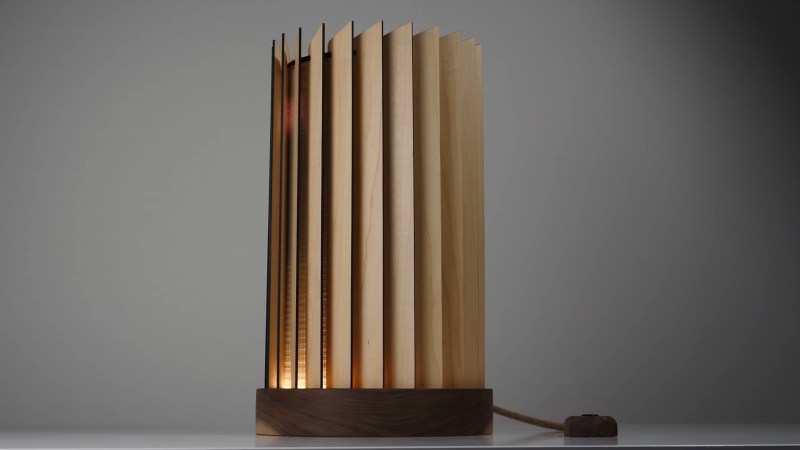
A series of wooden rectangles are arranged vertically around the edges of a dark wooden base, reminiscent of a very tall radial fan. Light glows from the base up the slots between the vanes. a cord runs from behind the dark base to a small puck of the same color. The setup sits on a light grey table in front of a light grey wall.

A Beautiful Lamp-Inspired PC Case

Sometimes you see something super cool and think of how it would be really neat if applied in a totally different context. [MXC Builds] saw an awesome lamp from [karacreates], but decided it would be better as a PC case.

We love seeing how different techniques can be used in conjunction to make something that no one method could produce on its own, and for this build, we see [MXC Builds] use 3D printing, laser cutting, CNC, sewing, soldering, and traditional woodworking techniques.

A large part of the video is spent on the CNC process for the walnut base and power button enclosure for the build. As with any project, there are a few places requiring some creative use of the tools on hand, like the walnut piece for the base being too tall for the machine’s usual z-calibration puck or any of [MXC Builds]’s bits to do in one pass, and it’s always interesting to see how other makers solve these issues.

If you’re looking for other beautiful casemods, how about a transparent PS2 or this Art Deco number? Before you go, may we bend your ear about how PC Cases are Still Stuck in the Dark Ages?

Continue reading “A Beautiful Lamp-Inspired PC Case” →