TerraPower’s Natrium: Combining A Fast Neutron Reactor With Built-In Grid Level Storage

Most new nuclear fission reactors being built today are of the light water reactor (LWR) type, which use water for neutron moderation into thermal neutrons as well as neutron capture. While straightforward and in use since the 1950s in commercial settings, they are also essentially limited to uranium (U-235) fuel. This is where fast neutron reactors are highly attractive.

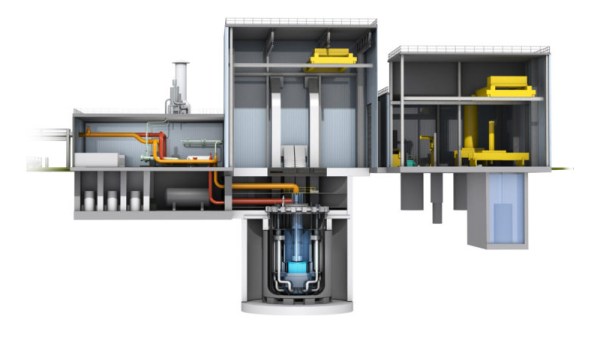
Fast neutron reactors can also fission other fissile elements, covering the full spectrum of neutron cross sections. TerraPower’s Natrium reactor is one such fast reactor, and it’s the world’s first fast reactor that not only targets commercial use, but also comes with its own grid-level storage in the form of a molten salt reservoir.

The upshot of this is that not only can these Natrium reactors use all of the spent LWR fuel in the US and elsewhere as their fuel, but they should also be highly efficient at load-following, traditionally a weak spot of thermal plants.

TerraPower and its partners are currently looking to build a demonstration plant in Wyoming, at the site of a retiring coal plant. This would be a 345 MWe (peak 500 MWe) reactor.
Continue reading “TerraPower’s Natrium: Combining A Fast Neutron Reactor With Built-In Grid Level Storage”

You Can Put Toothpaste In The Tube (With Effort)

Old wives’ tales, folk knowledge, common sayings, and even cliches and idioms are often taken as givens since they form an often unnoticed part of our vocabulary and culture. There’s so many examples that it’s possible to fill a 17-season TV show busting potential myths like these, and even then there are some that slipped by. For example, the saying “you can’t put toothpaste back in the tube” which, as it turns out, is not as impossible as we might be led to believe.

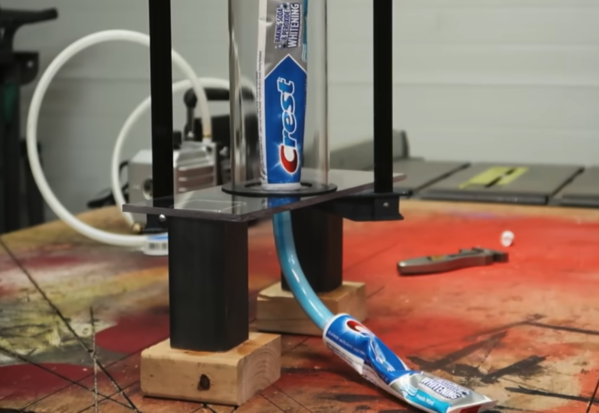
This video is the product of [Tyler Bell] who has taken this idiom on as a challenge. To figure out if it was possible he first got to work building a vacuum chamber, which turned out to be a little easier than he thought it would be. After cutting a piece of polycarbonate tube and sanding it down, all that was needed were some rubber gaskets and fittings for the vacuum pump.

From there, the theory was to put an empty toothpaste tube into the vacuum chamber, pump all of the air out, and let atmospheric pressure “push” the toothpaste back into the tube. During [Tyler]’s first run he thought that it had worked successfully but it turned out that he had just inflated the empty toothpaste tube like a balloon. Further iterations were able to return some of the toothpaste to the tube, but each time some air would eventually work its way into the toothpaste which would immediately fill the remaining space in the tube with air rather than toothpaste.

While not completely successful, he was able to get some toothpaste back into the tube with a relatively small bill of materials. It’s not likely that this experiment will result in a change of this particular idiomatic expression, but it was interesting to put it to the test nonetheless. For other instances of toothpaste and its relationship to tubes, both inside and out, be sure to check out this recent piece on various methods of toothpaste storage.

Continue reading “You Can Put Toothpaste In The Tube (With Effort)”

$10 000 Physics Wager Settles The Debate On Sailing Downwind Faster Than The Wind

By now, many of you have seen the video of [Rick Cavallaro]’s Blackbird, the controversial wind-powered land vehicle that can outrun the wind. The video has led to a high-profile $10 000 wager between [Derek Muller] aka [Veritasium] and [Alex Kusenko], a professor of physics from UCLA. [Veritasium] won the wager with the help of a scale model built by [Xyla Foxlin], and you need to watch the videos after the break for some excellent lessons in physics, engineering, and civilized debate.

After seeing [Veritasium]’s video on Blackbird, [Professor Kusenko] contacted him and said the performance claims and explanation were incorrect. After a bit of debate [Veritasium] proposed a wager on the matter, which [Professor Kusenko] accepted, and it was made official with a written agreement witnessed by [Neil deGrasse Tyson], [Bill Nye], and [Sean Carrol]. From the start, it was agreed that the entire debate would be made public.

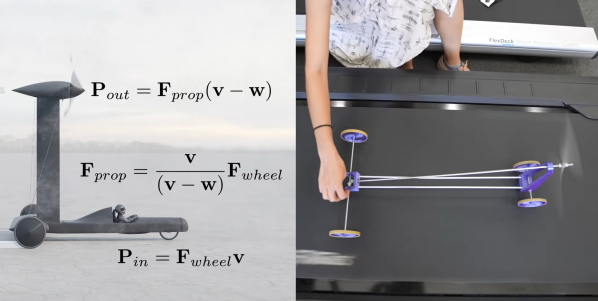
[Professor Kusenko] made a very thorough and convincing argument, backed by calculations, against the claims in the video. He claimed the observations were due to a combination of gusty winds, a vertical wind gradient. He was convinced and that the vehicle would not be able to maintain a speed higher than the wind, directly downwind. By [Veritasium]’s own admittance, his original video could have contained more details and proof of performance claims of the Blackbird vehicle. He added these to the latest video and included two model demonstrations. The model that brought the concept home for us is at 13:46 in the video, and substitutes the propeller for a large wheel being driven by a piece of lumber being bushed across it. The second model, built by [Xyla Foxlin] was designed to demonstrate the concept on a treadmill. The 4th version of [Xyla]’s model was the first to be successful after she found out from [Rick Cavallaro] that the key design detail is the Vehicle Speed Ratio, which must be 0.7 or less. It is the pitch of the propeller divided by the circumference of the driven wheel, assuming a 1:1 gear ratio. All the 3D files and details are available if you want to build your own downwind cart. Continue reading “$10 000 Physics Wager Settles The Debate On Sailing Downwind Faster Than The Wind”

Adding A Gentle Touch To Prosthetic Limbs With Somatosensory Stimulation

When Nathan Copeland suffered a car accident in 2004, damage to his spinal cord at the C5/C6 level resulted in tetraplegic paralysis. This left him initially at the age of 18 years old to consider a life without the use of his arms or legs, until he got selected in 2014 for a study at the University of Pittsburgh involving the controlling of a robotic limb using nothing but one’s mind and a BCI.

While this approach, as replicated in various other studies, works well enough for simple tasks, it comes with the major caveat that while it’s possible to control this robotic limb, there is no feedback from it. Normally when we try to for example grab an object with our hand, we are aware of the motion of our arm and hand, until the moment when our fingers touch the object which we’re reaching for.

In the case of these robotic limbs, the only form of feedback was of the visual type, where the user had to look at the arm and correct its action based on the observation of its position. Obviously this is far from ideal, which is why Nathan hadn’t just been implanted with Utah arrays that read out his motor cortex, but also arrays which connected to his somatosensory cortex.

As covered in a paper by Flesher et al. in Nature, by stimulating the somatosensory cortex, Nathan has over the past few years regained a large part of the sensation in his arm and hand back, even if they’re now a robotic limb. This raises the question of how complicated this approach is, and whether we can expect it to become a common feature of prosthetic limbs before long. Continue reading “Adding A Gentle Touch To Prosthetic Limbs With Somatosensory Stimulation”

China’s Mars Rover Goes Exploring

China’s space program has big goals and is already starting to achieve them. Recently, the China National Space Administration has landed its first rover on Mars, and begun to explore the surface of the red planet.

It’s a huge step, and something only previously achieved successfully by NASA. Let’s take a look at the Chinese project, its goals, and see how it compares to the American rovers that have also roamed so far away.

Continue reading “China’s Mars Rover Goes Exploring”

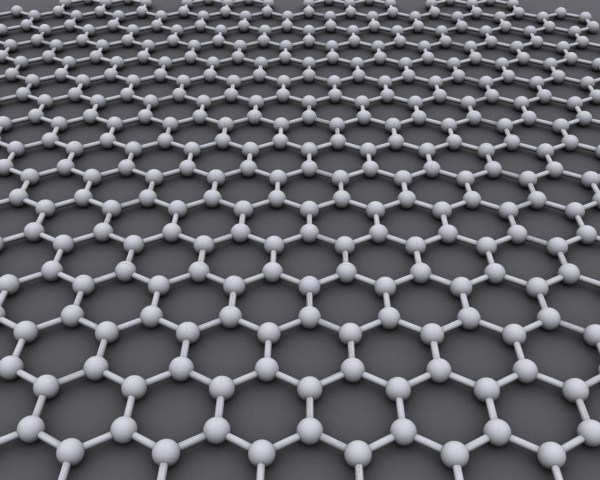
Graphene lattice

How Graphene May Enable The Next Generations Of High-Density Hard Drives

After decades of improvements to hard disk drive (HDD) technology, manufacturers are now close to taking the next big leap that will boost storage density to new levels. Using laser-assisted writes, manufacturers like Seagate are projecting 50+ TB HDDs by 2026 and 120+ TB HDDs after 2030. One part of the secret recipe is heat-assisted magnetic recording (HAMR).

One of the hurdles with implementing HAMR is finding a protective coating for the magnetic media that can handle this frequent heating while also being thinner than current coatings, so that the head can move even closer to the surface. According to a recent paper by N. Dwivedi et al. published in Nature Communications, this new protective coating may have been found in the form of sheets of graphene.

Continue reading “How Graphene May Enable The Next Generations Of High-Density Hard Drives”

Tiny Tesla Valves Etched In Glass

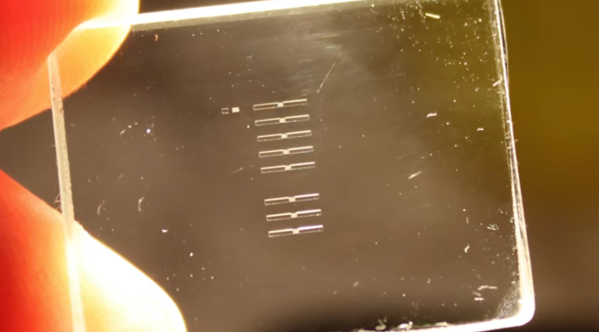
While it’s in vogue right now to name fancy new technology after Tesla, the actual inventor had plenty of his own creations that would come to bear his namesake, including Tesla coils, Tesla oscillators, Tesla turbines and even the infamous Tesla tower. One of the lesser known inventions of his is the Tesla valve, a check valve that allows flow in one direction without any moving parts, and [Huygens Optics] shows us a method of etching tiny versions of these valves into glass.

The build starts out with a fairly lengthy warning, which is standard practice when working with hydroflouric acid. The acid is needed to actually perform the etching, but it’s much more complicated than a typical etch due to the small size of the Tesla valves. He starts by mixing a buffered oxide etch, a mix of the hydroflouric acid, ammonia, and hydrochloric acid, which gives a much more even etching than any single acid alone. Similar to etching PCBs, a protective mask is needed to ensure that the etch only occurs where it’s needed. For that there are several options, each with their own benefits and downsides, but in the end [Huygens Optics] ends up with one of the smallest Tesla valves ever produced.

In fact, the valves are so small that they can only be seen with the aid of a microscope. While viewing them under the microscope he was able to test with a small drop of water to confirm that they do work as intended. And, while the valves that he is creating in this build are designed to work on liquids, [Huygens Optics] notes that the reason for making them this small was to make tiny optical components which they are known for.

Continue reading “Tiny Tesla Valves Etched In Glass”