Bluetooth Control For Your DSLR Or Just About Any Other IR Operated Device

Just the other day we were reading a Reddit thread asking about how to control a television with a smartphone. The conversation started by talking about adding an IR LED to the phone.  Then it was suggested that there should be standalone Bluetooth devices that convert commands to IR, and came around to the ideas that TV’s should ship with native Bluetooth hardware. We couldn’t agree more but we’re also not about to replace our TV just for this option. That’s why we were delighted to find this project waiting on our tip line. It’s a method of controlling a camera shutter from a smartphone using Bluetooth. But the technique will work for any device which uses an infrared remote control.

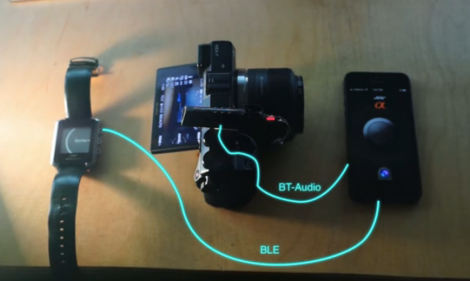
The video after the break shows two different devices controlling the camera shutter. As you can see in the diagram above, the iPhone is the master controller, connecting to a Bluetooth headset mounted on the camera. That headset was altered to feed the speaker connections into an IR LED pointed at the camera’s receiver. The iPhone plays an encoded audio track matching the IR remote command, resulting in the properly formatted message flashing on the LED. The watch doesn’t have the ability to playback audio, but it can send a message to the phone, which then plays the proper audio track through the headset.

Continue reading “Bluetooth Control For Your DSLR Or Just About Any Other IR Operated Device”

Qube Robots Use Well-designed Laser-cut Acrylic

These robot cubes, called BOXZ, use an interesting interlocking part design to mount and protect the parts within. But to really make them pop you need to color and apply your own papercraft skins.

The actual hardware is quite simple. They’ve used an Arduino, along with motor driver and Bluetooth shields, to control a set of geared DC motors. There’s a battery pack which holds four AA cells and a pair of servo motors which seem to be there to act as arms. This base can then be adorned with sensors to add functionality (line following, wall following, obstacle avoidance, etc.).

Despite the simple appearance of the cube, the chassis is the most complicated part. It uses sixteen pieces of acrylic, but they may also be hand cut from cardboard by printing out templates and gluing them onto the material. The parts are designed with interlocking tabs which we often see used on laser-cut wooden box parts.

We’ve embedded the video presentation of BOXZ after the break.

Continue reading “Qube Robots Use Well-designed Laser-cut Acrylic”

Hackaday Links: Sept 15, 2012

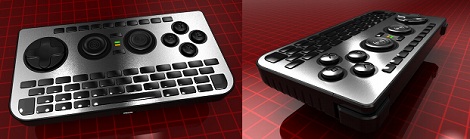
Very tiny keyboard

The idea behind the iControlPad2 is pretty simple – just take the slide-out keyboard from a phone, discard the phone part, add two analog sticks and a D-pad, and put Bluetooth in it. It makes for a very small keyboard perfect for controlling a Raspi, a home media server, or even a phone or tablet. I think it’s cool, anyway.

I mustache you a question. Where’s the Hawaiian Shirt?

At her local hackerspace, [Akki] heard someone pronouncing Raspberry Pi as, “Raspberry pee eye.” Of course this joke needed to be taken to its fullest absurdity, so [Akki] gave her Raspi a [Tom Selleck] mustache. Slightly better than the Googly Eyes Arduino shield.

Not giving a Flip about proprietary batteries

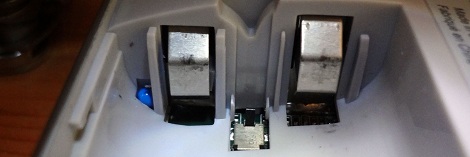
When powering a Flip video camera, [Dan] had two choices: regular AA batteries, or a proprietary battery rechargeable through the USB port. When the rechargeable battery is inserted, it closes a small switch telling the Flip it can recharge these batteries. Wanting to put his own rechargeable batteries in his camera, [Dan] closed the switch with a little bit of cardboard, thus allowing him to use his own NiMH rechargeable batteries.

Building operating systems from scratch

A while ago we posting something about a Cambridge professor putting up a tutorial for developing an operating system from scratch on the Raspberry Pi. [Joey] decided to follow these tutorials and has a blog dedicated to his adventures in OS development. It’s not a custom UNIX-inspired OS yet….

Put a quarter in, get a goldfish

[Yooder] over on Reddit spent a week turning a gumball machine into a fish tank. A very nice build that is now home to a few neon tetras. Check out the imgur album for a full build walkthrough.

RC Car Upgraded To Bluetooth Control

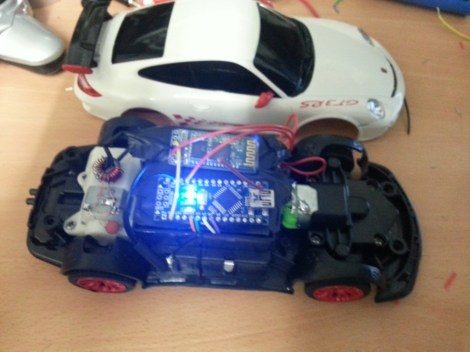
[Chet] is showing off the Bluetooth controller upgrade for this RC car. The donor vehicle is a rather inexpensive Porche which he purchased to make sure he didn’t start hacking up his more expensive toys.

He took a bit different route than the IOIO RC truck we saw earlier in the week, but the concept is basically the same. That build used an IOIO board with a USB Bluetooth dongle. This one uses an Arduino Mini with a serial Bluetooth module. He patched into the motor driver circuits on the original PCB. While he was at it he also soldered in some LEDs to use as switchable headlights.

There was one issue which he had to overcome. The current draw from the motor starting up would sometimes dip the voltage low enough to reset the Arduino. He tried using a bigger capacitor to feed the board, but in the end opted to add a boost converter.

IOIO Controller Replacement For An RC Truck

This RC truck can be controlled with the tip of your thumb or the tilt of a wrist. That’s thanks to the IOIO which was inserted in place of the toy’s original controller. [Exanko] made the hardware changes in order to use his Android phone as the controller. The white circle is a software joystick that acts as throttle when your thumb moves along the Y axis, and steering when it moves along the X axis. But while he was at it he also included accelerometer input as an alternative control option.

The IOIO board has a Bluetooth dongle connected to its USB port as a means of wireless communication. The dongle was hacked to accept an external antenna, thereby increasing the truck’s range. There is also some on-board flair like LEDs for lights and even a laser diode for… well we’re not sure what that’s for. Get a better look at the hardware internals in the clip after the break.

Continue reading “IOIO Controller Replacement For An RC Truck”

Bits And Pieces Robotic Arm

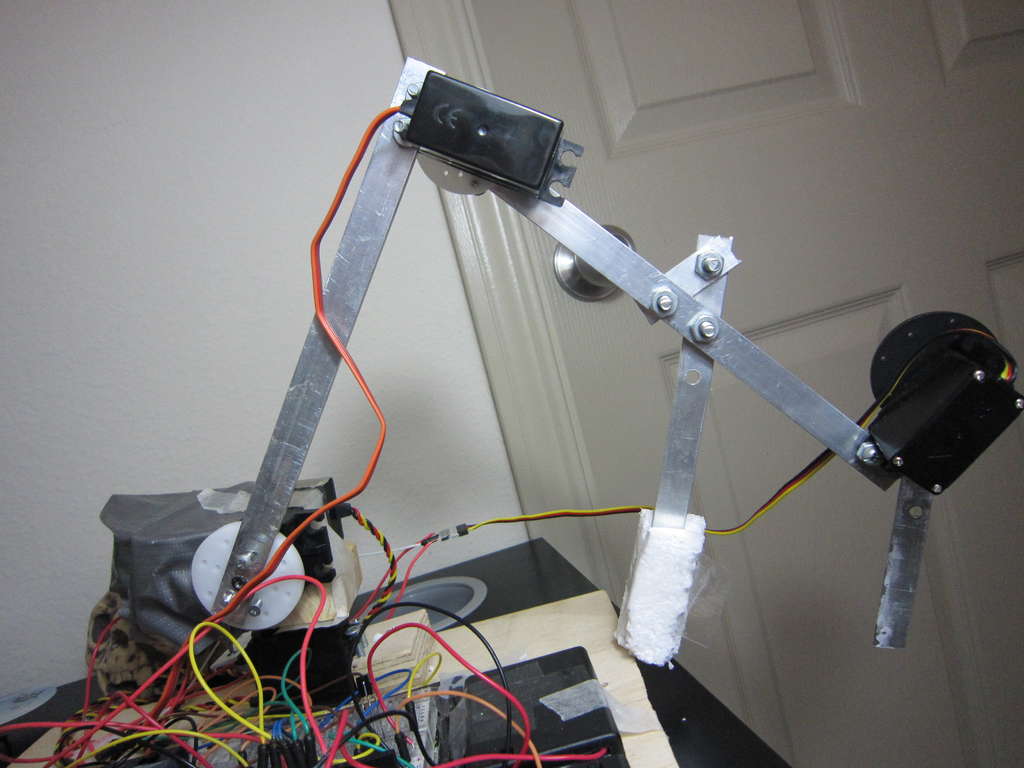
[V0R73X], who is 17  has been working on a project, to build A robotic arm. This project started out as a challenge put forward from one of his school teachers to build a robotic arm for $200.  [VoR73X] accepted, and the challenge began.

He came up with a robotic arm that can be controlled from his mobile phone and other bluetooth enabled devices. He also designed it so that he can control it from the infrared remote control of an old tv set. [VoR73X] decided to kept the design simple, to make it easy for others to build.  [VoR73X] has shared the code and a step by step process of how to build in the hopes that others would also like to take up the challenge.  Watch the video after the break for further details on his project.

via[Instructables]

Continue reading “Bits And Pieces Robotic Arm”

Wireless Stereo Add-on Turns On Receiver And Pipes In Some Music

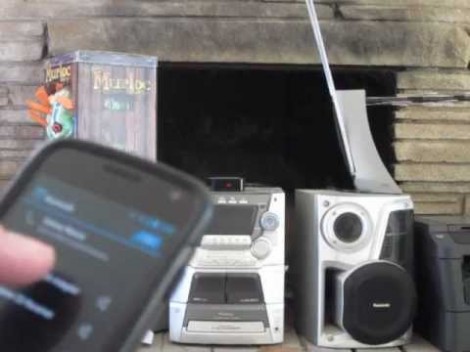
[PC486] wanted to add Bluetooth to a simple shelf stereo system. But if you’re going to go wireless, why not develop an all-in-one solution. His adapter turns on the stereo and feeds it audio all from a smart phone.

This is his roommate’s hardware so cracking it open and grabbing an iron wasn’t really an option. He needed a way to control the system without any permanent alterations. Since the unit has IR remote control capabilities that’s the most obvious way to go. But the original remote is long gone so he had to hit the Internet. Luckily the remote control codes are in the LIRC repository. He grabbed a small microcontroller, an ATtiny25, and wired up an IR led to send commands to the unit.

Next he examined the Bluetooth audio receiver board he planned to used in the project. It’s got an LED that lights up when connected to another Bluetooth device. The microcontroller knows when to turn the stereo on and when to shut it off again by monitoring that LED with a pin interrupt. Check out the final results in the clip after the break.

Continue reading “Wireless Stereo Add-on Turns On Receiver And Pipes In Some Music”