Electronic Diaper Bag Reminds You To Pack Everything But The Baby

lilypad_diaperbag

[jnorby] knows what it’s like to leave the house with her baby in tow, only to realize that she has left something she needs at home. Instead of relying on a paper checklist, she decided to craft her own diaper bag that alerted her if she had forgotten to pack a particular item.

She built her bag from scratch, wiring small circuits into each of the pockets she created on the inside of the bag. Wires were run to each half of a snap fastener, so that they would complete the circuit when the snaps touch. The LEDs and snaps were then connected to a LilyPad Arduino, which checks the status of the snap circuits, lighting the appropriate LED once the proper item has been packed.

While we like the idea of a bag that uses functional indicators that remind you to pack items, we do think that the use of the Arduino, or any microprocessor for that matter, is massive overkill. We would ditch the LilyPad and snap fasteners for reed switches or perhaps normally closed micro leaf switches that turn the LEDs off once the proper item has been packed, rather than the other way around.

NBA Hangtime Pinball Display

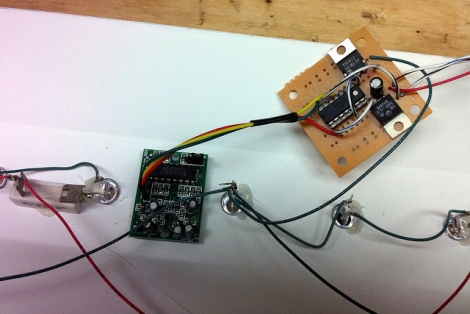
[Ed Zarick] continues work on his NBA Hangtime pinball machine with the completion of the scoreboard and backglass. You should remember this project as we already covered the layer audio he developed for the system. Now he’s proving to be a protoboard master, using point-to-point techniques to build a pair of two and a half digit LED displays for team scores, as well as a shot clock timer and other status indicators.

The lighting board that controls it all is commanded via the i2c protocol, just like the three audio modules. It uses shift registers along with MOSFETs and [Ed] has taken the time to add pin headers and sockets for board interconnects. As is true with the audio system, one Arduino Mega acts as the master on the i2c bus and you’ll notice in the video after the break that the display works in perfect harmony with the sound effects.

We can’t wait to see what he comes up with for the play field!

Continue reading “NBA Hangtime Pinball Display”

ASync-Firefly

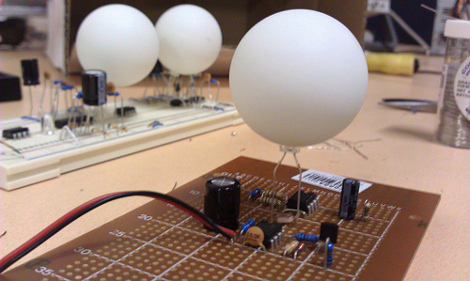
[dev_dsp] wanted to try his hand at creating a purely analog implementation of multiple synchronizing fireflies powered by a single battery and built from off-the shelf, through-hole components on inexpensive protoboard. In theory, even your local Radio Shack should still carry all of this stuff. He was obviously inspired by [alex]’s fireflies that we’ve covered in the past, but he wanted to see how far it could be taken without the use of a microprocessor.

In the end, [dev_dsp] relied on one crucial piece of digital ware, the ever-popular 555 timer IC, but he’s using analog discrete components to do the grunt work of adjusting the phase of each firefly by feeding a little extra current to the trigger capacitor whenever the flash of a nearby firefly is detected. After the jump, you’ll find schematics and a video demo of three ASync-Firefly modules in various stages of assembly playing with one another while [dev_dsp] discusses their operation.

Water Droplet Sculpture Using LEDs And Arduino

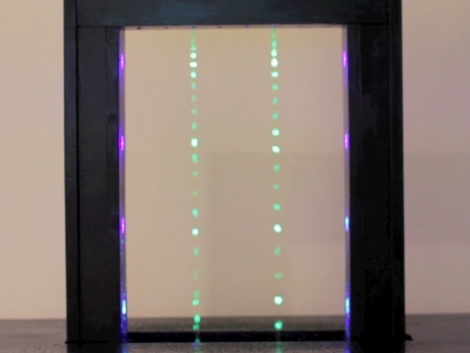
This water sculpture can stop drops of water in mid-air. This is accomplished by flashing LEDs to illuminate the droplets at just the right time. But it’s not limited to blinky lights alone. The top of the frame has eight nozzles, each fed by its own pump. An Arduino controls the pumps and the lights making it possible to create different motion effects by adjusting how events line up. For instance, the image above shows just two of the water nozzles on, but in the video after the break it appears one is dripping downward while the other is dripping upward.

Alas, there’s few build details for this but the source code is available for downloading. If we were going to build one of these ourselves we’d probably try to regulate the drips using some solenoids built from scratch. How would you do it? Leave your ideas in the comments.

Continue reading “Water Droplet Sculpture Using LEDs And Arduino”

DIY Flower Bouquet Guaranteed To Get You Dumped On Valentine’s Day

led_flower_bunch

[Erik] is a broke engineer.

When this past Valentine’s day rolled around he didn’t have any cash to buy a gift for his girlfriend, so he had to get creative. Every girl likes flowers, but unless he was going to give his lady some day old daises from the grocery dumpster, he would have to make them himself.

He started by bundling together and bending some T-shirt hangers into stems. He then wrapped them in the green & green/white wire pairs from some Cat-5 cable to give them some color. An old keyboard was sacrificed to create the flower petals and leaves, which were presumably colored with markers before being glued to the end of the hangers. He added a reed switch to the flower pot, which illuminates the LEDs he installed under the petals when a magnet-bearing cardboard placard reading “Love Erik” was placed near it.

How did his girlfriend like them?  Well, let’s just say she’s no longer in the picture. He didn’t tell us if the bouquet was the reason, only that she’s gone. (though we happen to think it’s pretty cool).


Keep reading to see a quick video demonstration of the light-up bouquet.

Continue reading “DIY Flower Bouquet Guaranteed To Get You Dumped On Valentine’s Day”

Sound-sensitive Android Figure Speaks In Morse Code

mechanized_android_figure

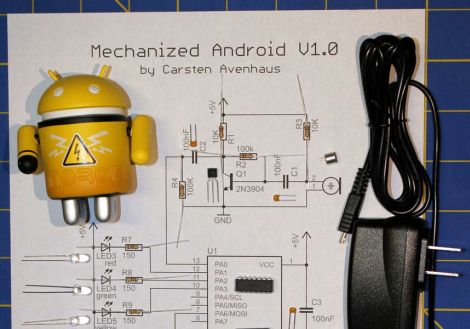
Instructables user [tanbata] recently got his hands on a Google Anroid figurine and thought that while it looked great, it served no real purpose. He decided to change that, and converted this once-useless hunk of plastic into a miniature robot that moves and responds to sound.

He pried of the head of the figure and got busy fitting a servo into the Android’s body to enable head movement. An ATiny was added to control the figure, along with a microphone to enable it to respond to sound. A piezo was inserted to relay Morse code messages, and a handful of LEDs were installed in the body cavity and eyes of the figure just for kicks.

When the bot is powered on and senses a loud enough sound, the eyes light, the head spins from side to side, and the robot spouts off a random message in Morse code as you can see in the video below.

It’s not the most advanced project out there, but with a few tweaks, it could make for a great USB-powered email or IM notification system for your PC. Better yet, it’s a great project to do with a child who is interested in electronics, since they get to make a cool robot toy they can keep.

Continue reading “Sound-sensitive Android Figure Speaks In Morse Code”

Shedding Some Light On Your Kitchen Chores

led_light_bar

[Garret] over at Macetech wanted to supplement the lighting over his kitchen sink, which is always too dark at night. He says his house is a “geek house”, so a standard light socket just wouldn’t do – he would have to construct a LED bar for over the sink instead.

Since nobody wants to use a light switch with wet or messy hands, he did what anyone would do and rigged up a motion detection circuit to automatically turn the lights on and off for him. 16 bright white 10mm LEDs were mounted in some foam core board, along with a PIR motion sensor. He used an ATiny84 to handle the PWM fade-in and fade-out of the lights, as well as to keep track of the activity (or lack thereof) at the sink.

He does admit that the ATiny84 is way overpowered for this project, but he lacked anything smaller, and says that 555 timers wouldn’t give him the smooth light fading that he desired. Regardless, it works as advertised, and now nobody has to peel potatoes in the dark any more.

Continue reading to check out a quick video demo of the motion-sensing light system.

Continue reading “Shedding Some Light On Your Kitchen Chores”