
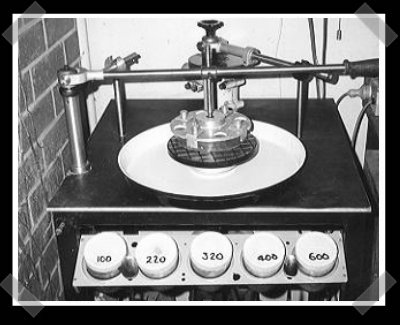
The true test of the amateur astronomer is building their own telescope. Grinding and polishing your own mirrors is a long, arduous process. Instead of lapping the blank by hand, Laurie Hall built this mirror grinding machine from scratch. His site has notes covering his mirror creation machines and other projects.


6 thoughts on “Mirror Grinding Machine”
Leave a Reply
Please be kind and respectful to help make the comments section excellent. (Comment Policy)










when i used to manufacture optics we did the same sort of thing but upside down. The mirror was attached to the plate the spindle rotated in, and swept across a large, thick, rotating steel plate that the liquid abrasive was dripped onto. No stabilizer arm was needed but to do a good polish the big turntable/plate absolutely had to be thick and flat so it didnt flex.
That and the whole thing sat in a tub so the abrasive slinging off didnt make a mess all over.
Saw something like this when I was a little guy in 1959.
An old record player/changer was used to turn the mirror blank and the arm that stabilized the next records to drop had a cam in it to give a secondry side/ side movement.
Solid concept, but there is a reason telescope mirrors are made by hand — machines are too regular, whereas humans are random and flawed. the problem with a machine is that it develops patterns which can induce surface irregularities. the random error and deviation of a hand-polished surface averages out to a near-perfect surface. this is, of course on a near-undetectable scale, but when it comes to fine optics, even nanometers of surface deviation can mean the difference in a focused star and a blob of light. Mirror surfaces are often graded in f/# numbers, corresponding to fractions of a wavelength of light. An average commercial mirror might be f/4 or 1/4 wavelength surface deviation, whereas a very high-end morrir might be between f/10 and f/20. Hubble used to be f/2 back when it was broken, but it is now f/50-ish. Most modern mirrors (from Celestron or Meade, for example) are machine surfaced and ground, but finished and tunes by hand. This machine is prettymuch ideal for roughing aout a surface, but a hand-polish at the end would be crucial to obtain that last bit of perfection. Still, it beats the hell out of hand-grinding an entire surface from the glass blank.
#3 “are mirror machines that useful” – much more useful than making your own lenses!
Utter cock about f/4 etc. What you mean is lambda/4 where lambda is the wavelength of light used for measuring the surface departure from a parabola. lambda/20 is considered very good. lambda/4 is passable. F/4 means the focal length of the mirror is four times the diameter – just like on any camera.
PS I have a mirror-o-matic grinding machine, they can be just as random as a human and don’t need to give a patterened surface. Its all in the tools and who uses them.
Looks like it has potential for those doing a lot of heatsink lapping.