
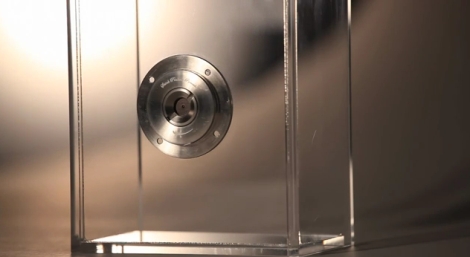
Once again it’s time for you, the sharp-eyed readers of Hack a Day, to decide whether the following video demonstrates technology at its finest, or if it is complete hogwash. This edition of Real or Fake? is brought to us by Hack a Day reader [Wizzard] who sent us a link to “The Invisible Camera”
Watch the video embedded below to see the unveiling of this camera as well as a discussion of its new, revolutionary technology by its creator – photographer Chris Marquardt. The camera is composed of a simple, non-moving lens mounted in a completely transparent box made of specially polarized glass. This glass is supposed to align the ambient lighting, which amplifies the energy coming through the lens, in order to expose the special film they created for the camera.
The film was developed using standard film “combined with innovations in chemistry” to produce ultra-low sensitivity image media, which the creators are calling “Directionally Desensitized” film. This film can be handled in full light, as it is only sensitive to the high-energy light directed on its surface by the aforementioned lens. It is claimed that due to this special film, the camera goes beyond the Megapixel, past the Gigapixel, and captures images in Terapixels.
Now, call us skeptical, but isn’t it a bit early for April Fools jokes? We just can’t imagine any scenario where holding a piece of film in the sun as shown in the video would not cause it to be exposed in at least some areas due to the massive amounts of reflected light in the environment.
What’s your take?
[youtube=http://www.youtube.com/watch?v=rWU3-gA3ueo&w=470]











Fake – no filter is 100% effective and even the slightest leakage would lead to overexposure over time.
Ummm… You should post this on April 1st along side the perpetual motion from an Arduino posts…
Complete Fake
Jules
The glass does not look polarized at all… My best guess is that it is a great hoax to see and hope it is real :-)
I couldn’t hear it very well because of the voice over, but I’m fairly certain that the dutch gentleman in the clip from 3:05 till 3:30 is not talking about “Directionally desensitized” film.
Also, if there was any real science to this, wouldn’t they be referring to it as “Hyper-polarized”?
I call BS.
could this be anymore obviously fake.
But if it is real (but it isn’t)
then i still would not buy it
srsly… a glass camera. WTF
if i drop my cheap digital camera and a bit of plastic comes off… eh so what
if i drop this camera…. it’s gona take me a long time to pick up all the little glass peices.
and what if I scratch it… won’t that change the picture.
I believe this is fake.
The clincher for me was the interview with the film designer. He was talking about chemical composition. And then moved to the subject of light angles. While talking about light angles he is “modeling” a chemical. But when people are speaking of abstract things such as light angles, they typically use hand gestures representing it. In other scenes, the camera “inventor” does just that.
@eldorel
they are not dutch, but german.
and its not true.. Its bull$ Made clear at 3:20
I Spy acrylic or poly-carb. Not polarized glass as in the video’s narrative. I vote fake.
Another thing is that the frame is polarized to prevent accidental exposure, but you can supposedly hold it in full sun without exposure. Then, why is the camera box polarized?
I could imagine a film that could only be exposed by laser in a specific light frequency after a long exposure period ( even that left in the sun long enough would begin to expose), but that isn’t what he’s claiming.
I say fake.
The camera is fake. Even if you make the film sensible to light coming from only a narrow angle, there will be radiation in the ambient scattered light coming from that angle. And ISO 1500? That would take fractions of seconds to expose.
Not to mention the pinhole…and so many pixels? Ya right.
If the case were to polarize light, it would also attenuate a lot, and not allow it to be so transparent.
Fake. Good production effort on the video, but still quite fake.
The film only exposes from a specific angle of light? That would make film alignment with the pinhole EXTREMELY difficult.
Allright hackaday, enough with the bull feces,
I’d rather read another arduino with a button post
then the complete content of the sci fi channel.
Bullshit.
For example, if you go to 3:10 you see this guy talking about “Directionally Desensitized” film. However, this guy, Michael Weyl, is well known in the the photographic community in Germany: He runs an internet shop for analogue photo supplies. The bottle with the super secret breakthrough chemistry he holds in the movie (marked “M..T..”) can be ordered here:
http://www.spuersinn-shop.de/index.php?page=product&info=366
It’s part of the “MixTour” film development kit (you can mix your own developer with that).
http://www.tipsfromthetopfloor.com/2011/03/22/tfttf506-special-the-invisible-camera-q-and-a/
listen to him explaining it, his voice seems stressed when he speaks about the existence of it.
I’m no expert, but I’ll happily agree that this is fake. Steve is right. No polarized filter is 100% effective. In addition, I have a hard time believing that the chemical emulsion on the film could be perfectly effective at filtering environmental light out of the image.
In addition, to get a “terapixel” image, his “9 x 12 cm” film would need to display items measuring less than 1.04E-7 meters across. Conventional optical microscopy can only resolve objects down to about 1E-6 meters. Note that this also assumes that the lens is perfect: every ray of light goes exactly where it is supposed to go, without diffraction.
I suggest that everyone apply to be field testers. The proof is in the pudding (or not, as I suspect is the case.)
Here’s an obvious question: if “ambient light” is being “amplified” why can’t we see it? I.e. why isn’t the back of the camera emitting the visible light that’s allegedly being measured by the meter?
Pretty sure the First Law of Thermodynamics would have a say in all this business.
The techno-babble is also a dead giveaway. Comments on the YT page point out lots more “plot holes”.
Popular Science covered a gigapixel camera once. The film was from a spy satellite and was measured in feet.
Anyone have calculations about the size of a pixel for a one terapixel camera?
On top of this, is it possible to amplify such a broad range of wavelengths? I’m no physics guy, so I could be off-base.
And I would be surprised if a photographer would routinely handle his film in daylight, given that it would “wear away” the exposure. And all it would take is one flash in some good sun light and BAM film ruined. (Sun light is effectively one direction, remember.)
“Bullet proof”? Really? No way.
Well maybe my english is not good enough for this but doesn’t invisible mean that i can’t see it? Obviously i can.
What I don’t get is why they describe the resolution in pixels. Since this is not a digital device there are no pixels.
Also, Michal Weyl seems to talk about “ungerichtete Lichtstrahlen” (undirected beams of light) – in sync with what the english speaker says – So he’s probably in the joke :-)
this is lame
this is not a hack
–> go start realorfakeaday.com
are you posting anything anyone sends you at this point?
blatantly fake for many reasons. here are a few:
since when is analog film resolution rated in pixels?
if you lay two pieces of polarized glass on top of one another you cant see through it (the transparency is dependent on how the polarization of the glass lines up) — it wouldn’t be clear at all angles if arranged in a box. that thing is plastic.
that “film” he is using is just regular film that has been exposed to light. that’s what color film turns if you don’t process it and leave it in the light. you can even see the notches cut into the side used to identify what type of film you are loading in the darkroom — you feel the notch pattern with your finger.
and there’s the fact that… ahh forget it…
Someone call the waaambulance because this is not a “real” hack. Sure as heck looks “hack-y” to me.
No different from the other real or fake crap posted before. If it is too good to be true it likely is.
What fool moves a camera AFTER opening the exposure shutter? The guy does not even know how to use a camera!
Fake.
Fake.
First clue: at 2:31 they are holding a light meter in the camera, but I’m pretty sure this kind of light meter has the sensor at the top, not on the front.
Next, they don’t show any pictures made by the camera in the video (let alone prove convincingly that they are actually made with the camera).
Next, they are talking about desensitizing the photo chemicals. This makes no sense to me; didn’t early cameras need to have their shutter open much longer because the film was a lot less sensitive than today? It should be very easy to produce low-sensitivity film, you just make it not as good as you normally would.
Finally, the whole point of manufacturers making the film more sensitive (besides making it possible to use short shutter times) is higher resolution. Making the film less sensitive would only DECREASE resolution, not increase it, and definitely not increase it by a claimed factor of 1000 (gigapixel->terapixel) or more.
Furthermore, theorizing: Let’s say you want to make a transparent camera with a pinhole for a lens. What would it take? You would have to block the light from reaching the film. Yes, polarization filters (basically transparent films with microscopic straight lines of light blocking material) come to mind. Any high school student should know that if you use two polarization filters at a 90 degree angle it blocks the light from going through. I can’t see how you would improve on that.
So they put polarization filters on the walls of the camera I guess. But then what? The light still comes from all directions so even if you put another polarization filter right on the film, it’s never going to align with all (any?) the polarization filters on the camera walls. And it wouldn’t keep the film from being exposed when it’s outside the camera because the light isn’t blocked unless there are two filters: one on the camera walls and one on the film.
The only way I can think of that this might work is to construct some filter that consists of microscopic light pipes that let light through from a certain direction and block it from all other directions, like a bundle of glass fiber cables. But then you would have to align each of the light pipes to point to the lens/pinhole. In a camera that’s the size of the one shown in the video, the angles of the light pipes would vary wildly and it would be impossible to make such a thing at a scale so small that you can’t see it in the video.
I would think you’d get better results by using the light pipes themselves as tiny little pinhole cameras: just put some photo paper behind a bundle of glass fiber. No need for a lens or pinhole in front of it. You would still need a shutter, though, and it would have to be as big as the paper, so it would not be very practical…
Clearly that’s not what they did.
Busted.
Seriously,
My Bullshit-o-meter (TM) reading is off the scale here.
A Glass camera? INVISIBLE film (ie: film that lets light pass through…)?
Pull the other one.
Fake!
What is the fascination with creating these elaborate fake videos? What are they hoping to accomplish with it all? Just harvesting email addresses?
The pinhole implies that every point on the film’s directionally-sensitive surface must be perfectly aligned with the cone of light rays coming in from the pinhole. This seems a bit far-fetched.
If the camera body were indeed of polarized material, why can we see clearly see through multiple layers of the material, regardless of the angle to the video camera recording the scene? That’s not consistent with a polarized material.
Why would ambient light from random angles “amplify” light entering the lens? Does it suddenly change direction? Nope, it would simply cross any light entering the lens.
IF YOU CAN SEE THE PLATE IN THE BACK LIGHT HAS HIT IT AND BOUNCED BACK!
so in short the invisible camera cant work
its another fake and honestly im tired of these fake things
@Matt: Though unorthodox, he is converting the relative light exposure concentration vs. surface area of developed exposure. Its a relative conversion, though still inaccurate. He also mentions “D-mk.II” as a light rating, but I’ve never heard of that measurement before. Could be real, but I find it oddly coincidental that Canon makes a line of cameras called the “D Mark 2”.
1. If the housing is so special for polarizing light to “amplify” the light, you’d want to keep it immaculately clean. Video at 5:24 shows more fingerprints on it than the touchscreen of my phone.
2. I agree to hearing the film chemist clearly speaking German when they say he is Polish.
3. How can you begin to say “directionally desensitized” for a film that will only expose given a specific light angle? Polarizing doesn’t bend light, it filters light so only waves “vibrating” on a certain axis can pass. There’s no way to amplify light this way, only SUBTRACT that which isn’t oriented the correct way. Its like putting a comment card in a sealed suggestion box: you have to line the paper up with the hole for it to fit through or it won’t go in.
4. On a further note, you can’t take the same light you already have and make it more intense without focusing it; this is why lenses were invented. Ignoring that a polarizing filter would actually FILTER OUT useful light, its not going to change the angle of refraction to more greatly expose the film.
5. He didn’t say anything about the pin-hole being polarized or including this special glass, just the box. So, essentially its just a trace amount of light that’s still getting through to form the image anyway.
6. If ambient light coming from the sides of the box are expected to amplify the total image, it would be light that was reflected off of other surfaces; this would mean that, even if it were possible with the given structure, the image would be exposing itself to other images over the pinhole’s intended image.
7. Pics or GTFO. Didn’t see a single example of a photo taken by the camera in-question.
8. “…in broad daylight with no effect whatsoever…” Seriously? You mean you developed a “directionally sensitive” film that WON’T react to the daylight that also happens to include every possible angle of light? Does it just ignore those supposed angles that are correct until the magic glass is in front of it?
Sorry, but IMHO: Myth busted!
They’re trying to rick-roll people. Just like the 3D eye-lid video. It get’s them advertising money on youtube and their website. Bullet-proof plexiglass! Ha!
I say 100% real. That is an invisible camera…that also produces invisible pictures, and will make the inventor invisible billions.
Where is this additional energy coming from? The light is supposedly “amplified” by the glass box, but where is the energy coming from to allow that to happen?
And for that matter, your choices for increasing the exposure on a piece of film are (1) higher number of photons (brighter light) or (2) higher energy photons (shorter wavelength). So if this box is working the way they say it does, you could stick your head in it and either see way brighter light than the outside ambient light level (what?) or you’d get a blast of gamma rays in your face.
A true scientist doesn’t just reject claims of new science because they don’t align with the existing models, but these should really publish some instructions for duplicating the process if they aren’t just making it all up. I’m pretty skeptical.
Hehe it’s not a fake it’s only an ART :)
BS meter offscale positive.
Bob is dead on, haha.
Mrshko is the most correct though. by simply watching these videos you’re giving the hoaxers money. It’s a shame that hoaxes are so easy nowadays and so easily distributed. loads of people will see it and, through the magic of the internet, give the creator of the hoax real life money within a few days if done with a little thought.
even the intelligent discussion here on disproving them is perpetuating why hoaxes are a reasonable advertising model and worse, a veritable ‘get-rich-quick’ scheme.
I gotta get me one of these! Then again, i just fell off of the cabbage truck too.
I’ll check the “Plausible” box.
What if it’s like this:
1) Made of plastic that blocks Infrared light.
2) Uses film sensitive to IR.
3) Uses a pinhole lens which will pass IR light.
Now, the scene showing the film in sunlight would be just wrong, but loading film into a holder in the dark, placing it into the camera and then removing the shield, exposing for a long time, putting the shield back on, removing the film pack and developing in an area with not much IR light seems plausible.
And look at these IR images. They look similar to the ones on the site.
http://en.wikipedia.org/wiki/File:Nikau-IR.jpg
http://en.wikipedia.org/wiki/File:SD10_IR_Bending_Tree.jpg
Now, all the buzzword bingo, that’s another matter.
I say Plausible.
I fail to see how the hoax = real life money. It just makes the guy look like an a-hole with too much time on his hands, imo.
@macw
it uses a common method used by many inventors called “lying”
this is also a common method used by politicians of amplifying political standing XP
This sound like an study of how many morons will send him an email asking for one of those cameras…
hashah so fake.
This camera is ABSOLUTELY real. Unfortunately it can only photograph functioning free-energy devices and perpetual motion machines.
A slow film would create blurry images. If the camera amplifies the light it would have to have a shutter.
That outer metal ring looks like the central hub from a hard disk motor.
F.A.K.E.
This is BS.
First, the film is BS, if as described, it would still develop in broad sunlight, because the ambient light has light of all polarities.
Second, the case is not polarized because as described bnecause the edges or faces would darken and lighten as the viewing angle changes.
Third, nothing that thin is bullet proof.
Fourth, when you are dealing with film, there NO pixels. The resolution depends on the films grain size.
The best image that this camera would make with any film would be a complete exposure, ie: a black image.
Kryoclasm
hey common, photons dont collide, so theres no chance he can use ambient light to amplify what so ever….
I call BS on this one.