Robotic bird flaps away last bits of privacy

posted Mar 30th 2011 4:03am by
filed under: robots hacks

This really gives a lifelike look to the eye in the sky. In case you were worried that every part of your life wasn’t being recorded by a surveillance camera, the Festo Bionic Learning Network has come up with a drone that will be hard to discern from the wildlife.

Watch the video after the break. We’re not 100% certain that it’s not fake, but it looks real enough (the mark of a truly amazing design). You’ll see the robo-bird flapping away both from a fixed point on the ground, and from a camera view behind the head of the device. It propels itself both by flapping and rotating the wings and is capable of taking off, flying, and landing autonomously.

It’s bigger than the hummingbird drone that was developed for DARPA, but we think that it sticks out less when caught at a glance. No word on the intended use for the device, but we’re sure that some of you are enjoying the nostalgia of the mechanical owl from Clash of the Titans, and that’s why we want one.

Read the rest of this entry »

Terapixel images and see-through cameras: Real or Fake?

posted Mar 22nd 2011 9:45am by
filed under: news

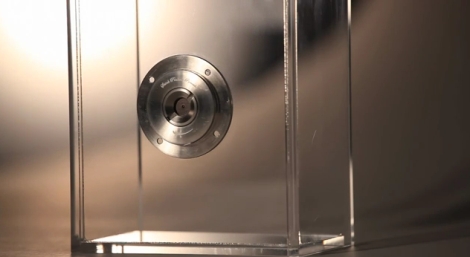
invisible_camera_lol

Once again it’s time for you, the sharp-eyed readers of Hack a Day, to decide whether the following video demonstrates technology at its finest, or if it is complete hogwash. This edition of Real or Fake? is brought to us by Hack a Day reader [Wizzard] who sent us a link to “The Invisible Camera

Watch the video embedded below to see the unveiling of this camera as well as a discussion of its new, revolutionary technology by its creator – photographer Chris Marquardt. The camera is composed of a simple, non-moving lens mounted in a completely transparent box made of specially polarized glass. This glass is supposed to align the ambient lighting, which amplifies the energy coming through the lens, in order to expose the special film they created for the camera.

The film was developed using standard film “combined with innovations in chemistry” to produce ultra-low sensitivity image media, which the creators are calling “Directionally Desensitized” film. This film can be handled in full light, as it is only sensitive to the high-energy light directed on its surface by the aforementioned lens. It is claimed that due to this special film, the camera goes beyond the Megapixel, past the Gigapixel, and captures images in Terapixels.

Now, call us skeptical, but isn’t it a bit early for April Fools jokes? We just can’t imagine any scenario where holding a piece of film in the sun as shown in the video would not cause it to be exposed in at least some areas due to the massive amounts of reflected light in the environment.

What’s your take?

Read the rest of this entry »


Commandeering public video screens: real or fake?

posted Mar 14th 2011 11:00am by
filed under: video hacks

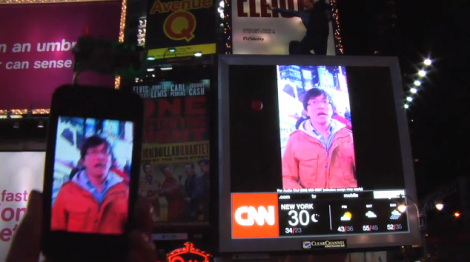
It’s time for everyone’s favorite comment thread game: Real or Fake? This week’s edition comes in from a tip that [Phil] sent about a way to take over video screens in Times Square. Watch the video after the break to see the hackers using a two-part solution to rebroadcast video from an iPhone onto a screen in the busy urban setting. The first part is a transmitter that plugs into the iPhone, the second is a signal repeater that, when held close to a video screen, overrides the clip currently being displayed with the video from the handheld. The image above shows the repeater being floated up to the big screen using a giant red balloon which you can make out in the black bar to the left of the replayed video.

Our first thought is that someone just watched Tron: Legacy and wanted to have a little Sci-Fi fun with the Internets. We can’t imagine a hardware solution that would actually make this work, but please do share your thoughts about that in the comments. We’d suspect this is more of a video hack that uses After Effects, similar to how the stopped motion candle video of the eyelid shutter glasses videos were faked. But apparently there is a follow-up video on the way that will show how the prototype was made so we could be wrong.

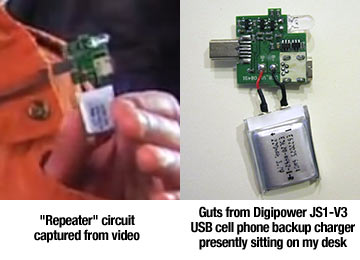
update: [Phil Burgess] points out that the “repeater” looks awfully familiar.

Fake for a variety of already-stated reasons (e.g. video out the headphone jack?). But the smoking gun, watching the 720P video on YouTube, is that I plainly recognize the hardware they’re using as the “repeater”: it’s simply the internals from a Digipower JS1-V3 cell phone USB boost charger (having torn apart a few myself):

Read the rest of this entry »

Eyelid shutter glasses: fake but still a hack

posted Feb 22nd 2011 5:06am by
filed under: video hacks

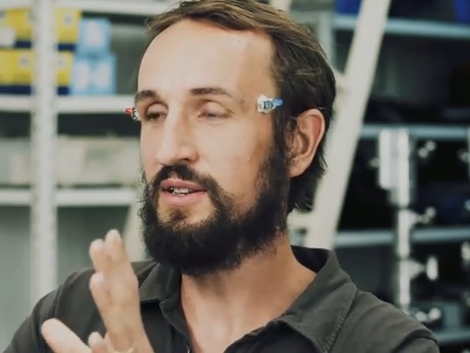
If you’ve been keeping up with our featured stories this year you’ll remember the post about using your own eyelids as 3D shutter glasses. Throngs of commenters called this one as fake and they were right. But we still enjoyed the experience… it’s more fun to be trolled when the trolls are skilled and idea is original. The perpetrators have released a follow-up video that shows how it was done. It’s not just an electronic trinket and some acting. There’s well executed post-production which maps out the area around this gentleman’s eyes and edits in the rhythmic blinking that made the farce somewhat believable. Check it out after the break.

Read the rest of this entry »

Electrodes turn your eyelids into 3D shutter glasses

posted Jan 16th 2011 2:00pm by
filed under: Medical hacks, video hacks

[Jonathan Post] has a way to watch 3D video without wearing shutter glasses but it might be kind of a hard product to break into the market. As you can see above, a pair of electrodes are stuck on a viewer’s eyelids, using electricity to alternately close each eye. The video after the break shows a demonstration of this technology. Obviously a camera can’t capture the image that the viewer sees, but this man describes a perfect 3D image. This reminds us of those ab exercisers that use electrodes to stimulate the muscles. Do you think a 3 hour epic would leave your eyelids tired and sore, eventually resulting and a steroid-esque muscle-ridden face?

Edit from [Caleb]: Judging from the comments, some people believe this to be an absolute impossibility. While we concur that this example is pretty silly (what’s powering those electrodes?), we invite you to watch [Daito Manabe]‘s facial electrodes fun.

Read the rest of this entry »


Candle stop motion: how’s it done?

posted Jun 18th 2010 10:03am by
filed under: HackIt

[Ollie] tipped us off about a stop motion video that uses a grid of tea candles to animate some classically pixellated game graphics. The image above is obviously a game of pong in progress. It’s interesting to watch but for us the fun is trying to decide how it’s done. Click through the break to see the video and discuss the methodology.

Read the rest of this entry »

Hack a Day serves up fresh hacks each day, every day from around the web as well as hacking related news.

Send us your hacks


Hacks

Resources