
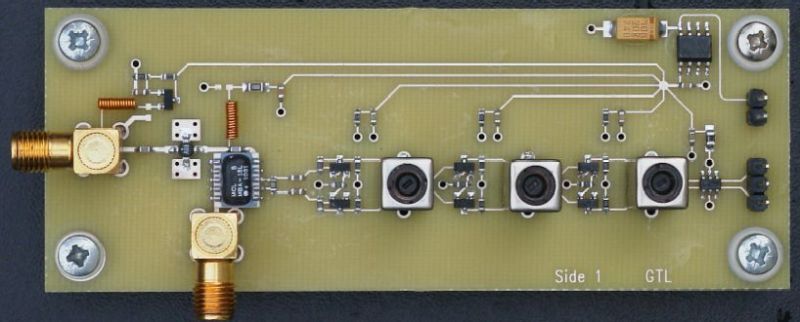
GPS receivers may be available for well under $100 these days, but what’s the fun in buying one when you can build it yourself? According to [Andrew], the creator of this device, he was inspired by Matjaž Vidmar who developed a GPS receiver from scratch over 20 years ago. His article can be found here and includes some nicely hand-drawn diagrams as well as a lot of theory.
However, [Andrew’s] article is a bit more up-to-date and features plenty of theory itself. He explains how he built his four-channel GPS receiver, able to track four satellites at the same time. This is the minimum number of satellites needed to track your position using such a device.
GPS technology is quite incredible, and the amount of soldering as well as the understanding of the theory behind it required to build such a device is astonishing. Interestingly (sadly?), it seems we are beyond the time of LORAN hacks, but if you have an old one to share, be sure to send it in! For something a bit easier, maybe one could try making a GPS “cateye” to track what your pet does all day!










is this legal?
no International Traffic in Arms Regulations Violations?
How would receiving some signal from the air be legal…?
*illegal…….
As per my knowledge, GPS is free to be used by anyone with a GPS receiver, and its perfectly legal
Source- Wikipedia
http://en.wikipedia.org/wiki/Illegal_prime
well you cant steal satilite TV or listen in on cellphone conversations or monitor wifi traffic either XD
it may violate the “Military Electronics” and “Aircraft and Associated Equipment”
it also may violate any GPS restrictions like the “COCOM limit” and acceleration limits, motion limits, and i THINK there is still an accuracy limit on civy units
Thanks bWare, that was a great link, never heard of such a thing, but very interesting.
@bWare – yeah very interesting. I’d never heard of that.
Weasel clause: IANAL
ITAR applies to publishing when information about a technology isn’t publicly known. If information being used to build a project comes entirely from textbooks and/or publicly accessible information, it can be posted online. Basically, if they teach it at university level, you can publish. *Shipping* the physical product out of the US is another matter.
I’d imagine there are some near space balloon projects that appreciate this as a backup for the day you can’t find a commercial receiver that doesn’t implement the cocom limits as OR rather than AND.
It’s illegal for a receiver to report a location 60,000ft above sea level. (Which can happen if you are actually that high or you don’t have enough satellites and there are two possible locations for you)
ITAR only comes in if you’re planning on distributing the hardware although IANAL.
but the bill also covers trading in information that includes posting articles on how to design such equipment
“GPS technology is quite incredible…”
Lest there be any uncertainty, it’s not ‘marginally incredible’ or just ‘incredible’ – it’s ‘quite’ incredible.
Wow.
I was just considering getting a GPS for geocaching/ wardriving purposes. It would be interesting to be able to build one from scratch.
Wow is right. Check out Andrew’s other projects. Very cool.
And sad that most of the discussion centers on the legality of this.
It is sad that such technology should be arbitrarily restricted. For once I’m glad that I don’t live in the US and thus don’t have to care too much, since I am considering building one
Agreed.
Actually, the COCOM GPS limits are not limited to the USA.
https://en.wikipedia.org/wiki/Coordinating_Committee_for_Multilateral_Export_Controls
However, as I understand the rules, it only applies to exports. IANL.
Xilinx FPGA+Dish setup..why get a cheap module when you can spend 300-8000 USD just on 1/3 the logic..
Plenty of cheap chips have DSP that can handle this, this isn’t efficient by far..also doesn’t handle common proto..
I just made a board for a GlobalTop GPS chip and FTDI and then added an USB connector :)
Gives standard NMEA sentences via a virtual serial port at 5Hz refresh rates.
Not as cool as this build but a bit smaller and more usable board alltogether :)
@xorpunk
You have no idea how little you know on the topic. Efficiency does not apply in discovery.
Learn something and post what you learned. Maybe some knuckle-head will call you inefficient.
“Plenty of cheap chips have DSP” huh??
I’m a senior level software engineer with a B.S. in computer engineering..speak for yourself there hotshot..
Also I bothered reading the whole thing and looked at the FPGA specs..what did you do before posting your hater-comment?
Above all, maybe take your own advice? Judging from your contributions you’re just a loser with no technical insight..
@xorpunk
I think this project is a very useful exercise in the practical applications of CDMA. It may lead to a new open-source GPS receiver design (one already exists at http://gps.psas.pdx.edu/ )
A truly ingenious effort!. Like the way how he expounds on the basics of doing DSP using FPGAs. very inspiring.
Yay no more speed and altitude limitations, we can make cruise missiles now!
Holy crap. WOW, just an awsome project. And I learnt something about GPS and illigal prime, two things I apparently knew very little about.
@xorpunk
OK you win. What’s your design for a “more efficient” acquisition, trackIng, & demod of GPS.
Be sepcific. Let’s see that BSCPE in practice.
I’ll await your link.
Has anyone came across a diy differential gps project?
Ugh, this is freaking awesome.. I am going to have to experiment with this for my next side PCB project! Thanks.
Cheers
Link is dead. Anyone know of a mirror or cache?
http://www.holmea.demon.co.uk/GPS/Main.htm
Its back up again. Must have been SOPA & PIPA clamping down on homeberw GPS projects to protect the citizen kane from Evil HaDers. Grrrrr.
Seems to be gone again now unfortunately. Anyone hosting a mirror of the article?
http://www.aholme.co.uk/GPS/Main.htm
He has a Raspberry Pi version now. I found that page, along with this post, with a Google search for ‘diy gps receiver’.
i was arrested due to this
This is trully a work of love. I take my hat off.
Hi Guys. I was hoping that someone could help me. I have a RC boat i use for fishing, bait boat. I want to be able to see, for example, on google maps where i go with my boat and save locations where i drop my bait so to be able to go back to that location again. So in other words i need a wireless GPS module mounted on the boat and then i will track this on my tab fro instance. I have a wireless Bluetooth GPS module that i got with a nokia cell phone. It connects via Bluetooth to the phone and then one will have a GPS on the phone with maps, streets every thing as per a normal car GPS. The problem i have is range. The Bluetooth connection wont make 500m, witch is the max i want it to work on. Is there some wireless devise, i could build that will connect to the GPS module, via Bluetooth, on the boat and and then send the data back over a distance of a minimum of 500m to a receiver and that receiver again connects via Bluetooth to the tablet and then i use the maps on my tab to do my thing? Or could i modify the GPS module from Bluetooth to wireless that will be able to connect at about 500m? Pleas help me, i would like to do this project. As i was looking around on the net for ideas i came across this website, that has such a wireless device but its in another country, very expensive, in a different language and it ready bult, i like by projects, even if it takes me a while. Look at this link if you guys would-http://www.carplounge.de/xtcommerce/product_info.php?info=p108_Carplounge-wireless-GPS-Bluetooth.html
Or could the GPS module work as a car tracker but then instead of tracking i could save locations, that will mean that i wont need any other wireless device as a car tracker is on its own is it not?
All u is it legal goody to shoes call white and ask them Obama care and in the middle east is it legal. It’s GPS device you can buy or make one and all the is it legal go a nd buy let the hobbyist have their fun.
Nice information, thank you for sharing it. Termites Control Service Guwahati
The original link has expired.
old link: http://www.holmea.demon.co.uk/GPS/Main.htm
new link: http://www.aholme.co.uk/GPS/Main.htm