
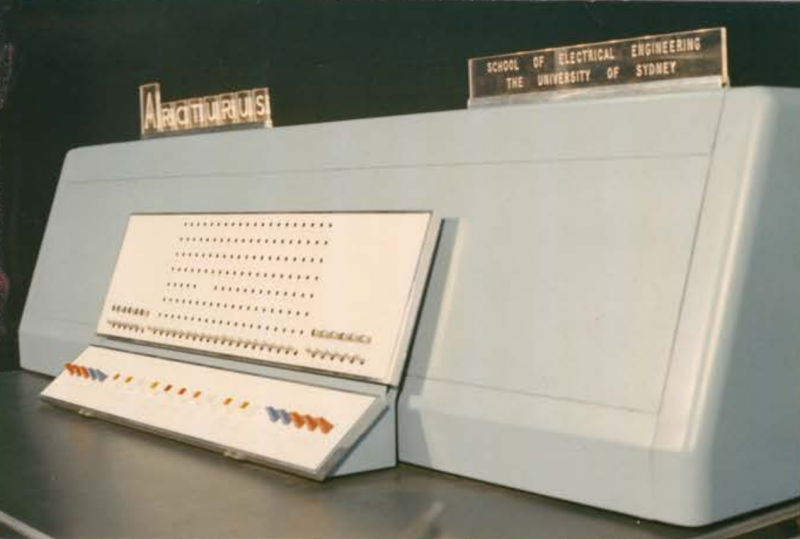
[State of Electronics] have released their latest video about ARCTURUS, the 14th video in their series The Computer History of Australia.
ARCTURUS was a research computer system developed on a shoestring budget at Sydney University in the 1960s, and was in service until 1975. Particularly the system was developed by [David Wong] as a part of his PhD thesis: The design and construction of the digital computers snocom, nimbus and arcturus (PDF). [David] worked in collaboration with [Kevin R. Rosolen] who is interviewed in the video.
The machine is described as a fixed-point, binary, parallel, single address, general-purpose digital computer using packaged diode-transistor circuits. Ferrite-core memory was used instead of drum memory because drum memory was too slow and performance was a high priority feature. For the same reason parallel features were implemented where serial might have been done more simply, if it hadn’t been so slow. In addition to the ferrite-core there were paper-tape peripherals and control panels.
The machine supported 32 distinct instructions and had a 13-bit address space allowing it to directly address 8,192 words, each word comprising 20-bits. Those word bits were one sign bit and nineteen magnitude bits for fixed-point two’s complement binary numbers.
We covered The Computer History of Australia by [State of Electronics] back when they released their 5th video in the series, Australia’s Silliac Computer, if you’re interested in more history of computing in Australia.










I love the look of this computer; it is straight out of every 70s movie and TV series I remember from childhood. Now I want to build a panel that looks like this. Time for a new project…
Link to PDF appears broken. I get a “forbidden” error. :(
I was able to get to the website and save off the pdf no problem. Interesting reading.
My first thought was create another small ‘panel’ for my collection of old displays (like the PiDP line). But I don’t have the time to make a proper software ‘simulator’ behind the scenes would the be problem. As a static prop I suppose…. We’ll see.
Fascinating.
“…A thesis presented in support of an application for the degree of Doctor of Philosophy in the School of Electrical Engineering of the University of Sydney…”
As an Australian I’d dearly like to watch more of the State of Electronics channel but I find the constant high speed cuts in the footage extremely mentally tiring to process. It seems there isn’t any bit of footage longer than six seconds, can’t I have a few more seconds of your time to catch my breath a little?