
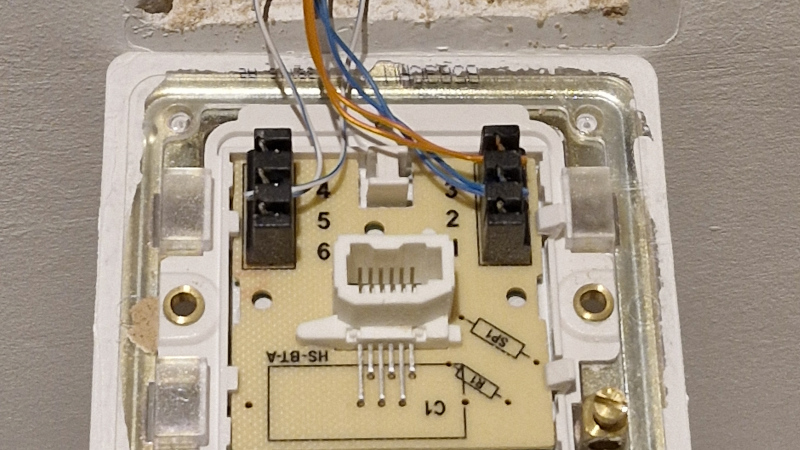
A quiet shift over the last couple of decades in many places has been the disappearance of the traditional copper phone line. First the corded landline phone was replaced by cordless, then the phone migrated to a mobile device, and finally DSL connections are being supplanted by fiber. This leaves copper-era infrastructure in houses, which [TheHFTguy] decided to use for Ethernet.
The hack here isn’t that he bought some specialized network boxes from Germany, though knowing they exist is useful. Instead it comes in his suggestion that they use the same technology as mains networking. Mains network plugs are a dime a dozen, but noisy power lines can make them of limited use. Our hacking curiosity is whetted by the question of whether a cheap mains networking plug can have its networking — in reality a set of RF subcarriers — separated from its mains power supply, and persuaded to do the same job at a fraction of the cost. Come on commenters – has anyone ever tried this?










This brings back memories. Around 1989 I had a PhoneNet network (AppleTalk via phone line) to link two computers and a printer, piggybacking onto the existing phone wiring. Only 7 orders of magnitude slower than gigabit Ethernet.
Hey, cool, that’s not too shabby! 😎
PhoneNet/LocalTalk could do 230 KBaud, which was better
than our 115,2 KBit/s null-modem connections that we PC users had to work with.
There also was an Amiga version, Double Talk, that supported higher speeds.
http://obligement.free.fr/articles/doubletalk.php
Also, I’m not sure if PhoneNet was that common in my country.
Interfaces show up on eBay sometimes, but our phone outlets were different.
We didn’t have western/RJ11 connectors on the wall, normally. But TAE.
To our defense.. Other European countries had their own, similar, weird connectors! 😅
Our phone wiring was two wires, also. On the wall box, I mean.
https://en.wikipedia.org/wiki/TAE_connector
Our TAE connectors had some extra pins, of course,
but that feature was mainly used to for pass-through reasons used by PBX systems and fax/phone switchers.
So the telephone could run through the fax machine, for example.
The telephone could work as a keypad for dialing,
then the fax machine would disconnect the phone and take over the line.
Here’s a “Germanized” version of PhoneNet.
http://www.applefool.com/se30/sites/LocalTalk%20umgebaut.htm
Not sure if it was ever used in an actual house wiring, it was a bit before my time.
I forgot to mention, AppleTalk was also available to IBM PC!
There was an “AppleTalk PC Card”, which was an 8-Bit PC board.
Farallon, the maker of PhoneNet, later had made such an ISA card, too.
That way, PC users on DOS could talk to Macintoshs and vice versa (there was a Chooser utility).
Later, Windows software came along, too.
(Linux could be made work it, as well, but it needed a bit of work.)
What’s cool, the PC software supported multiple network cards, including NE2000 compatibles.
So it was possible to use ordinary ethernet cabling
and hardware to have Macs and PCs exchange files and share printers.
Well, at very least in System 6/7 era, I guess. AppleTalk had underwent some protocol changes over the years.
This website (archived) has more information about the AppleTalk PC Card: https://tinyurl.com/na5kbyzy
That being said, you have actual experience with PhoneNet, of course. 😃👍
To me, by comparison, it’s just messing around as part of a vintage computing hobby.
Still, it’s an interesting technology. Clean and elegant in its own way.
Most of us PC/XT users still used Norton Commander and some quick&dirty, homemade null-modem cables in these days.
Funny, I did exactly this at home also with PoE to distribute my WiFi. Everywhere we had a landline phone back in the day, we now have an access point. :D
Also, when our neighbor got a solar plant that needed a network, we moved the router into the basement and used the now unused landline to get Ethernet upstairs.
oh haha from the headline i thought we were using it as an alternative to mains power. I just checked and mine is dead now but for years after it was disconnected, they still applied some voltage to it. I always assumed it would be enough to light an LED at least.
I used to work in telecom; that’s a regulatory requirement. Even with no service subscription, you could still hook up a phone and dial 911.
It should stay that way…for backups
All meth-heads climbing poles put behind bars
I tore out my old home intercom (Everyone has phones now), and wondered what to do with the free 24AWG cat-3 wiring. Initial testing showed it could carry 100BASE-TX without excessive errors, and could even do mode-A PoE. The amperage 802.3af carries is barely enough for a RPi zero, but if you had a local battery reserve to handle the peaks, it should work.
There’s only 3 pair in cat-3 cabling, so no GbE and no mode-B/4P PoE is possible, but limiting the ethernet and power to 2-pair means you could supplement it with RS-422 or RS-485 on the unused pair.
There’s also the possibility of carrying up to three distinct 10BASE-T1S signals with PoDL per cable, but I expect that increases the equipment costs significantly.
Standard CAT3 is 4 pair. You may have something else.
Maybe 4 pair is standard in some contexts, but 2 pair and 3 pair is very common in house wiring (in North America anyway). The cat3 spec doesn’t require 4; pretty sure even the 25-pair telco cables were technically “cat3”.
I’ve used coax to networking adapters for years to support a long distance run in a building. only 10Mbps, but for what it was running it was plenty of bandwidth. Could also run HD-SDI on the cabling.
I second network over coax. Grounded coax should (ideally/naively) keep RF noise floor down.
The suppliers know network over household coax as MOCA — multimedia over coaxial. More common when network was coming over the cable TV lines, as opposed to TV coming over the network lines. Of course you need a coax modem on the other end to bridge MOCA back to Ethernet; that was typically built into a router.
Optical network terminal (ONT) boxes can often feed MOCA, Ethernet, and POTS (plain old telephone service) simultaneously; pick the combination that works for your infrastructure. I used MOCA until I got around to running real cat 6 cable.
I wonder how far you could get with 100Base-T1 and 1000Base-T1 over telephone wires. While devices are still expensive, the PHYs can be bought for less than $10 a piece.
Please don’t encourage this nonsense. Our RF noise floor is already ridiculous, and powerline networking is one of the biggest pollutants.
And then there are houses that don’t have phone wiring anymore and people try to run a landline over coax because the cable TV wiring is unused.
I built my house in 1993, and installed two runs of CAT3 to each room, terminated on “66 blocks” in the basement.
It works fine, no errors, for GigE to this day due to the short length of the runs.
Wow, twisted pair! That’s quite advanced for its time! 😃
Here in Germany, 10Base2 was still common at that time, besides null-modem cables and LapLink cables.
Kirschbaum Netz (related to LittleBig LAN) supported serial/parallel connections (PC to PC to PC and so on) and NE2000 and ArcNet cards.
The simpler version was Kirschbaum Link (different product).
There also was an alternative to BNC T-pieces for coaxial connection, EAD.
https://en.wikipedia.org/wiki/EAD_socket
It basically used modified TAE wall sockets and plugs meant for telephones/faxes/modems/answering machines.
That way, users had a similar experience as with 10BaseT,
but without the need for new netwok cards, bridges/switches/routers, twisted-pair cabling and western connectors.
Network stations could be added/removed without interrupting the network.
Despite the wiring still being a bus topology, using RG58/CU cables.
The passive wall sockets simply bridged the connection if no plug was inserted.
The technology wasn’t perfect, though. Mechanically worn plugs caused issues not seldomly.
Btw, in 1993, Windows for Workgroups 3.1 (not 3.11) had been available as a kit with two 10Base2 ISA network cards.
It also came with a WfW screwdriver!
https://www.winhistory.de/more/win311.htm
Over here, 10BaseT got more popular by 1997 or so, I would say.
About the time Windows 98 was around, because I remember that the Windows 95 era was a transitional time, still.
Back then, Novell Netware and IPX/SPX and ISA network cards were still around.
In Germany, I mean. Or in my region, at the least. 🙂
A) Some HaD(!) tags that can help: homeplug av, power line communication, G.hn
B) pretty sure there was a HaD article many years ago where someone just modded their HomePlug AV adapters to run over whatever he wanted: Just disconnect the inject-RF-into-mains part (capacitive coupling I think) and connect it to whatever you want. Possibly even with powering one of the HP-AV devices over the cable via DC???
Can’t find that article.
C) You can also by basically a pair of ADSL modem and DSLAM and run your own local in-home DSL connection.
That’s how they did fiber internet around here. Fiber to the unused phone distribution box, then connecting to the old phone wiring going into the house. From what I understand, this is using G.fast, which is related to DSL.
Like with power line, the downside is RF noise. In my place, the noise floor in the VHF band raises by about 10dB when them modem is connected.
Ma Bell installed multiple varieties of station cables. The house I grew up in (built 1952) had “telephone twist”, 4 conductors color coded as green/red/yellow/black, with all 4 wires twisted together and a jacket overall. The green/red wires were used as a pair to deliver POTS service, the black/yellow could be used for a 2nd line or to deliver 6VAC for the incandescent lamp in a Princess or Trimline phone. Because the wires are twisted as a group and not as individual pairs, I doubt that you could get any sort of usable Ethernet connection over this type of cable.
Later installations used 3-pair station cable, color coded white/blue white/orange white/green, with each pair twisted separately within the jacket. You might get a usable-in-a-pinch network connection over this, since 10/100baseT only needs 2 pair, if-and-only-if the station cables are home runs (each running separately to the demarc), not daisy-chained from one jack to the next, no branches (aka half-taps).
My present house (circa 1970) has 6-pair station cable, daisy-chained. I’ve never tried to use it for anything but POTS.
Later installations used 4-pair Cat3 cable, which I have seen pass 100baseT over a shortish run. YMMV.
I am getting 1Gb/s over the cat5 I ran 26 years ago, but the runs are short (10s of feet).
Additional thoughts:
If there are not 4 pairs to support PoE, you could power the phone from a wallwart or PoE injector.
Some IP phones can communicate over WiFI, so you may not need cabling at all, just a wallwart and a WAP.
That all being said, you might look into https://www.nvtphybridge.com/products/#polrefamily or https://www.mitel.com/products/phybridge-polre if you must use existing cat3 cable. (PoLRE stands for Power over Long Reach Ethernet)
The jack pictured is ugly, with a capital UGH. You should never try to double-punch 2 wires into a single 66 or 110 contact; it is unreliable.
Wouldn’t there be a problem if someone dialed the phone number?
“First the corded landline phone was replaced by cordless” that’s like saying… well, it’s just wrong. A cordless phone is still a corded landline.
I repurposed our inside phone lines for … phones. I disconnected it at the interface on the outside of the house and connected each of the two pairs to the phone out on a VOIP device. Red/Green is the home phone and Yellow/Black is my own phone. From there the phones could be located anywhere in the house. This is especially useful in the case of the home phone, as this allows the cordless base with built-in answering machine to remain in the kitchen where it’s easy to access, without locating the VOIP interface in there.
Disconnecting it all from the telco was as easy as opening the box on the side of the house and unplugging the connection. I left a note in there explaining it should not be reconnected, and why. I think I also put a dummy plug in the socket, but I can’t remember for sure anymore. It’s nearly a moot point, as the incoming phone lines were dug through during a septic repair, and we never bothered to ask the phone company to repair them. Yes, I know, call 311 before you dig. But the cable and phone companies here take the position that they wont pay for that for a single home, just dig and they’ll come fix afterwards if necessary. Gas was suitably marked, and power was overhead, so not an issue.
I use abandoned cable TV coax to get internet to the far end of my house where my office Wifi doesn’t reach. I use a pair of commercial coax modems hooked up to a second wifi router on the far end. Works great. Haven’t tested the bandwidth, but there have been no complaints.
I suppose I could have done the same with phone wiring. There is a phone jack nearby I didn’t think about it at the time. I knew the cable TV coax was working as I did this shortly after I cancelled cable so that I could get internet to the room that has the big TV.