Replicating The Color-Changing Effect Of The Lycurgus Cup

Although most archaeological finds from ancient civilizations aren’t quite as exciting as what you might expect from the movies, occasionally you come across something that’s truly special. The Lycurgus Cup is one of those, with the 3rd or 4th century CE glass cup and its incredible detail surviving likely because it ended up in church treasuries after the fall of the Western Roman Empire. Now its almost magical dichroic glass effect has been recreated in a modern take by researchers at the University of Sheffield.
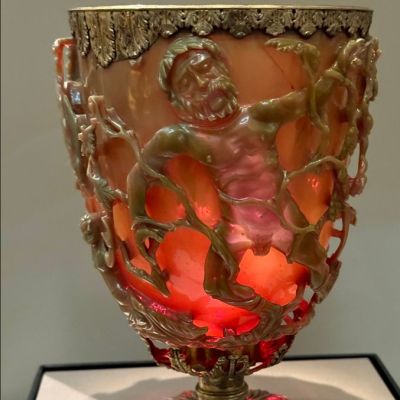
The Lycurgus cup with light shining through it. (Credit: Chappsnet, Wikimedia)

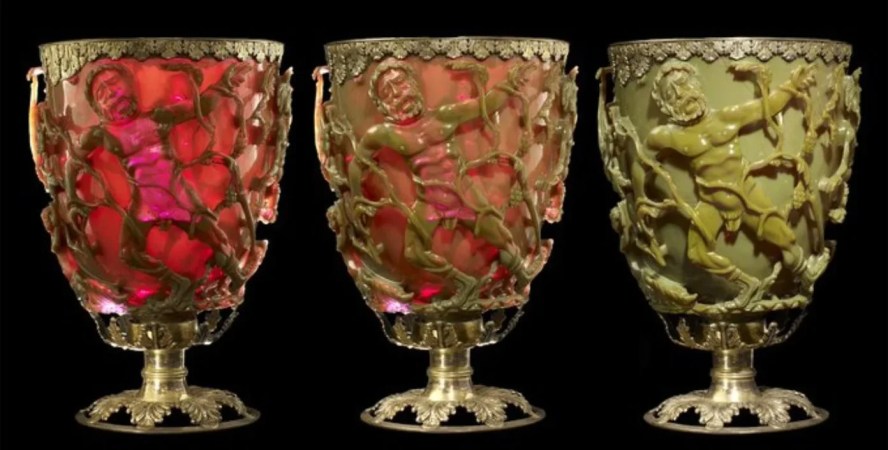
Dichroic glass takes on a different color depending on the lighting conditions, with the Lycurgus cup appearing to be green glass when lit from the front and red when light passes through it from behind. This serves to give the portrayed scene – of the demise of King Lycurgus from Greek mythology – an extra boost with the right lighting.

The cause of this dichroic effect in this ancient marvel of glass work was unknown for the longest time, but research on a fragment of the glass revealed that it contains nanoparticles of both gold and silver. Since then a number of researchers have recreated this dichroic glass, with [Lars Kool] et al. using FDM 3D printing to create objects embedded with the same nanoparticles that also display this effect.

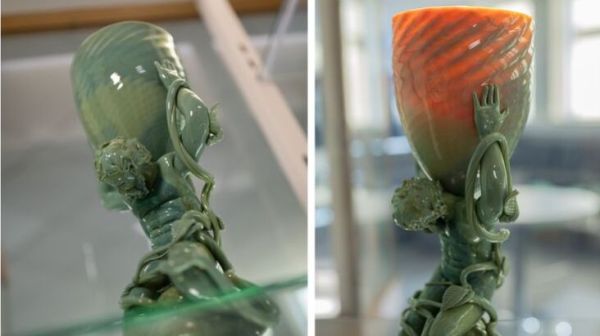
Where this work by the University of Sheffield differs is in that it creates the effect not only in glass, but also creating a piece of art in the form of a modified Atlas statue to use it. The resulting dichroic effect is rather similar, which isn’t too shocking since unlike over 1,600 years ago we can now literally see and measure nanoparticles in glass, while adding exact amounts of each to pure glass.

Here’s to raising a dichroic glass cup to bridging the millennia with recreated luxury glass recipes.

Nanotechnology In Ancient Rome? There Is Evidence

Anything related to nanotechnology feels fairly modern, doesn’t it? Although Richard Feynman planted the seeds of the idea in 1959, the word itself didn’t really get formed until the 70s or 80s, depending on who you ask. But there is evidence that nanotechnology could have existed as far back as the 4th century in ancient Rome.

That evidence lies in this, the Lycurgus cup. It’s an example of dichroic glass — that is, glass that takes on a different color depending on the light source. In this case, the opaque green of front lighting gives way to glowing red when light is shining through it. The mythology that explains the scene varies a bit, but the main character is King Lycurgus, king of Edoni in Thrace.

So how does it work? The glass contains extremely small quantities of colloidal gold and silver — nanoparticles of gold to produce the red, and silver particles to make the milky green. The composition of the Lycurgus cup was puzzling until the 1990s, when small pieces of the same type of glass were discovered in ancient Roman ruins and analyzed. The particles in the Lycurgus cup are thought to be the size of one thousandth of a grain of table salt — substantial enough to reflect light without blocking it.

The question is, how much did the Romans know about what they were doing? Did they really have the means to grind these particles into dust and purposely infuse them, or could this dichroic glass have been produced purely by accident? Be sure to check out the videos after the break that discuss this fascinating piece of drinkware.

Continue reading “Nanotechnology In Ancient Rome? There Is Evidence” →