Miniaturized, Working Replica Of Vintage Leslie Speaker

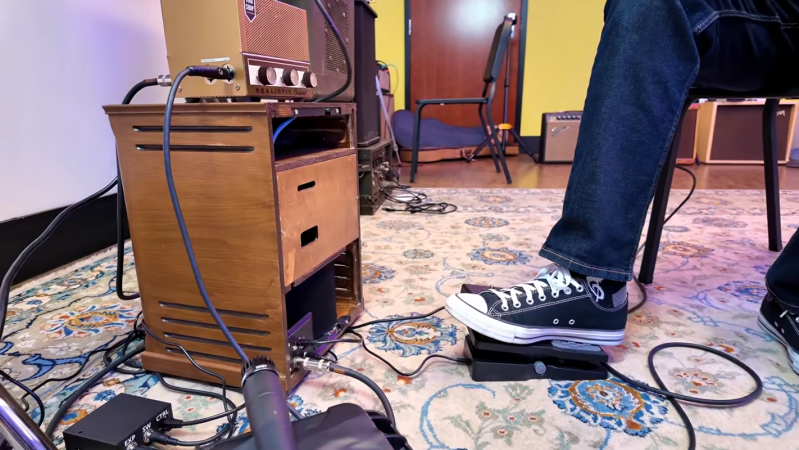
Few pieces of vintage audio gear from the turn of the century (the previous one) inspire the kind of devotion that a Leslie speaker does. Sure, there are plenty of pieces that are rarer or more valuable, but the Leslie speaker has such a big following because of its uniqueness of physically moving sound around a room. Two rotating devices in the speaker physically direct the sound around the cabinet with musician-controlled speed, and this sound remains extremely difficult to reproduce faithfully without the moving components. But originals are enormous and meant for organs, so [Eric] built a 40% replica with a few modern touches for his guitar.

The build starts with a CAD model, where [Eric] works towards making the most accurate enclosure for his speaker as possible. The CAD model heads out to a CNC machine which can care most of the details into the wood, and he eventually is able to finish it, although it took a few tries with stains and paintbrushes of various types. For the speakers themselves, he’s using modern versions including modern brushless motors to drive the rotating elements. Like the original speaker, the high range of sound is sent through a rotating set of horns, of which one is only a counterweight, and the low range is directed out of the bottom of the cabinet through a large rotating drum. Both rotating elements here are 3D printed, and with everything put together and wired up [Eric] has a much more portable, faithful recreation of the original Leslie speaker.

There are some upgrades in the wiring too, which makes it work better with a guitar rather than for an organ. It’s also much lighter, and was a hit when he took it to let a few other guitarists to play as well. It’s not the first time we’ve seen the Leslie’s movement recreated for guitar, but it is the most alike to the classic 1930s-era speaker we’ve seen so far.

Continue reading “Miniaturized, Working Replica Of Vintage Leslie Speaker”
A Modern Version Of Famous, Classic Speaker

Modern musicians may take for granted that a wide array of musical instruments can either be easily connected to a computer or modeled entirely in one, allowing for all kinds of nuanced ways of creating unique sounds and vivid pieces of music without much hardware expense. Not so in the 1930s. Musicians of the time often had to go to great lengths to generate new types of sounds, and one of the most famous of these was the Leslie speaker, known for its unique tremolo and vibrato. Original Leslies could cost thousands now, though, so [Levi Graves] built a modern recreation.

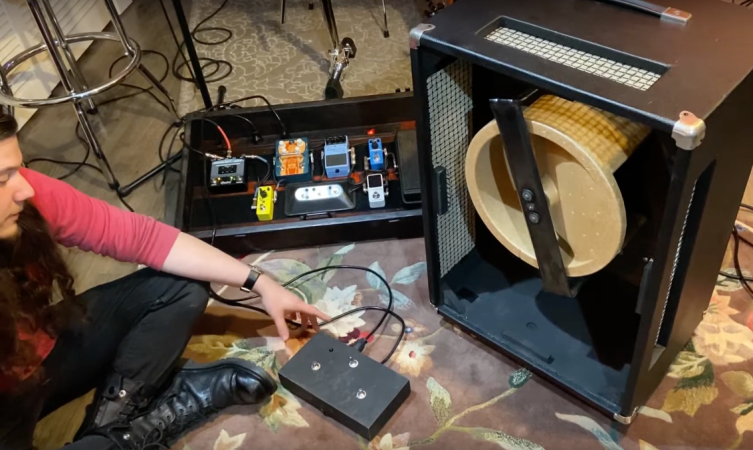
The Leslie speaker itself got its characteristic sound by using two speakers. The top treble speaker was connected to a pair of horns (only one of which produced sound, the other was used for a counterweight) on a rotating platform. The second speaker in the bottom part of the cabinet faced a rotating drum. Both the horns and drum were rotated at a speed chosen by the musician and leading to its unique sound. [Levi] is actually using an original Leslie drum for his recreation but the sound is coming out of a 100-watt “mystery” speaker, with everything packaged neatly into a speaker enclosure. He’s using a single-speed Leslie motor but with a custom-built foot switch can employ more fine-tuned control over the speed that the drum rotates.

Even though modern technology allows us to recreate sounds like this, often the physical manipulation of soundwaves like this created a unique feeling of sound that can’t be replicated in any other way. That’s part of what’s driven the popularity of these speakers throughout the decades, as well as the Hammond organs they’re often paired with. The tone generators on these organs themselves are yet another example of physical hardware providing a unique, classic sound not easily replicated.

Continue reading “A Modern Version Of Famous, Classic Speaker”

Making A Better, MIDI Controlled Leslie Stompbox

mint

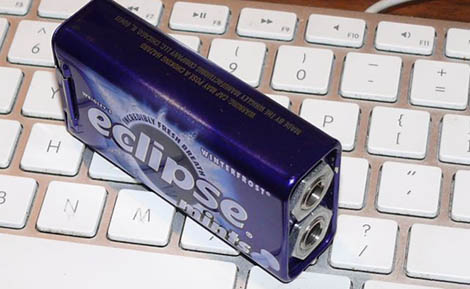
Way back before the advent of commercial DSP, musicians had really cool looking gear. One of these devices to change the sound of organs, guitars, and other electronic instruments was a Leslie speaker – a speaker cabinet with rotating horns that gives that wonderful warm warble heard on so many classic recordings. [Nigel] doesn’t have an original Leslie, but he does have a much less expensive and lighter digital effect that emulates the original Leslie sound very well. The only problem, though, is the requirement for a proprietary footswitch. No problem, then, because a transistor, a resistor, and a mint tin can take care of that.

[Nigel]’s Leslie simulator – a Neo Instruments Ventilator – has a foot switch to control the speed of the emulated rotary speakers. There are three possible states for the speakers, fast, slow, and brake, all controlled with a TRS phono connector. Possibly in an attempt to price gouge consumers on a proprietary footswitch, Neo Instruments decided they would use the ring and tip of the phono connector to control the speed. They did so in a way that made it impossible for a single relay or switch to change the speed, however.

No problem for [Nigel], then, because with a very simple circuit consisting of just a transistor and resistor he can use any footswitch he wants with his Leslie simulator. The build doesn’t support the brake function, but he doesn’t use that anyway. Not bad for less than a dollar in parts, and a buck fifty in mint tins.