Talking Resistor Calculator Speaks Component Values

If there’s one thing that will surely blind us, its reading resistor color bands. It doesn’t help that red looks exactly like orange, brown and black are indistinguishable, and different component manufacturers – for some reason – don’t use identical paints for coding their resistors. [Jeff] over at Gadget Gangster has been having the same problem, so he built a talking resistor calculator to speak resistor values to him.

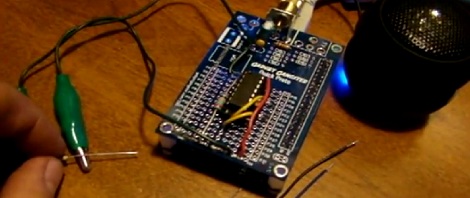
The electronics part of the build is extremely simple with just an MCP3208 ADC providing 12 bits of resolution. The software side is where this project really shines. [Jeff] used a Gadget Gangster QuickStart board housing a Parallax Propeller. With 8 cores running in parallel the Propeller is more than enough to run [Phil Pilgrim]’s software speech synthesizer. When a resistor is connected to the two alligator leads, the Propeller goes through a lookup table and finds a resistor value matching the number coming from the ADC. From there, it’s just sending a string of phonetic text to the speech synthesizer object.

Even though text-to-speech chips have been around for decades now, [Jeff] chose to build his speech synthesis tool with software. It may just be a testament to the power in the Propeller microcontroller, but anything that keeps us from squinting at resistor color bands is alright by us.

Building The Mind Of A Robot Overlord

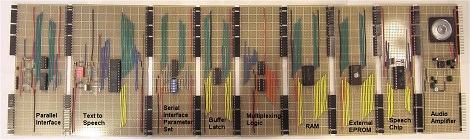
The folks at the Louisville hackerspace LVL1 now have a fabulous piece of wall art that is also a speech synthesizer. The speech synthesizer is over two feet long and is made of nine panels of stripboard connected with right angle headers. An awesome piece of art if there ever was one.

This speech synthesizer is actually 30 years in the making. In the early 1980s, one of the members of LVL1 across a few text-to-speech ICs in a bin in Radio Shack. These ICs sat in a drawer while college got in the way, and in 1990, the project was resurrected. The speech synth chips sat in a drawer for another decade, and it was finally decided to build a wall-mounted speech synth for LVL1.

This speech synthesizer is intended to be the voice box for FATHER, LVL1’s second hackerspace AI. Already the first AI – MOTHER – is already telling people to take out the trash and generally trying to become the AI-gone-amok we all deserve. FATHER will be implemented in a robotic monkey, so right now the only question we have is who has been messing with the Louisville water supply.

Hackaday Links: April 7, 2012

Need some gears? Got a timing belt?

[filespace] sent in a neat build he stumbled upon: making gears with plywood and a timing belt. Just cut out a plywood disk and glue on a section of timing belt. There’s some math involved in getting all the teeth evenly placed around the perimeter, but nothing too bad. Also useful for wheels, we think.

We’re on a chess kick now.

Huge chess sets are cool, right up until you try to figure out where to store the pieces when they’re not being used. [Jayefuu] came up with a neat solution to this problem. His pieces are cut out of coroplast (that corrugated plastic stuff political campaign signs are made of), making it relatively inexpensive and just as fun as normal giant chess pieces on a tile floor.

<INSERT MARGINALLY RELEVANT PORTAL QUOTE HERE>

[Randy]’s son is in the cub scouts. Being the awesome father he is, [Randy] helped out with this year’s pinewood derby build. It’s a car shaped like a portal gun with the obligatory color-changing LED. The car won the ‘Can’t get more awesome’ award, but wheel misalignment kicked it out of the competition during qualifying rounds. Sad, that. Still awesome, though.

These people are giving you tools for free

Caltech professor [Yaser Abu-Mostafa] is teaching a Machine Learning class this semester. You can take this class as well, even if the second lecture started last Thursday.

Turning an Arduino into a speech synthesizer

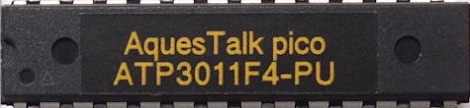
[AlanFromJapan] sent in this product page for an Arduino-powered speech synthesizer. We’re probably looking at a relabeled ATmega328 with custom firmware here; to use it, you replace the micro in your Arduino Uno with this chip. The chip goes for about $10 USD here, so we’ll give it a week until someone has this proprietary firmware up on the Internet. There are English morphemes that aren’t in Japanese, so you can’t just ‘type in English’ and have it work. Here’s a video.

Six things in this links post. We’re feeling generous.

What would you build if you had a laser cutter? [Doug Miller] made a real, working fishing reel. No build log or files, but here’s a nice picture.