
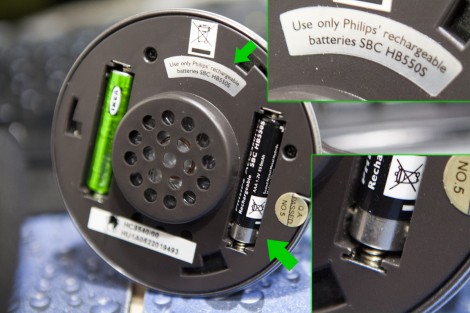
Here’s something we haven’t run across before. We’re familiar with proprietary battery shapes (we’re looking at you, digital camera manufacturers), or custom recharge connections (look of death directed toward cellphone manufacturers), but using electrical tricks to force AAA brand loyalty is a new one. It seems that’s exactly what is happening with [OiD’s] wireless headphones which were manufactured by Phillips.
The headphones take AAA sized batteries and can use either disposable or rechargeable varieties. There is a warning label advising that only Phillips brand rechargeables should be used, and sure enough, if you try a different brand the performance suffers both in charging time and in battery life. The original batteries are labelled as Nickel Metal Hydride at 1.2V and 550 mAh, which falls within common specs. But [OiD] noticed that there is an extra conductor in the battery compartment that makes contact with the sides of the battery case. Further inspection reveals that a reverse-biased diode makes contact through this conductor with a portion of the battery which has not been painted. This is not true with other brands, allowing the circuit to distinguish between OEM and replacements.
[OiD] shorted out that connection and immediately saw a performance boost from his replacement batteries. It’s hard to know exactly what’s going on here without a full schematic for the circuit, but we’d love to hear your speculation on this setup in the comments. Is this a low tech version of the identity chips that camera batteries sometimes hide?












Wow. That is infuriating!
I found the same detection system in a portable CD player I got in 1999. Rechargeable cells wouldn’t be recognized as such.
I should check, but I think the brand name matches…
My old Rio MP3 CD player was like this. the original NiMH’s had no insulation on the bottom 1/3 that made a secondary ground connection to ID them and allow faster charging. I took some Energizer rechargeable and stripped off the bottom of the insulation and viola, charged those fast too.
How low can they go? What a nasty deceitful trick. I would somehow feel cheated if I found out that’s what they were doing. It adds absolutely no feature to the device and is only a money grab attempt.
infuriating? no, just don’t buy the headphones.
All well and good to say that in hindsight, not good to say if it is not advertised.
You need to realise that what you have said is stupid!
There is nothing on the packaging to say that they only use proprietary batteries..
So how are you to know until you come across the little sticker when at home!
Even this only says to use their batteries and I have seen similar stickers being used that do not refer to proprietary batteries.
In Australia this does not even conform to consumer law, as it has misleading or absent information.
They advertise on the box that they use AAA NiMh batteries – nothing more!
Before you say something, you should get your brain into gear first.
Fortunately there is a easy and free fix that even you would be able to do to use any AAA NiMh battery in these heasphones.
ftf!
This is legit. Its to stop it from trying to charge up normal non rechargable battaries. Ive got a pair of wireless headphones from Phillips with the same setup.
How sleazy.
Thats just not on! greedy gits! not only do the extort cash for the product, they then force you into buy their batteries….that like a contract to buy more of their product, that you’ve not signed!
I can confirm the symptoms for my Philips SHD8900. I bought replacement rechargeable batteries for when I am using the headphones for a very long time. I have noticed that, despite having 1000 mAh each (expensive Varta stuff), the replacements last about 30 minutes, while the original rechargeable batteries last for several hours. This
Time to go shorting…
unfortanately there are so many different kinds of rechargable AAA batteries out there, that this is a safety measure that ensures nothing blows up or melts whilst on or close to your head…
Designed for worst case scenario, however they were kind enough to put in two charging options so a high performance chemisty could be used. They may be profiting for being the only provider of this battery packaging, however I suspect that insulation dimensions of a battery is not proprietary. liablilities would prevent other battery manufacturers from throwing their hat in this ring if they have not already.
@PaoloC : My Philips portable CD player got such a nasty thing (put a wire at this time to get it work) !
WWMD? (What Would MacGyver Do)
Just use a standard battery and stick of chewing gum! Take the foil wrapper off of a stick of Juicy Fruit, and wrap it over the negative end of the battery before inserting back into the headphones!
Kick back and enjoy your Juicy Fruit and long lasting tunes.
Thank you for that! Your suggestion works a treat!
I was thinking it was a support issue, meaning people support. That way they can say “Hey look, you need to use our batteries”. I know it sounds sleazy but it can be infuriating trying to support somebody when they are using inferior parts in your product. Almost invariably they blame your product instead of the cheap part they put in it.
The detection circuit, though, counters that argument. If it was just the label, than that would suffice, but I don’t understand why the diode is there.
I find it kind of disappointing because I have always enjoyed all of my Phillips devices. I hope this isn’t just a sham and there is some real reason behind it.
Assuming this is a protection mechanism, It’s a shame that manufacturers have been forced to prevent people from being retards.
infuriating? no, just don’t buy the headphones.
@Smithy:
They don’t print “works only with our batteries” right on the box, do they?
I used to have a Philips CD player about 12 or so years ago that used the same method to differentiate between rechargeable and non-rechargeable batteries. I just took some standard ni-cd batteries back then and trimmed the plastic wrapper off the base of the battery and then I was able to use the CD player to charge the batteries. I seem to remember having a Panasonic CD player before then that did the same thing…
Getting the exact batteries they recommend is hard here in NZ. I had to order a pair and it took 2 weeks to arrive and it wasn’t Philips. I am fascinated with the chewing gum thing method, have nothing to lose trying it. Dianne
@Matt
Agree… If people are this stupid (I hope not), they deserve the joy of exploding batteries close to their head…
@Henrik: It’s a kind of techno-darwinism… But I agree with that.
Not surprising at all coming from Philips.
They are very good at dirty marketing.
That’s just plain stupid.
Shame on the philips engineer.
Imagine the headphone breaking, a laymen would throw it away and buy a new one. This is non-ecological and non-sustainable.
I get that some circuits are secret and companies want to make money. I get that paying to repair some stuff is more expensive than buying new stuff.
But this mentality is destroying nature.
i agree with george, the 6th post. it looks like an easy way of preventing alkaline batteries from getting charged and potentially blowing up.
yes it looks like a sleazy move but think about it from their POV. if there’s a chance the end user can cause catastrophic failure by using other kinds of batteries, prevent that failure state.
be glad that the fix is simple enough that a clever person can figure it out and not put themselves in danger of wrecking their hardware
@Bjonnh and @Henrik Pedersen
Do you have any human compassion at all? What if somebody had a mental illness or something? Humans will always be humans, there will always be people who forget, people who are less knowledgeable. Who the hell are you to say somebody deserves an explosion near their head?
I don’t give a damn about what Philips is doing here, it’s just another case of “smart move for them, bad for us so let’s rage about it”. I’m just alarmed at some of these HaD reader attitudes.
@Frank
Technology messes with the natural order of things.
Those lucky enough to be endowed with relatively superior minds develop technology that allows those with relatively inferior bodies to survive and procreate (and relatively inferior minds to survive).
I’m not sure it’s always a good thing for the long-term survival of a species to be artificially inflated by technology- it has to crash at some point.
And if people really can’t be bothered enough to learn at least a little bit about the technology they’re using (especially when it pertains to their safety- and when using batteries it always does), then they probably shouldn’t be using the technology in the first place.
It’s not so much a matter of compassion as a matter of whether a small group of people should have to watch out for everybody else. I don’t expect anyone else to watch out for me.
Just don’t listen to music – problem solved and much cheaper too.
I had a Norelco electric razor with built-in rechargible batteries like this; I guessed they were NiMH, but they had this weird 3rd connection. The stock bats were not holding a charge any more, so I opened it up, and soldered-in a new set of COTS NiMH batteries with the outer foil wrapper peeled off with an x-acto knife in a small area, big enough to solder the third lead in.
I figured – worst thing that could happen: I’d have to buy a new razor anyway.
It worked though. :)
Next set I replaced in there two years later did not, though.
My portable Sony CD player from the mid 90s has this, too.
@Frank
Well it’s not like I’m exaggerating or anything like that, no no no….
Anyway, Agree with Matt, If you cannot use a battery please go away from wireless headsets… -.-‘
I could see it as recharge protection; to keep the headphones from charging an alkaline, but this headset doesn’t recharge.
No worries, though – I just won’t buy them; there are plenty of headphones that don’t require ‘special’ batteries.
Having some way of detecting battery types could be useful, though.
It seems to primarily be a safety feature. I guess normal battery chargers don’t enforce this because the batteries aren’t next to your head while being charged, so the danger is much less.
Seems reasonable enough tbh. If they were doing it for profit then they’d have stuck a chip in them like they do with ink cartridges.
About ten years ago I had a portable Philips CD player which used this method of detecting the battery type. The manual stated that one should peel off a few millimeters of the plastic from the bottom of rechargeable batteries.
If there IS a diode in/on the battery – it’s very likely being used as a temperature sensor. NiMh batteries can be charged more efficiently/safely/faster if you can carefully monitor the cell temperature.
I’ve heard of Panasonic batteries that were like this, a few years ago. Dunno if they still play such tricks.
This is not some dastardly plot to force everyone to use Philips batteries. It was just a cost-saving decision, but not a particularly bad one…
If a manufacturer intends a device to use standard-sized batteries, it must accomodate all the variability therein. Most manufacturers are happy to accommodate your rechargables, as long as you handle the charging.
But in order to allow in-device charging, you’ve got to prevent accidental charging of Alkalines. Most external chargers have temp sensors and regulating circuits that disallow this – but they’re big and expensive. Bottom line is, two tiny contacts is way smaller and cheaper than the alternative.
And in response to those draconian “anyone who recharges Alkalines deserves what they get” arguments: When your cell phone batteries run low, do you open it up and check that the battery is rechargable? No, you just plug it in! You assume it is rechargable, because it has a charging port.
Now, I’d much rather my devices all support in-device charging. But until there’s a standard developed, it aint happening. So I salute Philips. Their solution is very simple, cheap as-free, and fool-proof. I predict such a standard will eventually be adopted by all the other battery makers.
@jordan to prevent working with non-rechargeable batteries is not a good excuse. If they want to prevent that, then they should use a good charging circuit and detect rechargeable batteries using electronics. Not re-inventing “AAA” batteries with a crappy additional connector..
Thats brilliant. Evil but brilliant.
About on the same level as Dell with their chipped power supplies which only charge one model and nothing else, thereby ensuring you buy their expensive charger rather than the £19.95 generic replacement.
Oh, and they also have a “nice” habit of using special code on the memory chips inside their LCD panels which means you can’t replace a panel with anything else without it malfunctioning.
Learned this the hard way, turns out that you can swap the panel to a different laptop but not the other way around.
While I agree that this is a ripoff, I have to say that there is only one L in “Philips”.
@Leif
In regard to your statement about cell phone batteries, all [useful] cell phones nowadays have rechargeable Li-Ion batteries. Some may have Ni-*, but they all have integrated charge controllers.
Phillips -> Blacklisted
HaD should hold a list of what company does what kind of nasty trick and so we can easily boycott them.
Corsair does that with their wireless headphones-
Namely the Corsair Vengeance 2000 model-
I fully endorse the BadWolf’s idea of a list of disreputable companies and products with such artificial limitations (and, if possible, also the workarounds).
Another useful list could be which company uses which brand of capacitors in which product line; e.g. like Acer using C(r)apXon capacitors or Benq using Elite brand (which is all but elite) in at least some of their monitors.
Some kind of machine-readable identification could be useful there, to facilitate Greasemonkey-like script inclusions on eshop pages. Real-life linkage via e.g. UPC/EAN product codes would also be nice.
I really like Hackaday a lot!
It’s one of my favourite Websites.
But I don’t like silly conspiracy theories
like this (not the first one here,
and funny enough not the first one related
to Headphones)…
Just read Life’s Posting ;-)
I have the same Headphones and I just removed the plastic label of my recherchabel Battery of the same type and it works just fine.
I haven’t read all the comments, but what if you just peel off the paint on the battery, wouldn’t it be easier – and safer – than short out the connection?
As already pointed it is in fact a nice engenering trick to allows both normal battery and rechargeable battery to be use on the headset.
You can put any rechargeable battery if you remove the plastic isolation near the minus pole.
This is actually good, IF it becomes standard, what if all rechargeable batteries had a ground point at a level based on type (charger technique) it would solve some compatibility and safety issues.
I sent a mail to philips telling that this is a shame and that I won’t buy product from them anymore. Feel free to do so also.
I have an OLD set of AA Ni-MH rechargeables, and their “quick charger” that did something similar to this.
When the branded cells were inserted in the charger, it would switch into fast-charge mode.
When a “normal” rechargeable was placed in it, it would turn down the charging juice to a more moderate rate. A drop from around .4C to .1C.
At the time, this allowed them to recharge their “new chemistry” batteries in hours, while still being compatible with overnight charging of “normal” rechargeables.
It’s a lock-in feature.
I have a Phillips table charger built in the transmitter unit of a pair of headphones that don’t have a DC jack, and the table unit has the extra connector as well, preventing it from recharging other batteries.
No other battery charger has that. It isn’t a safety feature for the dumb, it’s just “buy our batteries”.
I also have a pair of AKG wireless headphones that automatically recharge when I put them on the stand, and they don’t have a problem between alkalines and rechargeables.
I’ve owned a cheap off-brand portable MP3 CD player with the same feature. While it may be exploited to sell quasi-proprietary batteries, I suspect the “safe” bare-ended rechargeable is some form of lesser-known industry standard and not proprietary to Philips. Here’s another vendor offering similar special batteries for their portable device:
http://www.amigofm.com/amigo/com/AmigoFM/Solutions/Accessories/PowerOptions/index
Note that, like the headphones, the AmigoFM device is designed to be worn on the user’s person, with conceivable safety implications.
It might be interesting for HaD readers to investigate all their portable electronic devices which support recharging standard form factors. The feature may be more widespread than we realize.