
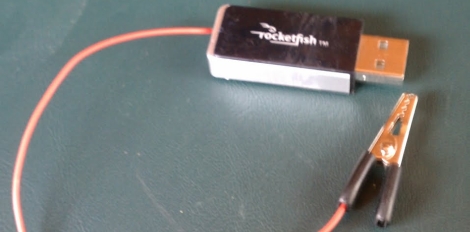
[Kyle] was digging through a box of junk he had lying around when he came across an old USB Bluetooth dongle. He stopped using it ages ago because he was unsatisfied with the limited range of Bluetooth communications.
He was going to toss it back into the box when an idea struck him – he had always been a fan of WiFi wardriving, why not try doing the same thing with Bluetooth? Obviously the range issue comes into play yet again, so he started searching around for ways to boost his Bluetooth receiver’s range.
He dismantled the dongle and found that the internal antenna was a simple metal strip. He didn’t think there would be any harm in trying to extend the antenna, so he soldered an alligator clip to the wire and connected the CB antenna in his truck. His laptop sprung to life instantly, picking up his phone located about 100 feet away in his house. He took the show on the road and was able to pick up 27 different phones set in discoverable mode while sitting in the parking lot of a fast food chain.
While it does work, we’re pretty sure that the CB antenna isn’t the most ideal extension of the Bluetooth radio. We would love to see what kind of range he would get with a properly tuned antenna.
Keep reading to see a quick demonstration of his improvised long-range Bluetooth antenna.
[youtube=http://www.youtube.com/watch?v=RtIKzhHcInk&w=470]












My microwave kablaminator does what now?
as has been noted there’s a lot of RF stuff that is not well, completely explained. I suspect what’s going on here is it’s just a larger ant, clip lead wire, CB ant, etc. VSWR is probably terrible, and the comments about a CB ant not being the right frequency are true, and the coax probably has huge loss also true, but in this case that really doesn’t matter. It’s just more “ant”, more physical area to pick up RF. It would have been nice if he’d gone to one spot and tried the BT dongle plain, with the clip lead, and then with the CB ant attached. For comparative results. Oh and yes high VSWR can damage a transmitter, but at the power levels of BT or even WIFI the devices are robust enough they’d probably just use a little more current than usual and get a little warmer, that’s all. of course as usual YMMV.
Video removed, any one have an alternative link? Or a written description?
In the author’s defense, if you are wardriving BlueTooth, aren’t you red-shifting the transmissions behind you making them PurpleTeeth signals? Plus, if you lookup a related Vespa scooter hack, you can boost the top speed so much that the red-shifted PurpleTooth signal falls into the CB band, as long as it’s behind you. Hope THAT resolves any further confusion regarding pesky impedance matching. I mean think people! So the BS isn’t the antenna impedance matching, it’s that the dongle is not going to see a signal in the BlueTooth band. Obviously. Oh, yeah… Also the Hyper-Vespa speeds won’t allow enough time to connect…. Hmmm…. Never mind then. Have a good day. (This is like Tom Sawyer and Hack Finn).
None of that shit you even said is even real. Stupid newfag furfag
You guys are such pathetic new fag kiddie scripts with you half assed shit articles and writing each others names with stupid punctuation and parenthesis marks around your name. Retard autistic dick suckers.