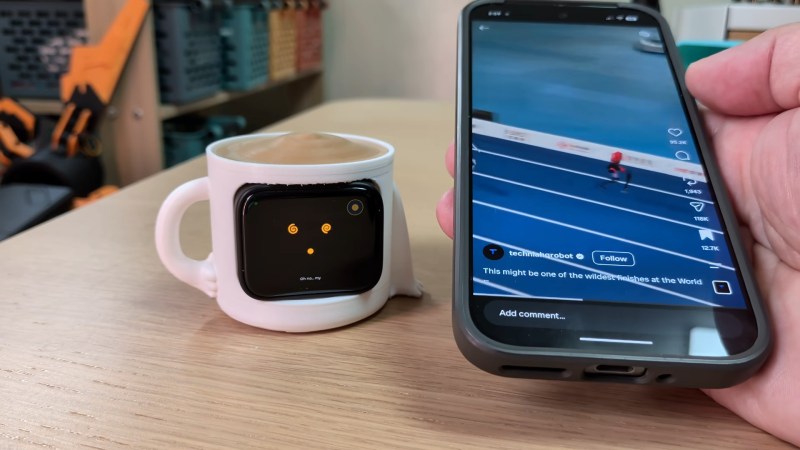
The virtual pet showing a distressed face while a phone is in use

Anti-Doomscroll Tamagotchi Only Lives If You Do

The odds are, you have a device deliberately designed to be addictive in your pocket or on the table next to you if you aren’t staring at it right now– your smartphone. We’ve seen a number of projects that try and help people control or moderate their phone usage using a variety of techniques; this vitual pet by [brenpoly] does it by weaponizing human empathy, and our bizzare ability to pack-bond with literally anything.

The virtual pet itself is based on an ESP32 in a cutesy 3D-printed case, and we think it would probably work well enough if it just had hard-coded behaviors based on hooks in what you’re doing on your phone– the “my little buddy is sick because I’m doomscrolling” should be effective enough on its own, and that part is hardcoded on the ESP32 along with the regular virtual pet behaviour–but this is the year of our Llama 2026, so there has to be an LLM in there somewhere, right?

Some people would leave this part out, but we think [brenpoly]’s use of a local LLM on the phone does improve the project. The local agent doesn’t just have access to his screen time, but his notifications, too, and runs a whisper model linked to a microphone in the virtual pet via bluetooth. So you can get the contents or a summary of your notifications without looking at your phone, or just ask the little guy to tell you a joke. Giving the pet a voice with a the local piper model is also more effective at getting you to put your phone down when you hit the limits.

They’ve put the whole thing up on GitHub if you want to make your own– and if we can keep one person from strapping themselves to a shock collar, then this project is doing good in the world. If helps [brenpoly] or any of his fans do less scrolling and more hacking, that’s even better. Of course there’s a whole spectrum between “electrocute yourself” and “lovable virtual pet” when it comes to controlling your phone use, a spectrum that includes phone stands or even smart vaults for your device.

Thanks to [brenpoly] for the tip! Remember, all of your doomscrolling is justified if you find something to send to our tipsline. 

Continue reading “Anti-Doomscroll Tamagotchi Only Lives If You Do”

Free Your Rotary Telephone From Its Wire

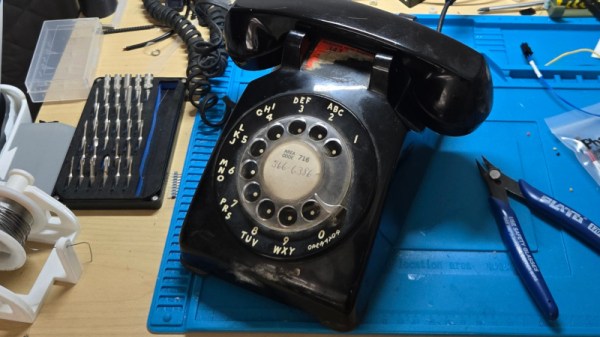
It’s said that a teenager given a rotary telephone in 2026 would be mystified by its operation, yet there are enough surviving instruments for them to be an attractive target for a project. But just what project? [fregacmols] is here with one possibility, turn that old phone into a cellphone.

Connecting to the phone is a subscriber-line interface module, containing all the electronics to simulate a copper phone line. This in turn feeds audio and control wiring to a Lilygo ESP32-S3 board which provides the brains as well as talking to a cellular modem. We especially like that this allows the phone to be used entirely unmodified.

The software does a good job of simulating a North American subscriber line, complete with dial tones, and ringing the phone’s bell on an incoming call. There are a couple of special codes, one to open a wireless network for maintenance, and the other for diagnostic purposes.

Over the years we’ve seen many rotary phone projects, but one which sticks in our mind used an alternative way to connect one to the cellular network.

Bluetooth Shock Collar Keeps Wearer On Task

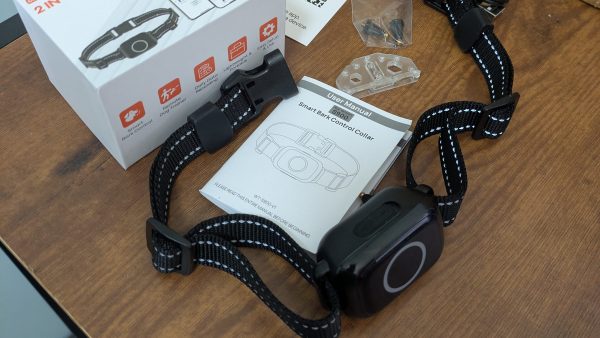
Like a lot of us [Liam Kloppers] had a problem with doomscrolling. Unwilling to go cold-turkey because he does find some utility in social media. He tried a number of things before deciding to say “Screw it” and just go full Pavlov on himself with some old-fashioned classical conditioning. Who needs willpower when you have electric shocks to dissuade you?

The key here was finding an electric-shock dog collar that could be controlled via a smartphone application, which meant he could reverse-engineer its Bluetooth protocol and get it linked up to his own software. The initial implementation ties his quick-and-dirty Python control program with a web server living on his laptop, which he’s configured MacroDroid to call on when his personal criterion for ‘doomscrolling’ is met.

With the shock collar wrapped around his leg, [Liam] was ready to test. It turns out dogs are a lot tougher than people, because even when set to a low level, the shock from the device made him toss his phone across the room and had him hesitant to even pick it up again.

Since he couldn’t bring himself to put the shock collar back onto his leg, he’s now thinking of an audible alarm, something we’ve seen work before. If you’re as unhappy with your habits as [Liam], perhaps consider a device like Commodore’s social-media-free phone before resorting to self-electrocution.

Terminus Is A Text Only Phone Because Telephony Is Dead Anyway

This may say more about us than the current state of the telephone network, but unless your Grandma is still kicking, how many phone calls do you take that are actually worth picking up? Around here it’s one variety of scam or another, with the odd cold-calling salesperson to round it out.

So when we saw [Bolan Xu]’s texting-only TERMINUS cell phone project, it took but a minute to decide that, yeah, we wouldn’t miss the telephone part of the phone very much either.

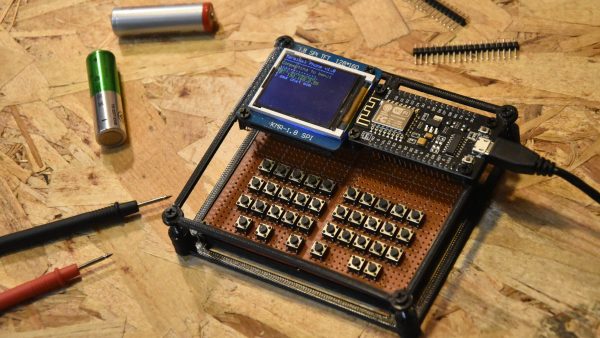
The trade-offs are immense when compared to your smartphone; there’s no voice, no web browser, no social media, and no camera. But on the flip side there’s also no spyware and no annoying spam calls. Besides, he’s built a QWERTY keyboard onto this thing, and that does seem to be what most of us miss in this era of black rectangles.

In terms of electronics, its rocking a tiny OLED display for you to read your messages on, driven by an ESP8266. When WiFi is available the plan was to bridge over the internet in an SMS version of VOIP, but [Bolan Xu] ended up installing a cellular modem in it anyway.

As you can tell from the skeletal case, this is very much a prototype, but it is a promising project. We’ve seen ESP-based phones before, but they tend to be a bit smarter, and run on ESP32 instead of the more modest ESP8266.

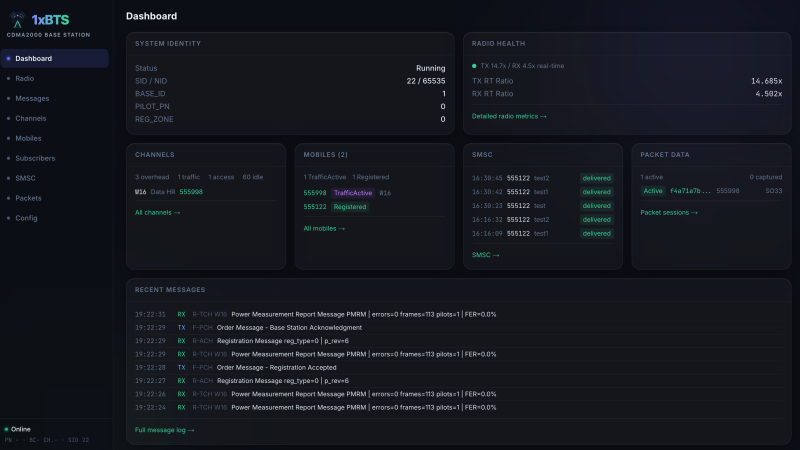
A web interface is shown providing information about a cellular network base station.

Running Your Own 3G Network

CDMA2000 was one of the protocols defined for 3G networks and is now years out of date and being phased out worldwide. Nevertheless, there are still vast numbers of phones that will happily connect to it, creating an opportunity for hackers seeking to run their own cellular networks. [Chrismoos] recently made this endeavour significantly easier by releasing 1xBTS, a Rust implementation of the lower three layers of a CDMA2000 network.

The lowest layer of the stack is an SDR for the actual radio communications. It’s been tested with the USRP B200 and B210, the LimeSDR Mini 2, and the BladeRF Micro 2.0. The code might work with certain other SDRs using the SoapySDR abstraction layer. The SDR is controlled by the base station (BTS) software, which, in turn, is controlled by the base station controller (BSC) over an Abis link. The BSC manages channels and mobile device associations, and exchanges frames with the mobile switching center (MSC), which handles message switching.

Continue reading “Running Your Own 3G Network”

Front and back of the prototype phone

Neither Android Nor IOS: DIY Smartphone Runs On ESP32!

You may or may not be reading this on a smartphone, but odds are that even if you aren’t, you own one. Well, possess one, anyway — it’s debatable if the locked-down, one-way relationships we have with our addiction slabs counts as ownership. [LuckyBor], aka [Breezy], on the other hand — fully owns his 4G smartphone, because he made it himself.

OK, sure, it’s only rocking a 4G modem, not 5G. But with an ESP32-S3 for a brain, that’s probably going to provide plenty of bandwidth. It does what you expect from a phone: thanks to its A7682E simcom modem, it can call and text. The OV2640 Arducam module allows it to take pictures, and yes, it surfs the web. It even has features certain flagship phones lack, like a 3.5 mm audio jack, and with its 3.5″ touchscreen, the ability to fit in your pocket. Well, once it gets a case, anyway.

Continue reading “Neither Android Nor IOS: DIY Smartphone Runs On ESP32!”

Pi Compute Module Powers Fully Open Smartphone

With the powerful off-the-shelf hardware available to us common hardware hobbyist folk, how hard can it be to make a smartphone from scratch? Hence [V Electronics]’s Spirit smartphone project, with the video from a few months ago introducing the project.

As noted on the hardware overview page, everything about the project uses off the shelf parts and modules, except for the Raspberry Pi Compute Module 5 (CM5) carrier board. The LCD is a 5.5″, 1280×720 capacitive one currently, but this can be replaced with a compatible one later on, same as the camera and the CM5 board, with the latter swappable with any other CM5 or drop-in compatible solution.

The star of the show and the thing that puts the ‘phone’ in ‘smartphone’ is the Quectel EG25-GL LTE (4G) and GPS module which is also used in the still-not-very-open PinePhone. Although the design of the carrier board and the 3D printable enclosure are still somewhat in flux, the recent meeting notes show constant progress, raising the possibility that with perhaps some community effort this truly open hardware smartphone will become a reality.

Continue reading “Pi Compute Module Powers Fully Open Smartphone”