
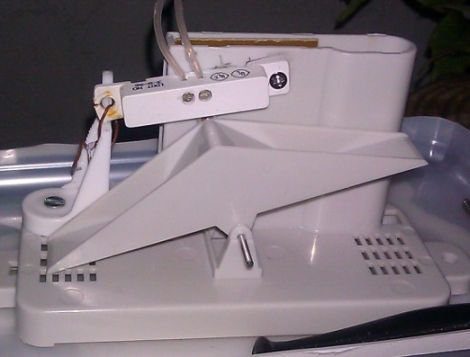
One thing that annoyed [Jashua] to no end was hearing his automated sprinkler system kick on in the middle of the night, when it had rained earlier in the day. He wished that his sprinklers were a bit smarter, so he decided to give the system an upgrade.
Rather than pay hundreds of dollars for a more sophisticated automation system, he spent about $45 on supplies and scrounged together some items he had sitting around the house to make a rain-sensing module of his own.
The resulting project, Pysprinklers, uses Python along with a handful of components to better manage his water usage. He got his hands on a cheap rain gauge, and modified it with a game controller and a set of magnetic surface contacts. If there has been a significant amount of rain in the last 24 hours, his system will prevent the sprinklers from turning on. Additionally, if there is rain in the forecast, the sprinklers will be delayed a bit to see if rain makes its way into the area.
We’re all for saving money (and water), so we think [Jashua’s] system looks great, especially because he ended up using a handful of things he already had on hand.











In my old home town, there was actually an ordinance against watering in the middle of the day, and watering the sidewalks. The local groundwater table was very low and the local farmers were on drought water rations.
Here in Sacramento, my stupid apartment complex waters at night, but 50-75% of the water is running down the storm drain, and I know of at least one sprinkler that’s been broken for months, gushing gallons right into the driveway.
While I don’t believe the hype about shrinking water supplies, in a relatively dry state it’s frustrating to see the waste.
Good job!
Link broken, 10/19/11 12:31 EST
If you live within the vicinity of anyone else that happens to be uploading their rain gauge data to wunderground, you could scrape their weather station data as a comma delimited file off the website. (ie. http://www.wunderground.com/weatherstation/WXDailyHistory.asp?ID=KCASACRA58&format=1 )
I believe you mean “wastes LESS water”
A much better solution is to landscape with vegetation appropriate to the local climate which does not need human-supplied water.
Pretty cool…I want one with a soil moisture sensor and RTC…. is it 0800? Is the soil dry? Water!
I’m pretty sure a sprinkler system that doesn’t waste water is kinda impossible…
depends, if it fed a population with nowhere else to get food i wouldtn call it a waste.
all depending on design of course
I recently saw a design for a solar powered still that circulates early morning air through buried underground pipes that are slightly slanted, creating a large amount of condensed water that’s collected in a plastic drinking fountain bottle. total cost is very low, and it uses next to no power, but it collects a great deal of water. Then that water can be applied directly to plant roots. (the two systems are installed at the same time)
Embed drip watering tubes (cheap to make at home but a little effort to install) and water only when a simple moisture sensor says to.
Rainbird makes a simple “sensor” to provide the required data. A plastic cup about the size of a shot glass faces skyward, supported by a stick up its middle and lifted by a small spring. When enough rain falls to matter, the cup gets heavy with water and compresses the spring. As it moves downward, a magnet attached to the cup approaches a reed switch which inhibits watering. The amount of evaporation which “empties” the cup approximates the evaporation time before the yard will again need watering, the magnet rises, the reed switch opens, and watering is enabled.
One moving part, zero power required for operation, no calibration, and surely under $5 to make. Some problems are more easily solved by thinking outside of the microprocessor box.
You need a microprocessor to check the forecast though.
This type of apparatus already exists. All four major irrigation manufacturers (Toro, Hunter, RainBird, and Irritrol) offer their own versions. Toro will be releasing a very simple, inexpensive, and universal wireless soil moisture sensor in 2012.
If you mispronounce Pysprinklers as piss sprinklers, you get a bonus funny mental image. (Yeah, I’m like 8.)
If you readd most news articles nowadays you will find that
game programming is on the rise despite the fact that thhe economy iis apparently struggling.
The console was called the Magnavox Odyssey and it sold for $100.
Of course, there are many platformer games that followed and wiull continue to follow.
That’s not to say there aren’t other hot vampires out there *coughs* Momica Bellucci in Dracula *coughs* but I wanted
Rayne to take a bite out of me back when gkth was still taboo.
The researches propved that the ability of working together voluntarily to help others
is found in those children who play pro-social kids
video games. On the other hand, when game playing is addictive, it takes
over as the person’s main way of dealing with life, with
other important areas of life being neglected or disrupted as a result.
Entertainment is just about the most important characteristic.
Hi there, I desire to subscribe for this webpage
to get newest updates, therefore where can i do it please assist.
Un-fortunately there just wasn’t room in the new
car to place an oil cooler without a big redesign of the engine space; something that would cost time and money on the project and also ruin the new cars carefully tuned aerodynamics.
For example, paraffin, a common refined oil component, causes refined oils to thicken and flow poorly
in cold temperatures. The dilemma with the Turbo, is that when the engine is
shut down temperatures climb rapidly, while at the same time
oil circulation (That also cools the bearings) ceases.
71 seconds with a trap velocity of 122 miles for
each hour. This pair of fleshy cluster of tissues ‘traps’ the
incoming germs and infections before it even reaches inside us.
He has been performing a variety of motorcycle stunts, and these have been immensely popular television exhibits in the entire nation.
It is most likely that a family member or a friend knows of a good defense attorney or has used one before.
While accidents of this nature happen all the time, not all of them have happy endings.
The Dalai Lama is a strong proponent of restorative justice, and has taught that “the more evil the crime, the greater opportunity for grace.
I enjoy, cause I discovered exactly what I used to be having a look for.
You have ended my four day lng hunt! God Bless you man. Have a great day.
Bye
Why visitors still use to read news papers when in this technological world everything is existing on web?
1) Create an image container and position it relatively on the web page.
And finally, what about when one person masturbates another.
Go to the bathroom before you set up your cameras ‘ it’s gonna be awhile before
you get back home.
Starving artists are loading amazing graphics you can acquire cheap on bloodline.
Tonight’s episode of Teen Mom 2 started out with a big realization from Kailyn: it wouldn’t
be fair to Jo or Isaac to move to Texas. ” CBS cameras captured Eldrick Tont snapping at himself after a poor shot during the 2010 Masters.
Aw, this was a really good post. Taking the time and actual effort to create
a very good article… but what can I say… I put things off a whole lot and don’t manage to get anything done.
Thanks for finally talking about >Python powered sprinkler system wastes no water | Hackaday <Loved it!
Terima kasih atas berbagi Artikel yang menambah pengetahuan saya,
sekali lagi thanks buat berbagai inspirasinya
Porn addiction recovery, just like other forms of addiction is a long road for addicts to travel.
Secondly, once you get addicted with pornography, chances are you will become
increasingly entrenched in it over time. Yes,
willpower will help for a while maybe, but your will fall back into your addictive habits sooner or later.
I’d like to find out more? I’d like to find out some additional information.
It’s amazing in support of me to have a website, which iss
helpful in support of my know-how. thanls admin
Thank you, I have just been looking for info approximately this subject for ages and yours is the best I’ve found out till now.
But, what about the bottom line? Are you positive concerning the source?
On television and movies, women are portrayed as voluptuous vixens that need to be adored for their beautiful and sexy body.
Courtney Stodden got bigger boobs and photos posted
online show her sashaying around in a tiny black bikini.
Living with large breasts is troublesome for some women because they have different
mindset about big breasts.
I’m amazed, I have to admit. Rarely do I come across a blog that’s equally educative and engaging, and let me tell
you, you have hit the nail on the head. The problem is an issue that
too few folks are speaking intelligently about. I am very happy I
came across this in my search for something relating to this.