
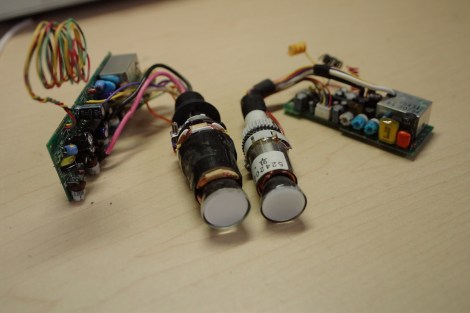
Every smartphone (and most dumb phones) has a video camera built into it these days. Some of them are even capable of recording respectable HD video. So we’d bet that the decades old camcorder you’ve got kicking around isn’t getting any use at all anymore. [John] wants to encourage you to hack that hardware. He published a post showing just how easy it is to salvage and use a camcorder CRT.
The gist is that you simply need to hook up power and feed it video. The board that is attached to the CRT has its own voltage hardware to drive the tube. He demonstrates a 9V battery as a power supply, but also mentions that it should be pretty easy to power the thing from a USB port. As for video, all it takes is a composite signal. Of course you’ve got to determine the pinout for your particular CRT module. The method he chose was to use a continuity tester to find the path from a capacitor’s negative leg to the appropriate pin header. Next he used a bench supply to inject a current-limited low voltage until he saw response when probing the pins. Finding the composite-in is a similar trial and error process.
So what can you use this for? Why not make it the display for a simple video game?











I had one I was going to use with one of the gameduino boards, but I accidentally fried the crt board when I shorted something . Oops!
Sometimes you can find the pinouts for the viewfinder connectors online.
Talk about good articles today.
What I do is look up the chip that’s on the board: most viewfinders use a more-or-less well-documented integrated viewfinder chip. Trace out the pins of that to the header, and you should be in business.
Perfect for RapberryPI :D
yeah i thought about these for the pi when it first was introduced
then you can make it and say
“what is this, a computer for ants?”
Hard part’s finding a color CRT viewfinder. When they went color they went LCD for the most part.
Color CRT is not really battery friendly technology. The shadow mask means much higher anode voltage and higher currents are required. Plus color decoding circuitry, convergence controls and three copies of the grid amp circuit. Even the very first color pocket TVs were LCD, when the monochrome equivalents were still using CRTs.
They are out there…but they seem to be going for 150$+ on Ebay.
I have made night vision with this and the lens from old camera. I swapped original CCD with insides of a CMOS pinhole cam module and added few IR leds and CDRW laser for use when zoomed at about 50 meters (yards). I plan to use one of the LCD viewfinders for glasses-display.
You could combine two of these to make a 3D display, right?
3D televisions send two different pictures to your eyes, typically at a slightly different angle to give the sense of depth.
You could do something similar and make a kind of kludgey head-mounted display. Probably tricky to do very well, and in my experience the viewfinders in camcorders provide a poor picture. But it might be neat.
Amazing what went into camcorders in the old days, anyway I could see building this into an HDTV converter box, just for the hell of it.
Great idea… I have 2 converter boxes that are unused.
baby sized crt clock – or better yet wrist watch :P
Wow CRT… Most I find are tiny LCD’s… I’d rather figure out the LCD’s as they are color.
Sure, the LCDs are color, but good luck finding a viewfinder LCD at full 480i or 480p resolution. The quality on the CRTs is ridiculous.
https://picasaweb.google.com/lh/photo/W-iK22ZxwtvPFMNPcjpZutMTjNZETYmyPJy0liipFm0?feat=directlink
is the best photo of mine that I can find easily.
Viewfinders of the Canon XL1 are 480p. Most places are throwing that camer in the trash right now as SD recording to Mini DV is useless. I have 4 of them that I nabbed for $20.00 in “not working” shape.
Nice, does that viewfinder take in composite video? how do you drive it?
I did something similar with a lcd viewfinder as you suggested, a little while ago. I ended up making it into a portable video projector.
http://diytronics.blogspot.com/2011/10/diy-portable-video-projector.html
Finding the power and composite input pins were the easy part. I noticed that when any of a group of three wires were not connected to the camcorder the display would display all black. I hooked it up to a logic analyzer and quickly found it to be an SPI control bus to a ADC to set the contrast, saturation, etc for the display driver chip. I captured the values and wrote a simple driver for a micro to replicate the values and everything worked. Now I have a low res semi-portable battery powered projector.
Correction: I meant DAC not ADC. I need to get some sleep.
TINY (retro)OSCILLOSCOPE!
YESSS!!!
TOS tricorder? The little crt screen was never shown “on” in the show but some color patterns or graphics would be cool. Probably need a mirror and semi opaque screen as the CRTs are smaller than the prop.
I remember doing this in High School with the CRT out of an otherwise broken camcorder. Used a 9v like this one, worked great. Played Super Mario Bros. on it, but that was back when I could focus that close. That was almost 20 years ago, now.
These things are great – I have one in my desk drawer. I was lucky enough to find one in a camcorder that, while borked, still powered the display on.
5V Supply, “active” line pulled high, GND, and Composite in.
One of these days, I’m gonna find a decent IR sensitive camera and make myself a night vision system.
Silicon is very sensitive to IR. Open a cheap digital cam and you’ll find an IR blocking filter in front of the sensor. Google for IR and UV photography and search diy projects.
I think I finally found a use for those video registers in the parallax propeller chips.
Mine runs on 5V, so be careful just hooking 9V up to them. That’s 5V measure as originally provided by the camcorder (which still works, just without a viewfinder now). This was a newer one however, it’s a hi8 camcorder, and reasonably small.
I actually have a 5V regulator on mine, so I can use a 9V to power it (super inefficient, I know, I have another power connector too).
The viewfinder I have from a VHS camcorder I can’t get to work, but I took that apart when I was like 13, so I might’ve done something stupid, I don’t remember. If I remember correctly, the viewfinder was flaky when the camcorder still worked, but when I took it apart, the VHS part was really messed up.
This + Wiimote = Games with zoom viewfinder. Awesome.
“Some of them are even capable of recording respectable HD video. So we’d bet that the decades old camcorder you’ve got kicking around isn’t getting any use at all anymore.”
Non-sequitur.
I did this as well, found a camcorder that had been dropped, most of the mechanical parts had seized up but the electronics were fine.
It took me an hour to figure out the signaling though, i had one typical composite signal, and one very strange signal that synced with the horizontal sync. It turned out the second signal was interference from the tube driver and i was measuring the unconnected pin to drive the REC-LED in the viewfinder housing. Mine also ran on 5V.
The worst part with LCD viewfinders isn’t that they are low resolution, low brightness washed out colors. It’s that they have skipped the composite video step in most cameras. It is cheaper to build the LCD line driver circuitry on the main board and just feed the LCD parallel or series data, often using proprietary protocols.
A lot of 8mm camcorders died of bad capacitors, not sure if the bad caps were in the viewfinder section, but sometimes you can find those camcorders for a low price at 2nd hand stores.
There was a post a long time ago detailing how to use these as viewers for improvised night vision devices.
I have an old Minolta 8mm camcorders. The last time I tried it the view finder had a rolling picture.
Is that something I can fix easily – would extract the CRT from the camcorder to run as a standalone project.
Start by removing the viewfinder and testing it, you have about a 50% chance that the problem is in the signal generation outside the viewfinder anyway.
I’d love to recreate the computer displays from “Brazil” with one of these. All you’d need to do is mount one of those plastic fresnel lens sheets at the right distance from the little tube.
Here’s a picture from the movie: http://i.imgur.com/I2MNX.jpg
Took a while to sort out the four wires to the CRT, 7 to 9 volts seems to work well and built a N Gauge cinema for my layout driven by composite video from a DVD Player. Looks good playing films in black an white, you can even make out the subtitles.
Clever use!
I get a nice picture when coupling through a capacitor, but the screen rolls up 1 or 2 times a second like an old TV with a “vertical hold” problem. Could this be a problem with NTSC vs PAL? The recorder was from USA and video signal from a camera bought in Asia. Alternatively, is this something I can adjust?
Most circuit boards have 3 adjustable preset pots that adjust the height, width and the horizontal hold to steady the picture. I used a eyepiece monitor and circuit board from a Panasonic M14 VHS Video camera. Hope this is of some help.
Yes, the board has 3 pots… I tried the one that looked accessible but got no joy. Will try the difficult ones later. Also I looked up the controller IC “BA7149f” and it has a note to use a smaller resistor on one pin in PAL systems… That will be a real test of soldering skills as the board has tiny SMD parts.
Just a thought, you could try and tack a higher value resistor across the existing one to obtain the value required using the principle of resistors in parallel. Good luck
Thanks for the good thought… sadly I mis-wrote… PAL actually requires a higher resistor.
Just managed to get my hands on an old busted video camera at the 2nd hand store i volunteer at, managed to get the viewfinder out and got it running on usb power and a composite input :).
still, had 5 wires going to the viewfinder pcb, no idea what the last 2 does yet, will have to investigate further.
The extra two cables are for OSD(on screen display) synchronization.
Hey guys. Hope someone is still watching thus thread. I’m hooking up a crt viewfinder to an IR camera and I’ve run into a snag that I can’t figure out. Both the camera and the crt are run from separate 9v sources that are run through 5v regulators. Everything works finr, but the image only appears on the crt when I have the additional composite out jack hooked up to a tv. I think maybe I need a resistor running on the signal line from the camera to the crt video in. Any ideas?
Do you have ground from both regulators connected together? If you are running from battery and the two are not connected then they are not in circuit.
In the end I dropped it down to one 9v source and it still did the same thing. I need a resistor circuit or something that drops the voltage on the analog feed line from 2 to .70. I decided to move on to a 1.5 inch diagonal TFT with analog board as my display instead of the CRT. It’s a lot more convenient and already has everything I need, including the analog out jack and a 9v supply lead.it will also make my build significantly shorter which is an important factor as I am sticking this on the back of a scope.
thanks for the reply though!
TFT sounds like a good solution, though it is fascinating to see these tiny CRTs working. ….Just a thought as I am not sure of your circuit, but one simple thing to try with the CRT is coupling the analog video feed through a capacitor. Most any small or medium size ceramic disc capacitor would give you a sense if that works. It keeps the input voltage from the feed line independent of the input line voltage, but pass through the AC component of the signal.
Ok, latest snag with version 2.0 (the tft version. ) If you have an idea how I can make both the camera and the tft run when the 9v isn’t enough juice to run both at the same time that would be great. Otherwise I need to add another battery and possibly a Thyristor. If I go that route, do you happen to know a model number of one that is switched on by 9v? I’d prefer not to add another battery though, I’m a bit embarrassed to say that I jumped the gun with my design and forgot to incorporate enough volts to run both components.
I’ve never used thyristors before & don’t see how it would help. Regarding Juice…. a heavy duty 9v battery should provide about 500 ma of current without problems, but would only last an hour or so. Maybe you have a photo battery that does not provide much current. If you check the battery voltage when your hookup is on it should be over 8v. I’m guessing that the TFT and camera each drain about 200ma. Have a look at the specs sheets.
I suck3d it up and increased the box size slightly to accommodate another battery. It only increases overall length by an inch which isn’t that bad, and gives me a bit more space to safely mount the TFT and board. I’ll let you know how it works out. Thanks for bearing with me through this.
Out of curiosity, wondering if my next project would be financially feasible. Do you know of any THERMAL board cameras/ detectors that aren’t super expensive? IR is great and all, but I consider this only my first pass at this project. If I could hook up a thermal imager in place of the IR camera it would actually be worth using in the field.
For a thermal camera, look for a “thermal eye” series on ebay. I got one for $700: 320×240, DC in and composite out. They come with a lens, and there are a variety of other thermal-transparent lenses you can adapt as a solution to custom FOV requirements.
Also, the output rate is 30 FPS which is exceptional compared to most low end FLIR gear.
i have a faulty mono crt viewfinder on a sony tr75e, is there an easy way to test 4 tiny electrolytic caps (220, 330, 2.2, 82 mf) on a spare viewfinder board i bought?
Hello
Where do I find the manufacturer of CRT
Viewfinders – Mini CRT’s MIYOTA 6400
Thanks
Hi, yes bad units can often have dried out fishy capacitors.
Irony: new SMD can be converted into through-hole units if you are very careful.
Only the end 2mm of the pin needs to be trimmed.