
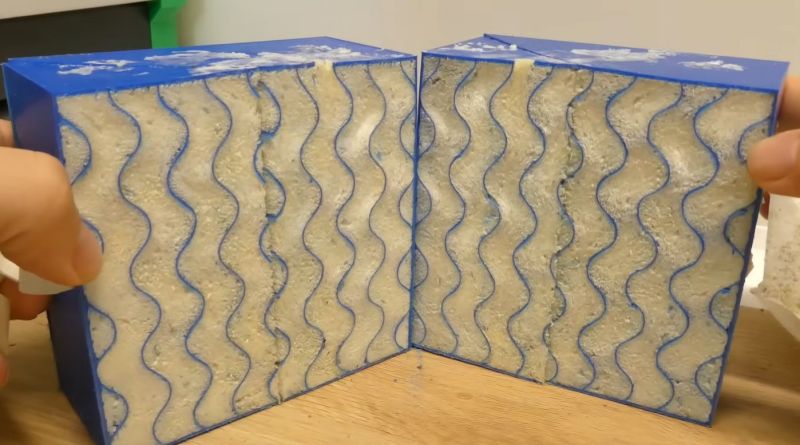
Closed-cell self-expanding foam (spray foam) is an amazing material that sees common use in construction. But one application that we hadn’t heard of before was using it to fill the internal voids of 3D printed objects. As argued by [Alex] in a half-baked-research YouTube video, this foam could be very helpful with making sure that printed boats keep floating and water stays out of sensitive electronic bits.
It’s pretty common knowledge by now that 3D printed objects from FDM printers aren’t really watertight. Due to the way that these printers work, there’s plenty of opportunity for small gaps and voids between layers to permit moisture to seep through. This is where the use of this self-expanding foam comes into play, as it’s guaranteed to be watertight. In addition, [Alex] also tests how this affects the strength of the print and using its insulating properties.
The test prints are designed with the requisite port through which the spray foam is injected as well as pressure relief holes. After a 24 hour curing period the excess foam is trimmed. Early testing showed that in order for the foam to cure well inside the part, it needed to be first flushed with water to provide the moisture necessary for the chemical reaction. It’s also essential to have sufficient pressure relief holes, especially for the larger parts, as the expanding foam can cause structural failure.
As for the results, in terms of waterproofing there was some water absorption, likely in the PETG part. But after 28 hours of submerging none of the sample cubes filled up with water. The samples did not get any stronger tensile-wise, but the compression test showed a 25 – 70% increase in resistance to buckling, which is quite significant.
Finally, after tossing some ice cubes into a plain FDM printed box and one filled with foam, it took less than six hours for the ice to melt, compared to the spray foam insulated box which took just under eight hours.
This seems to suggest that adding some of this self-expanding foam to your 3D printed part makes a lot of sense if you want to keep water out, add more compressive strength, or would like to add thermal insulation beyond what FDM infill patterns can provide.











It’s great for automotive body and frame repair too! (just kidding!!!!)
Hey, don’t knock it. I made it through a couple of years with a Datsun held together by polyurethane foam with old licence plates brazed on to add structural support and fill the bigger holes. Some Bondo and rattle-can top coat and it doesn’t even look too awful.
You can infer from the name “Datsun” that it predated all this airbags and seatbelts and crumple zone stuff, so it was perfectly safe to do body mods like this: they didn’t reduce the safety of the car at all!
Man I miss the days of stupid dumpster car projects where a running motor, a rally track, and a good laugh were all that were required. After that, redneck engineering all the way to the moon.
definitely… that’s how I built the countries only rear engine, front bedded pickup truck…
slid into a cab one winter which crumpled the front, as it’s supposed to, so I bought some new hacksaw blades, a bunch of beer & cut off the damage. Rebent some metal and added some oldsmobile headlights and away I went… :)
No to frame, yes to body repair! Placing a couple trash bags between inner and outer shell of an old van and filling with foam kept mice out (don’t know why), and air leaks for a few years… not kidding
Our shipping department did something like that. Bought it by the drum.
It’ll reinforce your aluminum hood for those high speed vibration issues.
People love to use it for stuff like that but it can trap moisture and does deteriorate over the years and become not only a sponge but a really hard to remove one.
Also burns really well if anyone ever has to weld near it.
Reminds me of the time when my gramps tried to sound-proof his old Volkswagen to reduce the tire noise in the cabin, by spraying inside the door panels and other voids around the door with urethane foam.
It kinda worked, except for the point where the car’s frame would shift and bend, and cause the foam to squeak as it rubbed against itself. Open the door, squeak squeak, drive over a speed bump, squeak squeak…
I used this ages ago to make little boats that floated around and measured turbidity in silt settling ponds. They all eventually waterlogged and sank (to some degree) but some lasted quite a while. Sections of PVC down pipe, capped at both ends and braced to make little Catamarans were the answer.
Fishing floats? Ping pong balls?
Needed to carry a reasonable sensor payload (ph, turbidity, micro, batteries, solar etc). It was in the ‘3D print all the things’ phase. The downpipe catamaran was way more storm proof and substantially more stable.
That’s what we do, but we use the 90°-bends of 110 mm pipe to make a “doughnut” float.
Spray foam may have a great application in 3d modeling. It is use in the shipping industry to make boats float. But it will water log. If a desire to fill filament style prints….perhaps a vacuum process to exchange air and a cure material that will solidify
I’ve wanted to use spray foam to fill the wheels of a Big Wheel tricycle so it wouldn’t sound like a bad drum solo when it goes down the sidewalk.
If you’re going to use this to make something float and you need it to last for years, be sure to use expanding foam intended for that purpose. The kind you typically get in a spray can from the hardware store will eventually become waterlogged.
Indeed. A very long time ago I helped build a bunch of fibreglass kayaks for our scout troop. One of the final steps was to add buoyancy to the nose and tail. Being that the tins of two-part expanding foam was ferociously expensive we stretched it out by breaking up pieces of expanded polystyrene foam into chunks and ramming those down whilst the kayak was stood vertically on its nose.
Once that was done we drizzled expanding foam down onto that to seal and lock it in place. It turned out perfect for every kayak, fourteen built in total. Yes we did test to see if the mix dissolved the polystyrene before we did this.
Ha, neat idea. Will have to keep that in mind!
I have used it in a speaker to fill the void between printed transmission line and wooden enclosure.
To make FDM 3d prints watertight and even threaded pipe low pressure water connections work, dip them in melted paraffin wax.
Great idea for certain use cases. Thank you.
Great for filling voids, huh? Will it work on my being?
Yeap, it will. But only one time that you will know. (Addendum for the idiots… Don’t try…).
Maybe “only once” is all that is needed.
Only once does not restrict the bad engineering attempts
Yes, if taken as a suppository.
You can also use the foam to dampen resonance in telescope piers and other structures. After a single can was added a pier that resonated like a bell was completely silenced.
Silence? Probably just changed the resonance frequency
I use epoxy resin to coat FDM prints, I’ve even made propellers for electric motors. It fills in all the micro voids and makes great structural parts.
Epoxy works well on PLA, OK on ABS or ASA, not so well on PETG.
Finding the right foam is the key. Different brands, formulations, and even batches can vary wildly in adhesion, initial viscosity, spray behavior, expansion, set-up time, and final hardness & consistency. Application temperature is a thing, too; even humidity. And most have a shelf-life, even if they claim they don’t. Some smell horrible long after application, too… that can be a problem – possibly even a health problem.
Also, cost isn’t necessarily a good metric to measure quality for the application. I had a $4.99 can of generic stuff perform much better for what I needed than the $15 name brand. Experimentation is required. It’s a serious pain to remove this stuff and start over.
This stuff is two-part so doesn’t require water, and is water-resistant once cured. The parts are in separate bags which must be opened and transferred to separate (tightly sealed glass, metal, or thick PE or PP) containers. Respirator or work outdoors; and GLOVES. Weigh the containers beforehand so you can calculate the mix ratio; it’s not exactly 1:1. I’ve used it over six months later.
https://www.menards.com/main/building-materials/concrete-cement-masonry/bagged-concrete-cement-mortar/fast-2k-trade-foam-deck-and-fence-post-anchor/259/p-4221069731064437-c-5648.htm
Unless you have a large print or lots of smart ones to fill you are going to waste a lot of foam.
Those cans of foam are one time use and then they clog.
You have to use the whole can right away and you can’t save any for later.
Unless you go steal some more straws from the other cans on the shelf at the store.
And even then it still probably won’t work.
You have only a short window to use the can or else it clogs.
So this is really very wasteful unless you have a lot of prints or plan on doing another project at the same time that requires the rest of the foam
They are, but there are pro foam dispensing guns that address the one use problem.
https://www.homedepot.com/p/GREAT-STUFF-PRO-Pro-14-Insulating-Spray-Foam-Dispensing-Gun-99046685/300841046
Can’t you print more straws?
The foam in the straw and dispenser is easily cleaned-up with acetone and a piece of baling wire.
I have had success cleaning the nozzle and hose of those cheap cans of foam with acetone after each use.
I’ve 3D printed some oilways, from PETG, for my cnc lathe. I haven’t yet tried them, but I’m now wondering if they’ll leak? I know that filling them with expanding foam isn’t the answer, but I wondered if anyone had suggestions / experience?
I 3D printed some self-watering planters. I used Polymaker Polyterra PLA (now Panchroma Matte). The bottom piece is a water reservoir, and I haven’t noticed any leaking. I followed Prusa’s guide to water tight prints.
Could be good for rocket parts, like nose cones. Print in vase mode, fill, and of course, smooth with filler primer and paint.
Never, never, never use spray foam without rubber gloves…..again. You’ll be peeling it off for days. Also be careful as propellant is flammable. Don’t ask me how i know these things!
wrt to ‘water logging’. There are two types of foam: closed-cell and open-cell. The latter seems most common and it’s lighter that former but can absorb water and become waterlogged. Closed-cell foam is water-tight but also heavier and more rigid.
Open cell foam is also known as “sponge”. It has zero flotation benefits.
The issue is that some (many?) of the closed-cell types (especially the polyurethanes, it seems) are permeable to water vapour, which slowly causes water infiltration, even in the nominally “closed” cells.
Not an expert here, but polystyrene seems to behave better. Much better still are the so-called “syntactic’ foams with incompressible and vapour-impermeable (and mechanically tough) glass microspheres.