
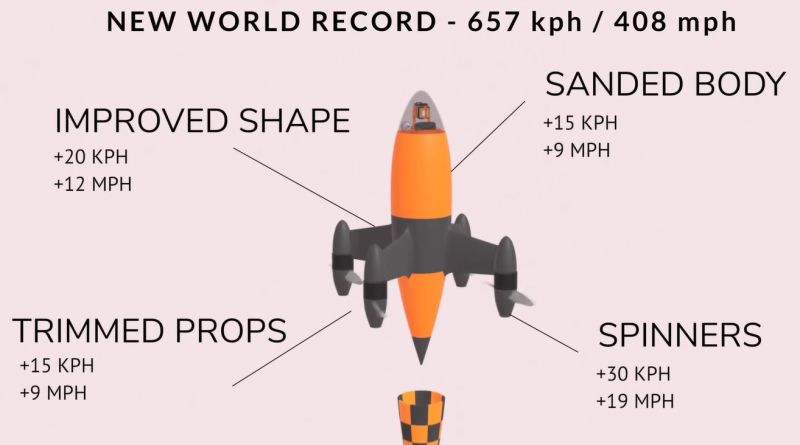
 The fun part about world records is that anyone can take a swing at breaking them, which is what [Luke Maximo Bell] has been doing with the drone speed record for the past years, along with other teams in a friendly competition. After having some Aussie blokes previously smash the record with a blistering 626 km/h, the challenge was on for [Luke] and his dad to reclaim the title. This they did with the V4 of their quadcopter design, adding a range of improvements including new engines, new props and an optimized body to eek out more performance.
In the video we see these changes and the tests in detail. Interestingly, the simulations ran on the computer showed that the new body actually had to be larger, necessitating the use of a larger FDM printer. Fortunately a certain FDM 3D printer company sponsors just about everyone out there, hence the new design was printed on a Bambu Lab H2D, also making use of the dual extruder feature to print combined PETG/TPU parts.
It was also attempted to have a follow camera attached to a second FPV done in the form of a 360 degrees camera, but this turned out to be a bit too complex to get good shots, so this will have to be retried again.
In the end a new world record was set at an average of 657 km/h, which sets the stage for the next team to try and overtake it again. As for where the limit is, propeller airplanes have hit over 800 km/h, so there’s still quite a way to go before details like the sound barrier become a problem.












408mph? Needs to reduce drag before it flies 33% faster like this…
World’s fastest RC aircraft hits a stunning 548 mph https://newatlas.com/aircraft/dynamic-soaring-speed-record-spencer-lisenby/
or https://www.youtube.com/watch?v=4eFD_Wj6dhk
Why they don’t use propellers with higher blade count instead of cutting the tips? Before WW2 some planes still got props with only 2 blades, at the end of WW2 the latest Spitfire got a 5 blades prop. You reduce the rpm while using the same power from the engines.
You lose efficiency as the blade count goes up, because each blade incurs drag. 1 blade is the most efficient, with the slight caveat that it’s wildly unbalanced :D
1 blade propellers were commonly used in control line speed planes.
So why does the fan in every turbofan engine have a high blade count? The largest, most efficient engine (the GE9X) has 16 blades.
Fewer blades are more efficient for open propellers due to tip losses. Ducted fans with sufficiently tight clearances between the blade tip and duct make that a non-issue, but that comes with costs and difficulties of its own.
That has to do with air ‘compression’ to get more power. The fans aren’t driving the jet. The exhaust is.
Hunh? The turbojet core is providing the power to the fan. The fan is moving the vast majority of the air: 90% in the case of the GE9x. That is where most of the thrust comes from.
So what do you mean by “The fans aren’t driving the jet.” ?
Turbo fan ≠ turbo jet.
Rather than repeat what is already common knowledge :
https://www.century-of-flight.net/turbojet-vs-turbofan-explained/
rclarke: Sure, that’s pretty standard stuff, but still doesn’t explain your odd statement of ” The fans aren’t driving the jet. The exhaust is.”
The turbojet core is the power plant providing power to the fan, by the turbine in the exhaust stream extracting power from the jet exhaust. The momentum imparted by the fan on the air passing through it produces the bulk of the thrust of the engine. The exhaust gas out of the turbojet itself produces a relatively small fraction of the total thrust of the engine. So your statement is confusing, at least.
What about a ducted fan version
Can we either not overuse the word “drone” to the point of meaninglessness, or at least add some qualifiers to make it factually correct? They didn’t get a record for “fastest flying drone”, they got a record for “fastest ground speed by a battery-powered remote-controlled quadcopter”
A QF-16 is a drone (Mach 2). A D-21 was a drone (Mach 3). The X-37Bs are drones (Mach… 20something? starts getting fuzzy). Heck arguably the Parker Solar Probe is a drone.
This isn’t to demean their work; it makes it more impressive that they hit that speed with a battery quadcopter.
I think this battle was lost some ten years ago when quadcopters became popular and everyone called (calls) them drones.
TBF they do drone
Heck, I don’t even mind (that much) calling it a drone. My pedantic side wants to limit “Drone” to something like “UAVs that can follow generic commands, such as Cruise or Hover or Land, without low-level pilot input” to avoid lumping in R/C model airplanes – even that gets blurry with things like multicopters that would crash instantly without the electronic abstraction layer between pilot input and direct control of the rotors. But fine, this quadcopter is a drone.
But that’s just not a very descriptive word, especially not for setting a record! The current world record for fastest electric R/C car was recently set by Stephen Wallis at 234.7mph, which would probably also make an interesting HaD article, since his car is a bit of a hack using quadcopter components to make a car. But you wouldn’t title an article on it “world record for fastest driving car”, because that’s just misleading.
Yeah this was my thought. I was trying to understand what the category is that they are trying to be king of. Is it quadcopters? Is this the fastest quadcopter?
*eke not eek. Akshually.
Thank you. Beat me to it. Speech-to-text gone awry, or confusion on the part of the author?
So, has a similar design shown up in Ukraine yet?
Attach warhead and you cut speed in half https://en.wikipedia.org/wiki/Sting_(drone)