
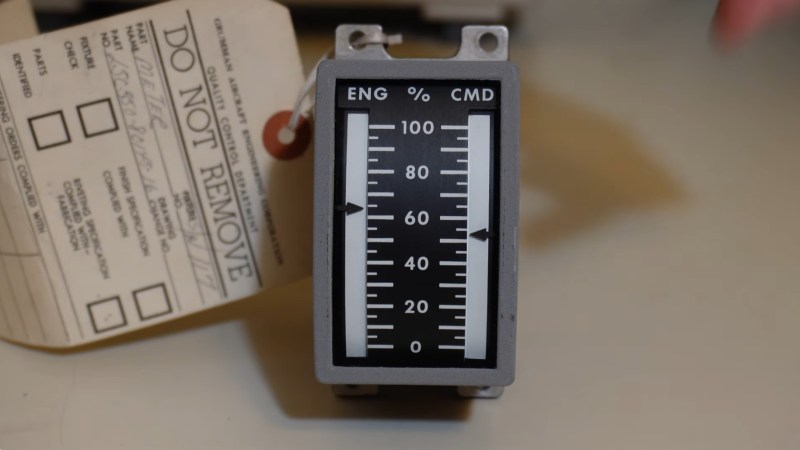
[Mike Stewart] powers up a thrust meter from an Apollo lunar module. This bit of kit passed inspection on September 25, 1969. Fortunately [Mike] was able to dig up some old documentation which included the pin numbers. Score! It’s fun to see the various revisions this humble meter went through. Some of the latest revisions are there to address an issue where there was no indication upon failure, so they wired in a relay which could flip a lamp indicator if the device lost power.
This particular examination of this lunar thrust module is a good example of how a system’s complexity can quickly get out of hand. Rather than one pin there are two pins to indicate auto or manual thrust, each working with different voltage levels; the manual thrust is as given but the auto thrust is only the part of the thrust that gets added to a baseline thrust, so they need to be handled differently, requiring extra logic and wiring for biasing the thrust meter when appropriate. The video goes into further detail. Toward the end of the video [Mike] shows us what the meter’s backlights look like when powered.
If you’re interested in Apollo mission technology be sure to check out Don Eyles Walks Us Through The Lunar Module Source Code.












Please lend this to Curious Marc and Ken Shirriff. They have lots of Apollo stuff and could probably wire this in where it belongs.
Don’t worry, it’s that [Mike]
[Mike] is aleady part of the team. No doubt we’ll soon see a drop from [Curious Marc] featuring this thing in context. Probably no tear-down video from [Ken], though :)
Cool! It looks like one could be emulated with a servo. Perhaps hard stops on a thick, hidden portion of the needle pressing against a stop would keep the needle from being bent.
” pin number” how dare you use a tautology at me? lol. Next thing you’ll be saying CD disc.
” pin number” I suppose you also say CD disk? Why must you use a tautology?
Calm down Karl. Pin isn’t an acronym in this context.
In our area we have MOM stores, with the name being short for Mom’s Organic Market. Let’s see doris and karl wrap their heads around 𝑡ℎ𝑎𝑡 one.