
Check one, two; check one, two; is this thing on? Over on The Public Domain Review [Lucas Thompson] takes us for a spin through sound, as it was in Britain around and through the 1800s.
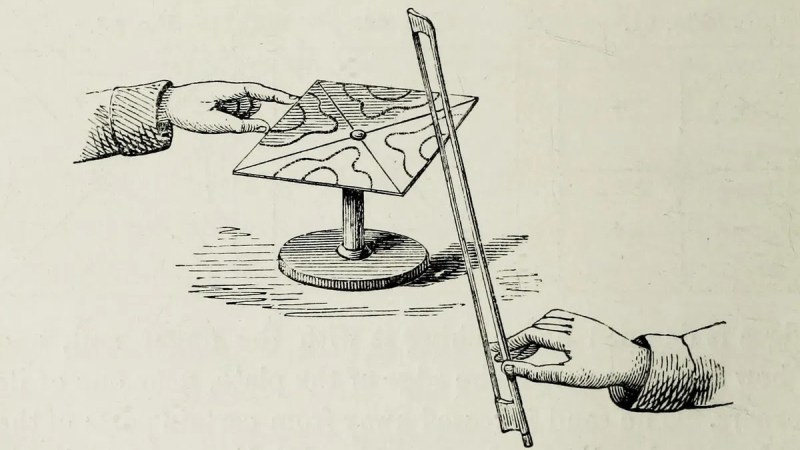
The article begins by introducing the Father of Acoustics, German physicist Ernst Chladni. After placing grains of sand on a thin metal plate and drawing a violin bow along one edge Chladni figures appear, making manifest that which previously could only be heard, that is, sound waves.
It’s fun to think that it wasn’t so long ago that the physics of sound was avant-garde. Middle class Victorian society was encouraged to reproduce cutting edge experiments with equipment in their own homes, participating in a popular science which was at the same time part entertainment and part instruction, for young and old alike. Throughout the rest of his article [Lucas] lists a number of popular science books from the period and talks a little about what was to be found within.
See the video below the break for a demonstration of Chladni figures from The Royal Institution. Of course the present state of the art regarding sonics is well advanced as compared with that of the 19th century. If you’re interested to know more check out Building A Wall-Mounted Sound Visualizer and Seeing Sound For Under $200.











I think we could learn something from the Victorians’ approach to hands-on learning and from their involving children in science experiments.
Although I was born long after the Victorian era ended, I was graced with parents who actively encouraged my interest in electricity and electronics, and in basic chemistry. I was also given several How and Why Wonder Books, as well as my mother’s library card so I could get books from the adult section.
I think that a lot of kids today are being short-changed by their lack of opportunity to learn even simple things such as cooking, mending a tear, fixing a bicycle, etc. We’ve moved so much of the social discourse into the virtual realm that – outside of sports – intensive real-world hands-on experience is becoming more the exception than the rule. Our society is both poorer and less resilient as a result.
When I was growing up, a library card was a very valued possession. My father opened up three different businesses just by reading stuff he picked up at random at the library.
Today, the local library is not a place I would send my kids.
Why not?
Lots of reasons. But WRT to my children and what they are exposed to, the local librarians believe that the porn viewers have the constitutional right to not be segregated from the other users in the public areas.
‘porn viewers’
I highly doubt a public library has porn, so I guess you mean classic art then which you view as ‘porn’.
Or maybe medical textbooks? Or is this about books mentioning gays or something.
@Aknup — I wish you were right, but I mean public computers with Pornhub and YouPorn on them.
I’ve known such people as well. They’re called serial entrepreneurs. Many for the reason that their business ideas didn’t really work since their expertise on the matter was picked up from the public library.
If the cover says “Plumbing for Dummies”, you’re still going to be a dummy after reading it.
My father was more into technical manuals. The businesses he opened were a laundromat, a dry cleaners, and a cultured-marble manufacturer. Why he read that subject matter, I don’t know, but he decided that “hey, I can do this myself”. All the businesses were reasonably successful. I personally learned a lot about hacking working at the laundromat on weekends and summers.
If the cover says “Plumbing for Dummies”, you’re still going to be a dummy after reading it.” Nah, you’ll just be unlicensed. I’m wondering about the silent fetish in the background.
That’s not hoe it works, the for dummy series are for people without prior knowledge and the will have gained more knowledge after reading the material. If they tried out that knowledge in practice they certainly are different from the dummy they were before reading and trying.
Gaining some elementary and trivial knowledge does not yet elevate you above a dummy.
The meaning of “dummy” is the same as “puppet” or “tool”. It means you can repeat simple actions on command though you might not understand them. That’s the point of the “for dummies” series – it’s instructional books for people who can’t figure it out for themselves.
The Public Domain Review is a really fun site, with occasional mind-meltingly weird bits.
I couldn’t agree more that involving children in this kind of “edutainment” is valuable, but don’t forget that the households that could engage in this practice were in the vast minority. When not only the parents but the children are working 12 hours 6 days a week for subsistence wages, if they are working at all, it’s unlikely they will be doing science experiments.
There are aspects of Victorian culture I find attractive, but the human cost was unbearable.
Cool song Paul! BTW. Nice turtleneck….. NERD!!!🤭🤗