
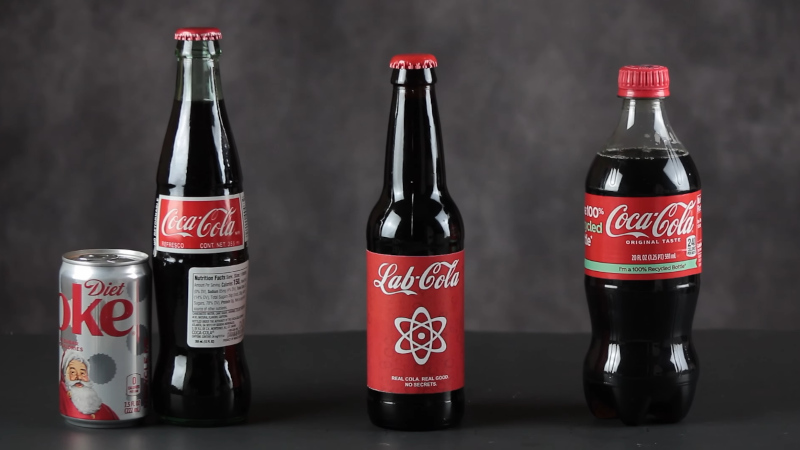
One of the most widely recognised product brands in the world is probably Coca-Cola, and its formula is famously kept a secret through precautions that probably rival those of many nation states. There are other colas, and there are many amateurs who have tried to copy Coke’s flavour, but in well over a century, nobody has managed it. Why does [LabCoatz] think his attempt will be successful where others failed? He has friends with their own mass spectrometers.
‘The video below the break is a nearly half-hour exploration into food chemistry and the flavour profile of the well-known soft drink. It’s easy to name many of the ingredients, but some, such as acetic acid, are unexpected. Replicating the contribution from Coke’s de-cocainised coca leaf extract requires the purchase of some of the constituent chemicals in pure form. Its value lies in showing us how flavour profiles are built up, and the analytical methods used in their decoding.
He makes the point that Coke has never patented the formula because to do so would reveal it, but perhaps in that lies the real point. The value in a secret formula for brands such as Coke lies not in the secret itself, as it’s not difficult to make a refreshing cola drink. Instead, it’s the mystique of their product having a secret recipe that matters. Since this isn’t the recipe itself but something that’s supposed to taste a lot like it, that mystique stays intact. He’s not positioning his Lab-Cola as the real thing, so while we might have used a different label colour and font just to make sure, we’re guessing he’s safe from the lawyers. If you’re interested in the legal grey areas surrounding perceived infringement, though, it’s a topic we’ve looked at before.
Thanks [Hans] for the tip!












Replicating the taste of Coke is quite trivial, exactly recreating it is very hard because only one company on earth can legitimately access the cocoa leaf with cocaine removed.
It’s just pointless, there’s loads of drinks people prefer to coke. But without the coke branding you don’t really care which is being drunk.
It’s not even just the Coca extract. Where you get your cinnamon, your orange and lemon, your caramel color. The processes that those companies use to extract the oils. The specific machinery that Coca-cola uses and how its calibrated.
But as you say the branding is a big deal. Anyone who drinks a fair bit of diet coke (for instance) can tell a difference between bottle, can and fountain drink – especially because the latter tends to be poorly calibrated…
This gives me flashbacks to when I had an ex- who drank a liter of diet Coke per day. She would get caffeine withdrawal headaches if there was no diet Coke available. Pepsi products were not considered an acceptable substitute. She had opinions about fountain machine calibration and cleaning schedules.
I know people who are the same way about coffee – physically addicted but so particular about their brew that they will choose withdrawal rather than drink coffee from a national chain.
It’s difficult to go anywhere outside with these people.
Unverified but someone told me the artificial sweeteners in diet coke (etc) is itself very very addicting. In addition to caffeine. And by anecdotal evidence I agree- people are massively more addicted to diet coke than regular coke and moreso than just the caffeine would explain. I will go one further and say they also tend to be way more annoying than even coffee snobs. There is a reason people call diet cokes “fridge cigarettes”
While not classically addictive like drugs, aspartame and other artificial sweeteners can create similar brain responses (dopamine release) and disrupt appetite signals, potentially leading to increased cravings for sweetness, altered eating behaviors, and even dependency
Yes only anecdotal evidence in my area as well, but aspertame sweetener seemed to cause significantly more issues with headaches than other formulas or sweeteners. Out of 10 people I knew that were or became regular diet coke drinkers (which was a definite shift to MAINLY diet coke like alcoholics lol) eight of them had headache issues that they either didnt have before or not to that intensity. The same is true with stevia and my SO. I have to put a teaspoon of sugar in her coffee or else her brain gets “mad” there isn’t real sugar there and causes issues. Sometimes your body just wants the real chemical base, especially if you had it previously/in youth. It would be interesting to see how a generation brought up with mainly artificial sweeteners react or if they get the “not real sugar” headaches and withdrawal symptoms but they probably take a pill for that already lol.
replying to TerryMatthews: that sounds kinda like low blood sugar irritability. My friend is pre-diabetic and may get low blood sugar. There are some physical signs but the mood is noticeable – we call it “monkey mode” and it’s fixed with a snack.
Again not verified, but there is definitely a pavlov type reaction to thinking you are going to eat- insulin dump and if you eat something “sweet” that doesn’t actually have glucose (or other real sugars) in it, you probably get a pretty bad hypoglycemia that would definitely result in crabby behavior.
The glucose co-transporter is a real thing for the uptake of salts, too, so it is funny to me the recent artificially sweetened Gatoraide type drinks that don’t work at all. The glucose (real, honest sugar) is mandatory for it to function any better than simply tap water.
The nearly exact recreation being hard is kinda the point. HAD regularly features people building things the hard way. [LabCoatz] thinks he’s gotten far closer than any other open attempt.
Also I don’t think it is pointless. I am a regular coke drinker ( I prefer glass bottle > regular fountain > plastic bottle > “freestyle” fountain > most store brands > Pepsi > Walmart store brand) and I would love to find a close enough DIY substitute.
“regular fountain > plastic bottle > “freestyle” fountain”
I’ve wondered now and then if the Freestyle machine would be more consistently/accurately calibrated than a regular syrup fountain.
(But maybe the “regular” fountain is electronically metered now, my experience with calibrating fountains is decades upon decades old).
What I don’t like about the Freestyle machine is the random other flavors that seem to end up getting mixed in to my soda, presumably from previous pours. I guess I should just try wasting some before putting my cup under the stream.
There was a fascinating hack on those freestyle machines that probably deserves it’s own had article. They retrospeced a valve to act as a pressure/flow meter to reduce call outs when simple cleaning would do.
Even ignoring the extra flavors issue freestyle machines seem to be worse at dispensing regular coke. Something about building a nozzle with 20+ injectors, most of which are not on for any specific pour, makes it worse at the job. Who knew?
I feel so grateful to have a poor sense of taste that prevents me from distinguishing between different brands of food and drink. I know people who are exclusively monogamous with a single brand of soda, coffee, tomatoes, garlic salt, etc. It’s very limiting.
(The book The Wine Trials also leads me to suspect they are being swayed by labels and visual appearance instead of taste, but I guess it’s all part of the experience)
If you drink enough of your home tap water, try tap water from someone else in the country. I’d be surprised if you didn’t pick up on it. Taste is an acutely evolved saftey mechanism in the body.
Wine I’ve gone full circle on. I didn’t think much of it with loads of research proving the words aren’t particularly useful to anyone but yourself yet I can reliable be handed a sparkling wine and say if it’s prosecco, cava, champagne, English sparkling. Could you trick me? 100% for sure. But the fact that I can recognise styles and guess about grape and even weather already blows away my preconceptions.
What’s weird is that Coke doesn’t even taste the same world-wide. Coke in different countries has noticeably different taste.
Maybe the recipe is the same. Maybe the concentrate is the same. Maybe it’s just the different water in the bottling plants. But it definitely tastes different in Europe, Africa and North America.
Glass bottles vs cans?
Definitely recipe changes.
Mexican Coke is notorious for using cane sugar instead of HFCS – although it has a bunch of OTHER differences. For example, its sodium content is significantly higher. Why, who knows? But that likely contributes to the perception that cane sugar is better. (In proper blind tests, people couldn’t tell the difference between HFCS Pepsi and cane Pepsi. Turns out that all of that acid in colas turns cane sugar into invert sugar, which is nearly the same as HFCS except for some slight percentage differences in fructose vs. glucose)
You can easily sweeten something with HFCS such that it will be chemically identical (and taste exactly the same) to invert syrup (fully hydrolyzed sucrose). You just adjust the amount of HFCS 55 and 42 to match up.
And yeah, of course Coke has different formulations regionally. Why wouldn’t they? It’s made locally, of course you tune it locally based on sales and testing.
Ah, so like Adams’ jynnan tonnyx.
Two words: Passover Coke.
If you want to taste cane-sugar Coke, wait a couple of months. You can get it in the weeks leading up to Passover. Look for the yellow cap on the big bottles.
It’s not in all stores. Where I live I have to go to a big-chain grocery store that’s in a Jewish neighborhood to get it. Other stores in the same chain a few miles away don’t carry it.
Yes, I can taste the difference. Yes, I prefer the sucrose variety. No, it’s not worth paying “Mexican Coke” prices for.
This is the way.
Probably just the long-term result of A/B testing.
This is why many in US prefer Coca-Cola imported from Mexican bottlers. They still use cane sugar in Mexico, while Coca-Cola in US uses high fructose corn syrup.
I just drunk a fountain coke from a Hungry Jacks store (Aussie name for Burger King due to some historic stuff) and I guarantee you it tastes different to the PET bottle of coke I will be drinking later.
Original coke used real cane sugar, what they call “original” is NOT.
If you want Original, get Mexican coke, FAR closer and you can certainly tell the difference.
I hate being lied to… Solved the problem here with Pepsi Real Sugar…
Mexican Coke’s taste difference isn’t due to cane sugar. It’s due to other changes to the recipe – notably it has much higher sodium content for some reason.
Proper blind testing of Pepsi Real Sugar vs. the original HFCS Pepsi resulted in almost no one being able to tell the difference. Turns out that 55/45 fructose/glucose is, unsurprisingly, almost identical to 50/50 – which is what sucrose breaks down into after not too long in an acidic unrefrigerated bottle and Pepsi never ships that stuff refrigerated.
Probably true, but zero people I’ve ever talked to that have had Mexican Coke prefer the good ol’ ‘Merican version, so I do questions what Big Coke is up to. Myself included. Sweetener aside (I did ascribe the difference to cane sugar vs HFCS, interesting point you make) it is just … way better. For the two or three times a year I drink sugar sodas.
Mexican Coke continued to use cane sugar due to local sugar subsidies which made its production more affordable than using corn syrup, which is/was cheaper in the US do to our corn subsidies, Mexican domestic Coke uses HFCS/cane sugar blends now to reduce the cost and keep the flavor closer to what people were used to there.
I don’t think it’s a blend, it’s just a different formulation of glucose/fructose syrup to match the previous taste. You can get glucose/fructose syrup in basically whatever (reasonable) ratio you want – in the US it’s usually 55, but to match the old profile in Mexico it’s closer to 50.
It’s not like it’s even possible to tell the difference between cane sugar and the equivalent ratio syrup – there was a hilariously-awful paper that came out about 15 years ago that tried to claim Coke wasn’t using cane sugar in those products based on chemical analysis. Except immediately after it came out industry experts basically responded “yeah uh you need to go back to chemistry class and remind yourself what happens when you put sucrose in an acid environment.” In other words – flavor Coke with sucrose, then go measure its chemical content… and you won’t find any sucrose, because it broke down into fructose/glucose almost immediately.
@paul
You dont think its a blend. But I know that it is.
I have persoanlly seen and drank a cocacola thats label listed “azucar y jarabe de alta fructosa” sugar and high fructose syrup.
But to prove you wrong definitively. Have a peek
https://thegatewithbriancohen.com/high-fructose-syrup-in-mexican-coca-cola/
“azucar y jarabe de alta fructosa”
Mexican domestic cocacola contains a blend of BOTH.
MicDrop……done.
In the US cocacola switched from cane sugar to high fructose corn syrup in 1984. Most people didnt notice or care but a percentage of testers found it noticible. Some theorize that New Coke was partially invented to SHOCK coke drinkers so that when they released “coke classic” 89 days later, still with HFCS no one would complain about the difference between the old cane sugar formulation being that it was much closer to their memory than New Coke, which actually appealed to many pepsi drinkers.
The actual sweetener itself doesn’t matter (you can tune it to whatever sweetness you want) – it’s just the market. HFCS itself obviously has a range of sweetnesses based on what mixture you want. Colas in the US for instance are sweetened significantly higher than typical HFCS 55.
the actual sweetener DOES matter cane sugar does not taste like beet sugar neither taste like hfcs. Stevia doesnt taste like any of those. Aspartame tastes nothing like other sweeteners either. Yes you can put more sweetener and make things sweeter, as the american palate prefers, but whatever sweetener you use will still impart its own flavor, because sweetness is only one component of their taste.
I just meant in terms of the sweetness, not the traces. You’re not going to taste the traces anyway in a drink like that. The reason Coke in the US tastes different isn’t because it’s made with HFCS, it’s because it’s made sweeter for a US audience.
and Im saying that I CAN taste the difference between cane sugar and hfcs sweetened beverages. I can also taste when something is sweetened with aspartame or stevia. It has nothing to do with HOW sweet a drink is made. It has to do with the flavor of the sweetener. There IS a difference. There is a FLAVOR difference between American coke, Mexican imported coke, and mexican domestic market coke that is NOT an issue of sweetness. Its an issue of flavor. I dont have a preference between the formulations but living in san diego and spending time in TJ It was very noticible to me when I got served whichever variant.
Its significantly more noticeable with Sprite than with Coke, So much so that mexican domestic sprite does not blend HFCS with cane sugar but instead just uses cane sugar due to consumer complaints when they started blending in mexico.
Totally right – when Coca-Cola returned to the market in the 80’s, I still had a case of the “old” Coca-Cola and compared to the Coke with HFCS it is worse tasting, especially as a drink mix.
They did the switcheroo in such a smoke and mirros way.
Hilariously, you actually need to get the Mexican Coke imported into the US rather than the stuff that stays in Mexico, because only the US is silly enough to pay more for it. The two taste the same (and both different than US, because there 100% are regional differences in sweetener content) but the stuff that stays in Mexico is made with fructose/glucose syrup just like in the US.
Coke, my beloved guilty pleasure…
Professor Frink: “According to the gas chromatograph, the secret ingredient is… love?! Who’s been screwing with this thing?!”
In my local Mall, there is a product called RC Cola that taste pretty much the same as the original when is cold, but not when is at room’s temperature. I have seing 3.3 liters presentations tho. In the other hand , last month, I got a project to design and manufacture a “smooshi Machine” like those used in Malasia street food to shake the coke.Currently we are just waiting for a couple of seals from the usual sources.
As for me I usually drink 600 ml Coca-Cola. But in this respect, we can really say: whoever is without sin, cast the first stone. We just choose our poison, like they say: if you choose not to decide, you still have made a choice.
RC cola was my preferred cola in the 80s, Its just not as widely available as coke. In the south RC cola and a moonpie is an after dinner tradition. https://youtu.be/loamVbAOsPo?si=FFCDRNO4jEXVi1Ii
My poison was Jolt Cola, famous for “all the sugar and twice the caffeine,”
It launched in 85, disappeared in 09, had a brief return in 2017, and theyre relaunching it this year….but reformulating it as a Monster competitor with even more caffeine (200mg), nootropics, and B vitamins, moving away from its original sugary formula to target the current energy drink market….so Ill prolly nope out on this incarnation.
Quick nod at Pepsi max.
Also gone.
All lame, compared to a good cup of coffee.
Not addicted, self medicated.
French press coffee, indica, no booze stronger then win..tequila.
CA sober!
And I thought RC Cola was a new novelty product! It turns out that RC stands for Royal Crown Cola
All cola tastes like malted battery acid to me.
https://tinyurl.com/dzppsutw
I quit my 2L/day Diet Coke addiction when I found a nasty, gooey foreign object in a bottle, and the local bottling company said I must have put it there. Never looked back, after switching to fresh iced coffee. Health and wealth gains!
If you knew what was in it, you prolly wouldn’t drink it. It’s for 9-years old’s birthday parties, and they rip on that stuff.
At least making your own means you’re not giving Coke your money…
https://markthomasinfo.co.uk/footerpages/about/belching-out-the-devil/
In the 70’s when I was a kid there was NO Pepsi. We had Coke and RC(and a MoonPie).
Pepsi ignored the mtns. of far west NC until the 80’s.
I will do without a drink before I will drink a Pepsi …!!
It’s funny, I noticed that with bread as well as with shop-brands of products the taste can differ constantly with each batch.
How different from guarding formulas it is when branding is not a thing.