
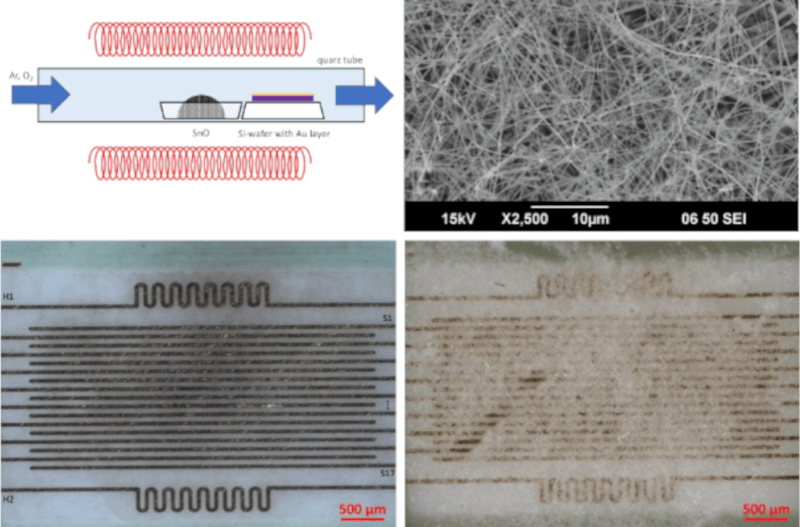
It turns out, that mold is everywhere. The problem is when it becomes too much, as mold infestations can have serious health effects on both humans and animals. Remediation is extremely expensive, too. So there are plenty of benefits to finding mold early. Now, German researchers are proposing an electronic “nose” that uses UV-activated tin oxide nanowires that change resistance in the presence of certain chemicals, and they say it can detect two common indoor mold species.
The nanowire sensors can detect Staachybotrys chartarum and Chaetominum globosum. The real work, though, is in the math used to determine positive versus negative results.
Traditional methods take some sort of physical sample that is sent to a lab and require days to process. However, trained dogs can also smell mold, but as you might expect, there aren’t many dogs trained to find mold. Besides, the training is expensive, you have to maintain the dog all the time, and if the dog knows what kind of mold it is, it can’t say. So an electronic nose that can give fast, specific results is quite attractive.
Even if you don’t care about mold, the data crunching to classify the sensor data has application to many types of sensors. They used training to build multiple models, then they combine the outputs using a regression algorithm to predict the true output. Finally, they use a majority voting technique to combine the results of the model and the regression output.
Could you make a sensor like this? Reading section 4.2 of the paper, it looks like you need a pretty stout set of lab gear to play. But the math ideas are certainly something you could replicate or use as a starting point for your own sensor fusion projects.
Want a deep dive into sensor fusion? You should have been at the Hackaday Superconference a few years ago. Luckily, you can still watch [Christal’s] talk about fusing multiple streams of sensor data.












“…mold infestations can have serious health effects on both humans and animals.” Can you provide a reputable source for this, or are you just going to parrot cleaning industry talking points like everyone else?
Didn’t notice the name at first, pretty good
Like with everything the spores cause a immun response and can cause allergies, asthma and many more symtoms.
Funny how my allergies disappeared once i moved from my ultra-clean parents house to my student apartment with more relaxed dusting schedule. Also funny how my cat allergies disappeared after geting two cats to sleep on my pillow for half a year…
Dust != mold
Sounds like Cleaning Industrial Complex propaganda.
Start on Wikipedia and follow the links in the references:
https://en.wikipedia.org/wiki/Mold_and_human_health
I’ve lived in a hurricane flooded house for a month with black mould, maggots, weird insects, a frog (he didn’t do much), and centipedes.
Came out fine without any issues. Keep your immunity up guys, vitamin C is your friend.
It’s the most plausible trigger for my friend’s chronic illness
There’s been a lot of issues in the U.K., often I think it’s people with existing respiratory problems like asthma or post-covid issues.
Definitely not related to being an island nation with lots of harmful smoke coming from the English Channel.
( /s just in case )
Ever since I’ve watched the 1993 film “Super Mario Bros.” where it had some kind of “intelligent fungus” to play an “important role” in the movie, mushrooms and everything related never looked the same.
This reminds me of a problem some friends had once.
Their daughter kept having problems with coughing and respiratory infections. The mother was kind of flaky, and instead of going to a doctor she took the girl to some quack. The quack did a “blood crystal analysis” which involved freezing a blood sample on a slide and looking at the ice crystals that formed. The appearance of the crystals told the quack that the daughter was deathly ill and could only be helped by some hoky pills that he happened to sell (and which were manufactured by a company he owned.) They bought the expensive pills repeatedly over a couple of years. The daughter kept having trouble coughing and other respiratory symptoms.
While all this was going on, the family was having a house built so that they could move out of the apartment they were living in. The house finally got built, so my wife and I (as friends) helped them move to the new house.
I went to move the furniture from the daughter’s room, and pulled her bed away from the corner in the wall where it stood. Behind the bed, at the end where the daughter slept, was a dark patch on the wall.
Where this poor girl had been sleeping for several years, there was mold in the wall and in the wallpaper. She had been breathing in mold spores every night for years.
They got settled in the new house and the daughter’s problems went away – no quack needed.
Honestly, depending on the amount of infestation, it’s fixable as DIY with the proper chemicals. I mean who doesn’t have to occasionally give the bathroom a wipe down with a cleaner? It’s a moist environment and is a perfect little place for that stuff to grow.
Where it gets tricky is when there’s moisture buildup from a leak or flooding event. Having to cut out drywall and clean out the areas where it grew is the big pain.
But when I watch these remediation places on TV coming out with Hazmat suits and tying up the drywall as if it were asbestos, I gotta scratch my head. Animals and humans have been living since forever with this stuff in the environment. You have to wonder if the reason it costs so much to remediate the problem is just to create jobs. Bag up the drywall? How about burn the mold and paper off at a recycling center for gypsum and re-use the inner bits?
You remind me of my grandpa, who always talked about seatbelts. “Back in the day we never had seatbelts, we drove all day every day with the dogs running around in the back of the car and nothing ever happened. Now suddenly every car needs a seatbelt… bla bla bla” I could tell him over and over again that he was lucky never to be in an accident, but I’m sure that if he was, he sure would talk different about those belts.
At some point you need to walk away from making EVERYTHING safer to some micro standard. Mold isn’t the best thing for you, but we’ve lived with it since the dawn of man. It has permeated our living spaces, been in our food supply, and a host of other interactions. It is not Cyanide. It is not Asbestos. It is an environmental allergen that some people are sensitive to and that can cause problems at high concentrations.
I am far more likely to drown than die from a mold infestation.
So, completely NOT LIKE THE SEATBELT ARGUMENT.
Nice argument to put the case of dr. Semmelweis under the rug. [/s]