
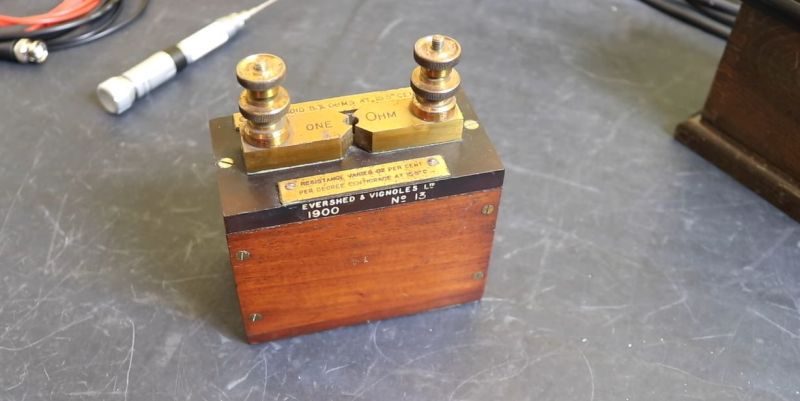
Resistance standards are incredibly useful, but like so many precision references they require regular calibration, maintenance and certification to ensure that they stay within their datasheet tolerances. This raises the question of how well a resistance standard from the year 1900 performs after 125 years, without the benefits of modern modern engineering and standards. Cue the [Three-phase] YouTube channel testing a genuine Evershed & Vignoles Ltd one ohm resistance standard from 1900.
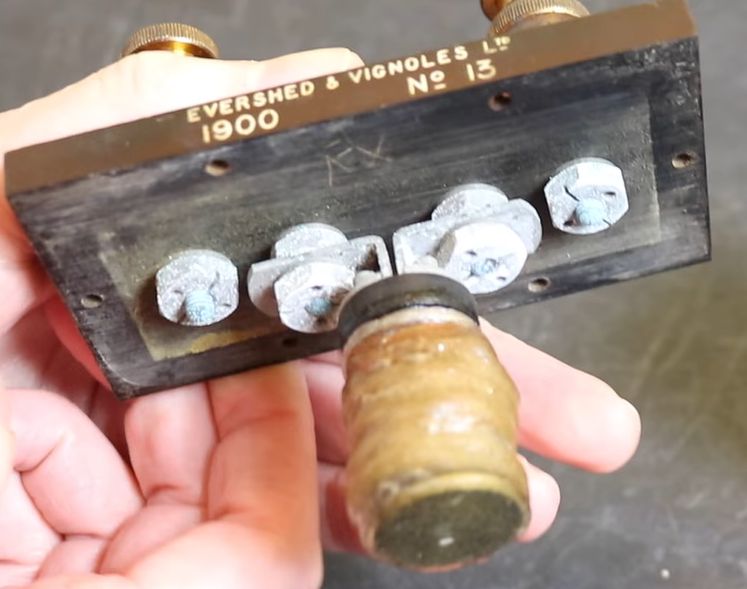
With mahogany construction and brass contacts it sure looks stylish, though the unit was missing the shorting pin that goes in between the two sides. This was a common feature of e.g. resistance decade boxes of the era, where you inserted pins to connect resistors until you hit the desired total. Inside the one ohm standard is a platinoid resistor, which is an alloy of copper, nickel, tungsten, and zinc. Based on the broad arrow mark on the bottom this unit was apparently owned by the UK’s Ordnance Board, which was part of what was then called the War Office.
After a quick gander at the internals, the standard was hooked up to a Keithley DMM7510 digital bench meter. The resistance standard’s ‘datasheet’ is listed on top of the unit on the brass plaques, including the effect of temperature on its accuracy. Adjusting for this, the measured ~1.016 Ω was within 1.6% tolerance, with as sidenote that this was with the unit not having been cleaned or otherwise having had maintenance performed on it since it was last used in service. Definitely not a bad feat.












To be fair, a resistor is about the ultimate in a passive component. The metal resistor is well-nigh immortal; so long as the contacts aren’t corroded and dirty it should be as good in another hundred twenty-five years or so.
I know it’s 125 years old, but 1.6% is fairly poor by modern standards.
That said, I’ve a sub-ohm meter here and the biggest issue I have with getting an accurate resistance is the connection between the device under test and the kelvin terminals.
Perhaps. But so are the skills by most electronic hobbyists these days, I’d say.
I personally wonder why they in their hubris think they deserve anything lab grade to begin with.
Their DIY would circuits would work with 5% or 10% tolerances just as good (bad), probably.
Agreed. They don’t know when “enough-is-enough”. The machine in this case never “maketh the man”.
There is a “gap” in the test equipment that we can buy these days. We get the ultra-expensive, and then the ultra-crap. During the 70s/80s there were almost countless brands that had “good enough” performance and accuracy (but not crap), and were cheap enough that “almost” any person on earth could acquire them.
Today there seems to be a stigma attached to test gear that is “good enough”…everyone wants ultra-accurate, and ultra-fast, but don’t understand how, and when to use the equipment. This is especially true of oscilloscopes…I lost count on the number of degreed engineers I’ve come across that doesn’t understand how an oscilloscope works, and have no idea how to interpret what they read from a digital scope (i.e. are you aliasing or not?). They simply hit the ‘auto’ button, and start praying something shows up (you can see this on their faces).
I think the problem lies in the education side of electronics…we need to go back to entry-level gear for educating in, and training electronics.
How do you know what people are making DIY would not need precision lab equipment? There are plenty of DIY projects that are well beyond Arduino’s and RPi’s involving everything from expensive FPGAs, custom RF front ends, laser optics.
I’m sure someone is wasting money but also, it is not your money.
Money, just like food, is a finite resource of an entire society and must not be wasted. If people are spending cash on expensive test equipment, BMW cars or hookers and blow they’re taking it away from less affluent members of the community.
Long term it leads to poverty, increased crime and loss of social cohesion. The end result is perfectly visible in places like United States, Venezuela or Congo. To replace current system built on vice and greed should be our first priority if we are to build a new, more resilient and fair society.
You’re talking about parts that cost pennies a piece. That’s 2026 pennies, not 1926 pennies.
Go out and touch grass.
Since I can’t reply to Tim Andersson directly, I’ll point out here that this social justice warrior’s comment is so far out in left field that it’s hiding in the next county. Money is most definitely NOT a finite thing; its value is based entirely and ONLY on the trust that people have in the government that printed it, and governments just print up more as they see fit. It’s legalized counterfeiting, as there has never been enough gold mined in the history of the world to represent the amount of paper in circulation. And there’s plenty of that. Drug kings in South America have been busted with warehouses full of palletized, legally printed US dollars, just sitting there being gnawed on by the rats. My buying better test equipment wiil not cause you to starve; the only thing I owe you is courtesy, as you owe the rest of us. Now please have the courtesy to do your.
Gold isn’t technically money either. Gold is gold – it’s merely accepted as money because of its relative scarcity and stability. More gold is mined every day, which technically would inflate the value of gold just like printing more paper money, except the economies are growing faster than we can mine it, which would result in deep deflation. That’s why we originally abandoned the gold standard.
The reason why people argue that only gold is real money is because they’re investing in gold and speculating on the price to profit from the fact that not enough gold can be made available relative to the demand they’re attempting to stir up. In other words, instead of printing more money, they’re trying to conjure up “funny money” the other way around. Hoard gold off the market and watch the price go up, then when it’s sufficiently overvalued you exchange it to other assets and watch the price crash down. Rinse and repeat.
Mr Anderson has no idea how economy works at all.
It’s interesting to see such lack of knowledge when a subject seems relatively easy to grasp.
I somehow doubt it is ‘poor by modern standards’ when you are talking about a 1 Ohm resistor.
What a strange attitude. It’s almost aristocratic levels of arrogance.
That is indeed the tricky part – we build automated test gear that can do single-digit milliohm measurements with 1% repeatability…until one of the contacts is not only lifted but shifted and all hell breaks loose.
Bingo! I’ve gound that sometimes I have to clean the test connections to get results that come anywhere near making sense; anyone know where i can get gold-plated #60 alligator clips? And what do you do when your test leads have more resistance than the device under test? The solution, of course, is the 4-wire ohmmeter, but even a little oxidation on the test connections sends your results all over over the map.
How much of this is a resistance standard, a reference, something to calibrate against? How it is shown it’s a perfectly usable resistor for experimental setups. Even at 2% tolerance.
I’m sorry. Take one look at the mass-build resistors out there. What are the +/- tolerance chart? 1, 5, 10, 20 percent. And a 125 year old mechanical resistor that “was not cleaned,” was in as-found condition comes in at 1.6 percent off? Come on, people.
Absolutely! Standard ohm meters can’t measure anything accurately within that range. Most people don’t realize that a milliohm meter of any standing is extremely expensive and only necessary beyond the regular hobbyist needs.
you can get 0.1% tol. Resistors that are like a few cents more expensive than those you mentioned, too.
I gather you have a point in mind; what is it? And the whole exercise is meaningless because we know nothing about the calibration history of the meter used to test the device, or about the methodology, or even of the person running the test, or the room he was running it in. If the test is repeated, will the result be the same? Basically what we have here is at least confirmation that the device is at least not defective. Beyond that, it’s good enough to check most test equipment, but if I had to have an exact measurement of its value, I’d send it off to NIST’s calibration service and be done with it.
The way resistors are made, they come out with a range of values. How you get tolerance resistors is by picking out of the lot by automated measuring machines. Resistors that fit within a certain tolerance band are separated at the production line, and then further separated to get the finer tolerances.
That means, for whatever resistance value you want, you’re unlikely to get the exact one, because those have been picked out. Most people want the 5% ones, so the 10% and 20% bins become the reject bins where you won’t find a resistor within 5% of the value. Within the 5% bin you’re more likely to find 1% or better resistors because there’s less demand for those, so not all get picked out.
I understand why there’ s unexploded ordnance still around….
I own a very rugged VOM that at one time was used by the USAF to test the firing circuits in nuclear ordnance. Still looking for a suitable modern battery substitute, as it was one of those devices with some arcane military-issue batteries… not quite AA, not quite C. Reads voltage just fine, though.
I wonder if they might be B batteries and would like to think they’re still being manufactured somewhere.
I thought of that, but when looking up B’s, I came with like ten different form factors from 1/3NS’s or whatever to lantern batteries. It’s almost the size of an 18650, but shorter and slightly narrower.
A couple years ago I stopped by my Physics Alma-matter to look for the name of the manufacturer of an old instrument. I learned that during a re-organization of the labs and storage they had dumpstered all the old “junk”. Dozens of the mahogany and brass resistance boxes, Weston Cells, big galvanometers, standard capacitors, spark coils from the 1890’s with paper and foil capacitors in the base made from cut of French ledger books. And optics galore including Kerr cells and things like experimental IR quadrant cells from a faculty member’s work in WWII and a big Beckman analog computer with tube op-amp modules and an amazing block of mostly metal gears and shafts and motors that could set initial conditions and gains of 50 10-turn potentiometers!
I found this action by this younger faculty incomprehensible. There must be some value in knowing how instruments were calibrated and precision measurements were made before the age of active components. For example finding the total current by electroplating a metal and then weighing the sample. Or using a ballistic galvanometer or with a “snatch coil” to measure a magnetic field, etc.
That is absolutely heartbreaking!
If nobody in the faculty knows how to use them, they’re as good as junk. Even if they did, how much time and money would you be willing to spend for the point?
It’s all easy to complain that these things should be kept around, but if it takes the yearly salary of multiple people just because of rents on the room, upkeep, and paying someone who knows how to work them, what good is it really? A million pounds spent on some trivial demo you might pull off to a group of schoolchildren once a year?
There’s a reason why these things get consigned to a museum.
A museum is one thing, the dumpster is another. It’s instructive to know our history, and artifacts are part of history. And if the day comes when technology is lost, it’s good to know how we did things, to save not only having to rediscover the wheel, but the roller bearing, rubber tire, gas engine, etc.
If the museum already has them, then the next place is the dumpster.
More important than the artifacts are the descriptions of how they were made. The artifacts will inevitably perish despite your best efforts to keep them, and ultimately reveal nothing interesting. The information will not rot or rust as long as it’s not lost entirely.
For the sake of keeping something around, it would be far better to keep re-making them instead of hoarding historical artifacts – but for objects without modern use or need, that’s a tall ask.
Nope. That is an incomplete usage per the definition of ‘tolerance’. Nor is it a defined and specified accuracy.
Did ya note the thermal drift?
The author of the video did, and the value of the resistor should have been 1.0003 Ohms given the difference in temperature.
The fact that it was 1.016 instead puts it at 1.569% above expected which is within a 1.6% tolerance.
Charles Springer wrote “There must be some value in knowing how instruments were calibrated and precision measurements were made before the age of active components.” This article would have benefitted from a little backstory: how did they decide the resistor is 1 ohm, and how was that tested? That would have been interesting.
Who are “they”?
Whoever signed off on its being a standard. I’d think that would be obvious but I apologize.
By comparing the voltage source real-time measurement to the drop across the resistor under test, or “four wire ohmmeter”… works with current too, with a stable, known power source. The practical application of Ohm’s Law.
The real question was, how do you measure 1 ohms without a known regulated power supply?
It goes into a merry-go-round chase of standards. How do you calibrate your meter to know what is 1 Volt or 1 Amp? Well, by Ohm’s law, but then you need that 1 Ohm resistor…
In practice, chemical voltage standards were used to calibrate meters, which were then used to calibrate resistors and power supplies. Sensitive electrometers were used to compare voltages.
https://en.wikisource.org/wiki/1911_Encyclop%C3%A6dia_Britannica/Electrometer
These devices work by electrostatic attraction. You measure the deflection of a torsion spring, or the swing of a very light pendulum, in an electric field to determine the relative strength of some voltage source in comparison to your standard electrical pile – a battery of some known voltage. How do you get a battery of a known voltage? You construct a fresh new one every time you want to calibrate your meter.
That’s what the four-wire setup is supposed to do, as it’s comparative with whatever is being provided and the test article.
An extension of that is to use multiple voltmeters and ammeters in the setup, too. All calibrated, of course.
Down to brass tacks, it gets into Coulumb’s and Joule’s at a rate, and also heat(which is where Watt comes in).
Yes, but you can’t use the four-wire setup before you calibrate your meters. Most notably, how do you calibrate a galvanometer to measure one amp if you don’t have a known voltage source and a known resistance to pass a known current?
With the classical electrical laws, you must know two to get the third unit. Ohm’s law, or Coulomb’s law, or Joule’s law merely give you the relationship between the different units. It’s like saying Tom is twice as tall as Harry; we know the mutual factor is 2 because we can compare them to each other, but we don’t actually know their heights until we measure one against an absolute standard.
So the question becomes, what are those standards? Voltage I already explained: it’s chemical standard electrode potentials.
For current, one of the first methods was to wrap a coil around a compass and see how much electricity was needed to deflect it by 45 degrees, at which point the magnetic field of the coil is equal to the magnetic field of the earth. That’s not exactly a standard value, but for the time it was good enough.
The trouble with all these measurements was that the magnetic and electrostatic forces are very weak, so they’re very hard to measure to any accuracy. Back then you had to compare your voltages or currents against the twist of a hair plucked out of somebody’s head, because you couldn’t make such fine springs otherwise.
Resistance standards don’t necessarily have a close initial tolerance. The absolute value is determined by calibration, and it is this value that is used, so the fact that it measures 1.016R is unimportant . What they do possess is a known behaviour with temperature and measurement conditions, again determined by calibration, so that compensation may be applied. The other characteristic of importance is secular stability, sometimes called drift, determined by repeated calibration. This tends to improve with age, providing the device is not abused and is maintained in an appropriate environment, so an older device (of good technology) becomes more valuable.
I wonder how much the measured resistance would change if the corrosion were carefully removed.
It’s covered in corrosion! No wonder it’s reading a bit off , all the metal on the surface has turned into an oxide/sulphate/carbonate! Come on people, elephant in the room.
If you’re measuring it with the Kelvin setup, corrosion doesn’t matter. That’s why he’s hooking up two probes on each post.
One set of leads puts a measured amount of current in, and another set of leads is used to measure the resulting voltage from a different point on the metal. The resistance of the current carrying wires, or any surface corrosion on the contact points, doesn’t factor in.