
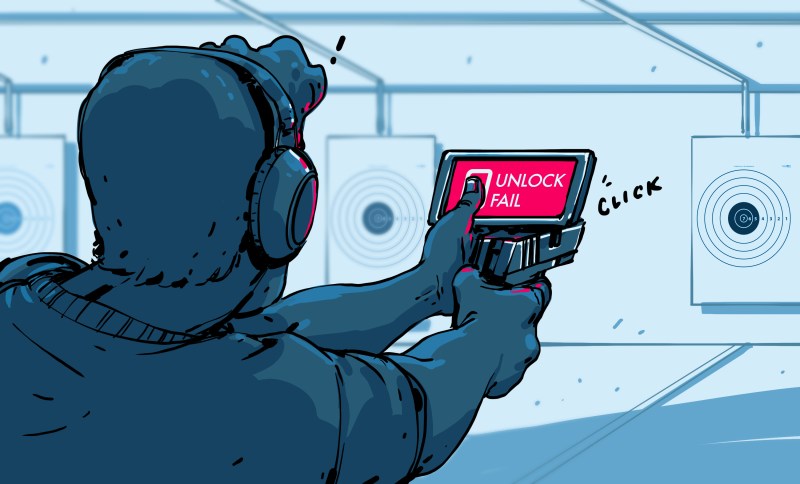
Washington State’s House Bill 2321 is currently causing a bit of an uproar, as it seeks to add blocking technologies to 3D printers, in order to prevent them from printing “a firearm or illegal firearm parts”, as per the full text. Sponsored by a sizeable number of House members, it’s currently in committee, so the likelihood of it being put to a floor vote in the House is still remote, never mind it passing the Senate. Regardless, it is another chapter in the story of homemade firearms, which increasingly focuses on private 3D printers.
Also called ‘ghost guns‘ in the US, these can be assembled from spare parts, from kits, from home-made components, or a combination of these. While the most important parts of a firearm, like the barrel, have to be made out of something like metal, the rest can feature significant amounts of plastic parts, though the exact amount varies wildly among current 3D-printed weapons.
Since legally the receiver and frame are considered to be ‘firearms’, these are the focus of this proposed bill, which covers both additive and subtractive technology. The proposal is that a special firearms detection algorithm has to give the okay for the design files to be passed on to the machine.
This blocking feature would have to be standard for all machines sold or transferred in the state, with a special ‘preprint authentication’ handshake protocol required. The attorney general is here expected to create and maintain a database of the no longer legal firearm and parts designs for those without a requisite license.
Putting aside for a moment the ridiculousness of implementing such a scanning feature, even if it wouldn’t be child’s play to circumvent, it also barks up the wrong tree. Although in the most recent ruling pertaining to this topic in Bondi v. VanDerStok it was acknowledged that advances in 3D printing have made this worth considering from a legislative context, the main issue with ‘ghost guns’ comes still by far from kits and similar sources.
Based on this, it seems highly unlikely that HB 2321 will be put up for a vote, never mind get signed into law. Although 3D printed designs like the 9 mm x1 9 mm cartridge Urutau bullpup are apparently quite functional, it’s notable that its manufacturing involves many steps, many DIY store parts, and a bolt carrier manufactured from steel bar stock, not to mention a significant time investment. Trying to detect ‘firearm parts’ at any of these steps would seem to be a fool’s errand, even if privacy considerations were not an issue.












Strange enough, nobody yet mentioned coil guns.
I don’t need to print guns on my 3D printer. I have two gun stores in my small town and can easily buy any gun I want. If I want a gun from out of state, they can send the gun to one of the two local gun stores and I can buy it there. There qre also gun shows and I go every year and spend money.
Thats beside the point. I don’t want the government to tell me how I use my 3D printer. My printer has the memory equivalency of an Arduino. It reads only gcode. There is no online to it. How is it supposed to phone home and compare my gcode to gun parts?
Maybe the slicer program could do it, but what if I use a different slicer? Will Debian have a newer compliant version of Cura or will it be years behind as always?
What’s next? Require ink pen makers to prevent the use of their pens to prevent hate speech?
More useless legislation that only harms law abiding citizens.
Criminals. Dont. Follow. Laws.
1) Politicians think a 3d-printer is like a star trek replicator. Push a button and a fully working machine gun comes out in a matter of seconds.
2) They think that it’s a black box with magic software/firmware that could be restricted in whatever way they want.
3) They think that criminals will obey the law.
3d-printers cannot print guns. Only gun parts. And not all parts. The parts have to be inspected, tested, assembled by experienced people.
3d-printers are very dumb, mostly open loop, systems that just follow g-code. It doesn’t know what it’s making and has no understanding of the final result. It cannot verify what it has made. There is no way it can detect it is printing a gun. You might be able to implement some type of hash. But changing a single coordinate in the g-code will invalidate the hash. Even if it was not impossible you can simply change the firmware. Not even a hack, just a version from before it became law.
They cannot retroactively regulate all existing slicer software, printer firmware, printers, kits, etc.
Criminals will break the law. The first time such a law would be enforced is probably a mother who buys her son an unregulated 3d-printer for Christmas.
While we are at it, require that all computer operating systems and / or browser software will detect the down or up loading of child porn and then “phone home” to the FBI reporting the offender. Ditto for pirated copyright music or videos. Better yet, lets ban computers, cell phones, and mp3 players because they encourage pirating copyrighted materials. Really, why does government bend over backwards to throw the baby out with the bath water?
As written, the bill covers not just 3D printers but also all CNC machine tools capable of doing 3D manufacturing (see Sec 1(7)). That means it covers everything from little benchtop machines to the house-sized machines that Boeing uses to mill wing skins for airplanes. Under this bill, it will be illegal to trade used printers or CNC machine tools in WA state.
The probability that FANUC, Haas, or any other major machine tool manufacturer will comply with this law is less than zero. They don’t make enough sales in WA state to justify the expense and risk involved, so small manufacturers in the state will be SOL when it comes time to acquire, replace, or upgrade their machines unless they go to the trouble and expense of getting a federal firearms manufacturing license. And it will be a crime to sell their used machines to anyone in the state.
This also effectively bans the sale of any 3D printer or CNC machine tool with user modifiable firmware.
This is rough. NY is trying the same crap. The politicians don’t know how ANY of this works: 3D printers, software to drive them, software that can detect shapes, firearms, none of it. It’s painful to refute when people think AI is magic and 3d printers are Star Trek replicators.
It’s like the Die Hard 2 “porcelain gun” scare all over again. Neither the threat nor the imaginary solution exist.
Also, wow, 2 pages of comments!
Politicians are completely detached from reality. They neither understand technology nor human nature. Nor the law/constitution.
They think that they can regulate 3d-printing firmware or slicing software. Even though much of it is open source and firmware/software is not encrypted and can be changed. Do they want to regulate it retroactively or only for new printers? And aside from the fact such a detection is practically impossible how would they enforce it? Send police officers inspecting firmware hashes on 3d-printers?
(Why were all my comments deleted for no reason? This website’s moderation sucks. The “Email me new comments” option never worked for me either.)
This is a “big-brother” bill and is absolutely government overreach. Also, this WILL NOT stop guns being an issue. There are other ways to battle this. But government pushing hardware producers to include, essentially a, kill-switch and/or spy-ware into our tinkering and creative engineering is ridiculous. It would also be the same things for PC’s and pretty much any other computer device. You wouldn’t want this on your mobile, laptop, PC, etc… You most certainly don’t want it here.
A point brought up on another forum, but what happens when ‘shape blocking’ gets extended to patented ip? doesn’t this have the potential to become an attack on the right to repair movement?