Know Audio: It All Depends On The DAC

Our trip through the world of audio technology has taken us step-by step from your ears into a typical home Hi-Fi system. We’ve seen the speakers and the amplifier, now it’s time to take a look at what feeds that amplifier.

Here, we encounter the first digital component in our journey outwards from the ear, the Digital to Analogue Converter, or DAC. This circuit, which you’ll find as an integrated circuit, takes the digital information and turns it into the analogue voltage required by the amplifier.

There are many standards for digital audio, but in this context that used by the CD is most common. CDs sample audio at 44.1 kHz 16 bit, which is to say they express the level as a 16-bit number 44100 times per second for each of the stereo channels. There’s an electrical standard called i2s for communicating this data, consisting of a serial data line, a clock line, and an LRclock line that indicates whether the current data is for the left or the right channel. We covered i2s in detail back in 2019, and should you peer into almost any consumer digital audio product you’ll find it somewhere. Continue reading “Know Audio: It All Depends On The DAC”

Know Audio: Amplifier Nuts And Bolts

As we’ve followed a trail through Hi-Fi and audio systems from the listener’s ear towards the music source, we’ve reached the amplifier. In our previous article we gave a first introduction to distortion and how some amplifier characteristics can influence it, and here we’ll continue along that path and look at the amplifier itself. What types of audio amplifier circuits will you encounter, and what are their relative merits and disadvantages?

A Few Amplifier Basics

Horowitz and Hill's Transistor Man
Horowitz and Hill’s Transistor Man

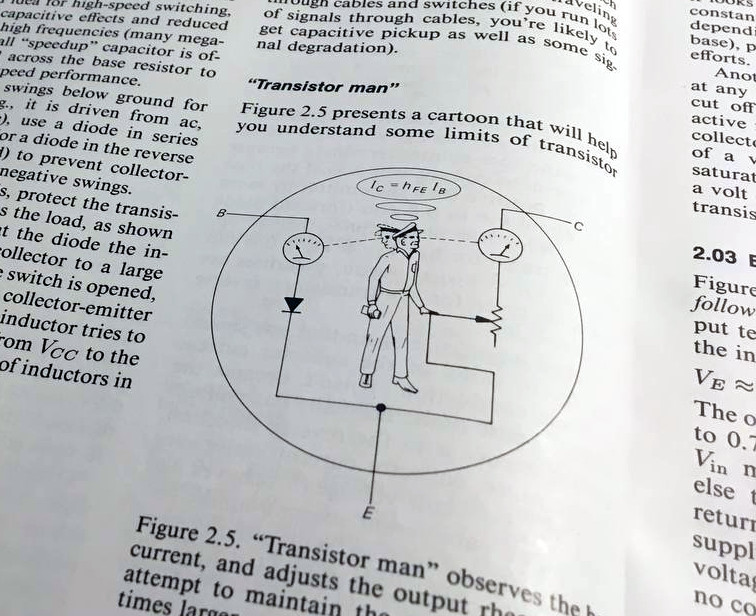
If you know anything about a transistor, it’s probably that it’s a three terminal device whose output pin forms part of a potential divider whose state is dependent on what is presented to its input pin. The Art of Electronics had it as a cartoon of a man standing inside a bipolar transistor and adjusting a variable resistor between collector and emitter while watching an ammeter on the base.

Properly biased in its conducting range, a transistor can behave as a linear device, in which the potential divider voltage moves in response to the input in a linear relationship, and thus the voltage on the output is an amplified version of the voltage on the output. This is the simplest of transistor amplifiers, and because different types of amplifier are referred to by lettered classes, it’s known as a class A amplifier. Continue reading “Know Audio: Amplifier Nuts And Bolts”

Know Audio: Amplifiers And Distortion

As we’ve traced our no-nonsense path through the world of Hi-Fi audio, we’ve started with the listener, understood the limitations of the human ear, and thence proceeded to the loudspeaker. We’ve learned a bit about speaker cabinets and their design, so it’s time to venture further down the chain to the amplifier that drives those speakers.

The sharp-eyed will be ready to point out that along this path also lies the  speaker cables, but since we’ll be looking at interconnects at a later date we’ll be making the dubious and simplistic assumption for now that the wires between speaker and amplifier are ideal conductors that don’t have a bearing on listening quality. We’ll be looking at amplifiers in enough detail to warrant more than one piece on the subject, so today we’ll start by considering in a slightly abstract way what an amplifier does and where it can fall short in its task. We’ll be introducing probably the most important thing to consider in any audio system, namely distortion.

The job of an audio amplifier is to take an audio signal at its input and present the same signal on its output at a greater amplitude. In the case of a preamplifier it will usually be designed to work with high impedances in the order of 50 kΩ at both input and output, while in a power amplifier designed to drive speakers or headphones it will drive a much lower impedance. Commonly this will be 4 Ω or 8 Ω for loudspeakers, and 32 Ω for headphones. Continue reading “Know Audio: Amplifiers And Distortion”

Know Audio: A Loudspeaker Primer

As we’ve started out on our journey through the world of Hi-Fi audio from a strictly practical and engineering viewpoint without being misled by any audiophile woo, we’ve already taken a look at the most important component in any audio system: the listener’s ear. It’s time to move down the chain to the next link; the loudspeaker.

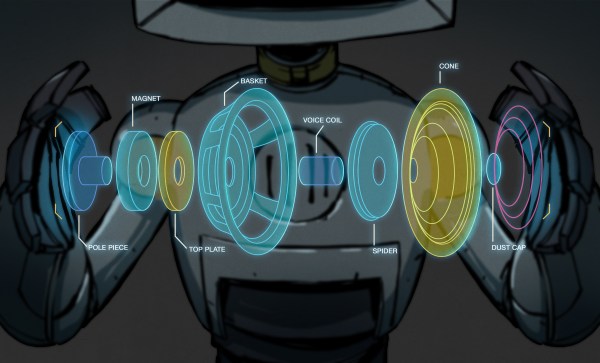
Sound is pressure waves in the air, and the purpose of a loudspeaker is to move the air to create those waves. There are a variety of “exotic” loudspeaker technologies including piezoelectric and electrostatic designs, here we’ll be considering the garden variety moving-coil speaker. It’s most usually used for the large bass or smaller mid-range drivers in a typical speaker system. Continue reading “Know Audio: A Loudspeaker Primer”

Know Audio: Start At The Very Beginning

A lot of our projects make noise. It can be something as simple as a microcontroller driving a small speaker or a truly ambitious Hi-Fi project, but common to all of them is the desire to get that sound out in as audible and high-quality a manner as possible. We’ve been known to make fun of the more preposterous side of the Hi-Fi world at times, but behind it all there’s a basis of solid and provable audio engineering that can be brought to bear on almost any project involving sound and electronics. Perhaps it’s time to devote some time to a series exploring the topic, and what better place to start than the ultimate destination for all that sound. Any Hi-Fi is only as good as the ears of the person listening to it, so in out journey through the world of audio that’s where we’ll start. Continue reading “Know Audio: Start At The Very Beginning”