You’ve probably heard of rubidium frequency standards, which are used where you need an extremely accurate time or frequency reference. [IMSAI] guy has a good explainer video about what’s actually going on inside one of these standards. Much of the basic idea also applies to cesium standards.
The explainer starts with the periodic table. Rubidium and cesium are both alkali metals, with a single electron in their outermost electron shell. Rubidium has 37 electrons, with the outermost one relatively loosely bound. Naturally occurring rubidium consists mainly of two isotopes, rubidium-85 and rubidium-87, which have the same number of protons and electrons but different numbers of neutrons.
A rubidium standard typically has three gas cells that have a bit of rubidium in them. An RF-excited rubidium-87 discharge lamp produces light at very specific wavelengths. The RF energy excites rubidium atoms into higher electronic states, and when their electrons fall back to lower-energy states, the atoms emit photons.
That light passes through a filter cell containing rubidium-85. The filter preferentially absorbs part of the lamp’s spectrum, leaving light that optically pumps the rubidium-87 atoms in the second resonance cell into one of two closely spaced hyperfine states of the atom’s ground state.
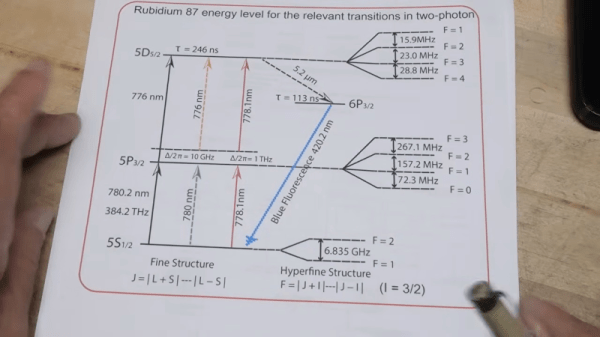
Those two states differ because of the interaction between the magnetic moment of the outer electron and that of the rubidium-87 nucleus. Their energy separation corresponds to a microwave frequency of about 6.835 GHz.
The resonance cell is illuminated by the filtered light while also being exposed to microwave energy from a local oscillator. When the microwave frequency is exactly equal to the rubidium-87 hyperfine transition frequency, it transfers atoms between the two ground-state hyperfine levels. That changes how strongly the cell absorbs the optical pumping light, producing a detectable dip in the light reaching a photodetector.
Electronics then servo the microwave oscillator onto the center of that absorption dip, using a feedback technique somewhat analogous to a phase-locked loop. Once locked, the oscillator is effectively referenced to an atomic transition rather than to the dimensions or mechanical properties of a crystal, giving you an extremely stable frequency standard.