
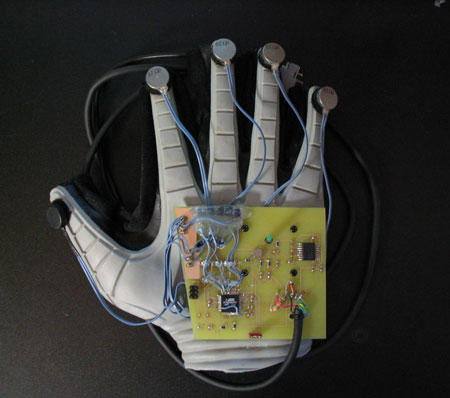
While we don’t see this coming to your local megaplex any time soon, we are starting to see the technology creep into our lives. After the break lets take a look at some examples, talk about projects we’ve covered before, and how you can get started developing your own.
The Novint Falcon is one of the first mass produced and consumer friendly versions of a haptic feedback device. With force capabilities of 2lbs and a resolution of 400dpi the unit can interact with several software programs and video games. The unit sells for around $239 and includes several compatible games.

Some inventors like [Steve Yohanan] feel robots need better response to the basic human touch. His latest creation the Haptic Creature is a small bunny that responds to touch through pressure sensors and then responds. Different forms of touch result in the creature changing it’s breathing, purring, and of course wiggling its little bunny ears.
On the fun side of things, we have several toys making their way into the market with haptic feedback features built in. The Pleo being one for of the more advanced examples with it’s almost unlimited amount of responses and feedback. The toy itself is touted as something to interact with as opposed to simply control. UGOBE is also talking up its therapeutic value for both children and adults.
While some of this technology may seem out of reach of DIY, there is one organization trying to bring open source to the scene. Backed by SenseGraphic the H3D API is an open source initiative to help programmers interface with various haptic devices. Browse their hall of fame page to see what individuals and universities have done with the API. This PDF also provides a broad overview of the history of haptics.
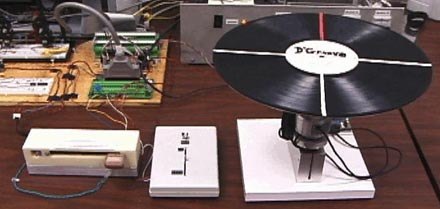
We’ve covered a ton of haptic projects here on Hackaday: D’Groove a force feedback turntable, a personal haptic radar, a PSP with feedback, and even reverse engineering the Falcon we mentioned earlier.
[via Gizmodo]












Cool… just wanted to say that the site has really been moving lately and that you all are doing a really good job with very cool articles lately, keep up the good work!
I wonder if you could use that novint falcon with a 3d modeling program. It’d could be just like using a tool to sculpt clay.
On that note, how awesome would Trauma Center be on this thing? imagine feeling the scalpel slide through different types of flesh, smooth bone guiding the flat of your blade..
You show a photo of a modified Mattel Nintendo Power Glove but you provided no information on it. I Googled on “powerglove haptic” and found the NewGlove project at http://www.geocities.com/mellott124/Newglove.htm (including the photo you used above). It looks interesting, but I miss the Nintendo controller on the forearm. It was removed as part of the hack.
I have a Power Glove stored in one of my “treasure boxes”, waiting for the day I’ll hack it. About five years ago, I interfaced the Power Glove to the parallel port on a latop running linux. I used the old pglinux driver that is probably still out on the net somewhere. I even wrote a Tcl/Tk (Tool Command Language) script to talk to the driver and graphically display the finger flexes and hand movements. Ah, memories! Cool interface, but tiring for the arm and shoulder!
This has been one of the best weeks ever at hackaday. First mech- power suits, then haptic and cnc.
Keep up the good work guys!