
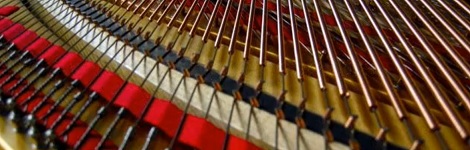
At Hack a Day, we don’t throw the term genius around lightly. We’re obligated to bestow that title on [Don Gilmore] for his amazingly simple self-tuning piano. To appreciate [Don]’s build, you need to realize that just because a piano has 88 keys, that doesn’t mean it has 88 strings. Treble notes have three strings per key while tenor and bass notes have one or two strings each. This usually comes out to more than 200 strings per piano, and [Don] can bring them all up to tune in under a minute.
[Don]’s system needs to perform two functions. The first one is sustaining the strings so the computer can ‘hear’ the strings. He does this with a magnetic sustainer that is a lot like an E-Bow. To bring the strings up to the right pitch, there are small heaters underneath the pin block. Running a little bit of current through these heaters allows [Don] to decrease the tension of each string and lower the pitch.
This tech reminds us of the Gibson Robot Guitar, a self-tuning guitar that does it’s trick with motors in the tuners. The Gibson didn’t do well on the sales floor, given that everybody and their mom can tune a guitar. Pianos, though, are another story. [Don] is looking for investors to bring his idea to market, and we hope to see it on the floor of a music shop sometime in the future.
[youtube=http://www.youtube.com/watch?v=ugAxXm2SAXw&w=470]
Yes, an REO Speedwagon reference. Only slightly ashamed, if you’re wondering.











First instinct is ‘well, that’s cool and all but then it requires you to burn electricity while you play to keep it in tune’.
Browsing the Youtube comments, he says it is costing 7 cents ($.07) per hour to run it at his utility rates.
I don’t play piano, how many hours per month would you require your piano to be ‘on’ and in tune? Would it really be worth the running cost just to avoid tuning strings? How often do you manually tune strings?
Not criticizing his work, just asking the questions to hear back from piano playing hackers. I’m curious to how practical this could be.
When the piano is just sitting there it can be off and thus out of tune. When you want to play, you turn it on an brings all the strings back into tune either by reloading the previous tune values, or by retuning.
I figured that out, which is why I asked “how many hours per month would you require your piano to be ‘on’ and in tune”.
It depends how well-tuned your sense of pitch is. Also how often you move the piano, as this detunes them. And how much climatic variation the instrument is exposed to. This could be great for theatres, school halls etc where pianos are stored and trundled out when used.
… though the process and equipment would need to be refined, and somehow a lot faster.
Assuming you play 12hours day, every day then at $.07 per hour it comes to like 3.75 usd / month of electricity :)
I think however he’s not including the power consumption of the PC /LCD (he’s using some kind of big I/O card as interface) :)
But if this is converted to a dedicated controller system then I would be surprised if it would cost more to run than a electronic keyboard.
And i must say I never heard friends who do music talk about how much their amps/sequencers/etc cost to run :)
I think you messed up your math. 12 hours * .07 is $.84 * 31 day = $26 / month.
With math skills that far from reality it’s safe to assume you work for the government.
I don’t see where he plans to market his invention.
Beginners, Amateurs, and occasional players don’t really care, nor can they really tell.
Pro’s, concert pianists, etc would never put such a device in their $150K+ Bechstein.
As to those players in between, if they want to plug in their instrument to the wall, they’ll have a high end digital piano that’s always in tune.
Besides, if I wanted to “auto tune” my piano, I would want to tune it under-pitch (for the 95% of the time it’s resting), and have the strings tighten when I play, not the other way around.
i don’t work for the government, but a 3am post is never that accurate :)
(and somehow you know but you keep doing that…)
What about the air conditioning? $.07 per hour is just about our rate per kilowatt. 1000Watts of extra heat….
Well, When I used to play 1-2 hours a day, every day for practice. about twice that for the week before a performance.
I would have the tuner come in every year or two, at a cost of just over $125USD.
Given all that, I’d still rather pay to have it tuned. I don’t like the idea of electrical heaters inside my wooden instrument.
I’m sure with some work it can be converted to natural gas if you prefer that ;)
Wow this is a lot of power. Assuming he pays the average worldwide domestic electricity rate of $0.10/kWh, it means his device consumes 700 Watt.
700 Watt can heat up a small room relatively quickly. It is comparable to the power drawn by small portable heaters the size of a shoe box.
I tune my piano about once every year. It really doesn’t slip much at all.
This would save a lot of money considering the cost of having a piano tuned at least twice a year @ $80.00 plus dollars each time!
If they are looking for start up money they might look at http://www.kickstarter.com/ There they can find support.
This is great for home use. I do see a couple drawbacks though. Over time the strings will stretch and will need to be retuned by a piano tuner (person). And, this only works if the strings are too tight, if they are too loose, your SOL. That certainly doesn’t detract from this amazing idea.
String stretch is a myth!
Non-engineers who sense pitch or tension changes in things like steel musical instrument strings or bicycle spoke assume the changes are caused by the steel stretch, when in the vast majority of cases it is due to other factors (stress deformation at sharp bends, slippage, warping of supporting framework, etc.). Do the calculations and you’ll find that the steel is operating well within its elastic stress range.
I wasn’t sure about guitar strings until I ran into the developer of the Transperformance guitar tuning system [http://axcenttuning.com/] (btw, tranperformance predates Gibson’s robot guitar by decades). He clearly knew what he was talking about, and spent some time telling me about the system. After initial setup, it operates as an open loop, reliably hitting different tunings without any feedback. “Stretch” is not a problem because strings don’t actually stretch and other factors are accounted for (locked nut, low friction bridge, no-kink tuners).
Maybe your’re right, but nevertheless my point is still valid. If the strings are not tight enough to begin with, or the strings become loose from transport or any other means, this system cannot help as demonstrated.
That’s vaguely true, but only for certain (artificial) usage conditions.
How to distill a mechanics of materials course into a couple of paragraphs?..
Materials stretch in two ways: elastically (which means the stretch, aka ‘strain’, disappears as soon as you remove the tension, aka ‘stress’) and plastically (some strain remains after you remove the stress). Elastic deformation happens because the bonds between the atoms in the metal crystals act like a bazillion tiny, perfect springs. Plastic deformation happens because flaws in the crystals move when you apply stress.
The point where plastic deformation starts is called the ‘elastic limit’, and is absurdly small for most real materials. Thing is, the amount of plastic deformation is also absurdly small, so we tend to ignore it. It stays small enough to ignore up to what we call the ‘proportionality limit’. Beyond that is the ‘yield point’, where most of the applied stress produces plastic deformation.
There are two things to know about the small plastic deformations though: One, they happen at an exponential rate, which means most of the fault slippage happens fast. Two, they raise the material’s actual elastic limit.. the point where faults start to move again.
That may sound good, but the proportionality limit and yield point don’t move. For every plastic deformation, you lose a little headroom between the elastic limit and the point where things go kasproing.
So.. if you tune your guitar and just let it sit there, yes, most of the plastic deformation will occur quickly, and the amount that accumulates over the next 24 hours will be small enough to ignore.
If you actually play the guitar, you apply additional stress every time you pluck the strings. Every vibration involve changes in tension, and every change causes just a little more plastic deformation.
If you allow the guitar and/or strings to change temperature, you get more changes in tension that produce more plastic deformation.
If you let a guitar sit for months, the long tail of the exponential curve catches up to you, and you see enough plastic deformation for the thing to need tuning again.
The fact that guitar strings eventually break is a sign that they’ve accumulated enough plastic deformation to raise the string’s true elastic limit to a point where there isn’t enough headroom left to play a note or bring it up to the correct pitch. If that wasn’t the case, they’d never break unless you applied ridiculous amounts of force to them.
mstone – I’m sorry, but while your points largely have merit when considered individually, they don’t add up to an accurate picture of steel music strings.
Most importantly, when stresses in steel are maintained significantly below the yield point, inelastic stretch is negligible.
Critically, notice that guitar strings don’t break in the middle! They break at the bridge or nut because of stress concentrators, abrasion, and work hardening. Yes, strings in a typical guitar stretch at these locations (before breaking), but the stretch is avoidable as I mentioned in my original comment.
A typical guitar string is tensioned to about 1/3 yield stress, which is safely below the the yield point and consequently very stable (at least before being played). It is hard to estimate, a priori, what happens when someone starts hammering power chords a la Pete Townshend, so I specifically asked the Transperformance guy about this and his response was that the strings don’t stretch. We had a really cool technical discussion on morning during a chance meeting at a local park, and he convinced me that there is no appreciable stretch in a string in his system, which includes special low stress nut, bridge and tensioning hardware.
By the way, many, perhaps most, bicycle mechanics have exactly the same misconception about spokes that loosen up. They think spokes stretch due to repeated stresses as they become partially unweighted when they roll to the bottom of the wheel. In fact, spokes in typical wheels never see more than 1/2 yield stress in use (I haven’t studied low spoke count race wheels), and the loosening is generally due to settling in at the elbow and/or deformation of the rim.
Oh, man. You actually used the word “loose” correctly but then you followed it up with “your” as a substitute for “you’re.”
Absolutely amazing. I wonder if and how the electronics change the sound of the piano.
An electric keyboard is always in tune, and the sound on the high end ones is pretty amazing. Very few people could tell them apart from a real grand piano, and I imagine they might sound better than a piano that has been hacked to pieces to add auto-tune.
Yeah, they may sound amazing but then you need expensive hi-fi speakers to appreaciate the sound. The built-in speaker of your casio doesn’t quite cut it.
In Australia there’s a list of keyboards approved for use in exams up to grade 6. Grades 7 and 8, and con degrees, require real pianos AFAIK.
There is a lot of feel in the action of a mechanical piano that the digitals have not yet replicated. your high end digital keyboard (ie fatar) is weighted to simulate the weights of the hammers as you progress across the scale but dont simulate things like the kick of the jack, off of the hammer’s knuckle, whippen spring tension, keyweight balance or even grams of friction that is taken into account with the wood n brass parts even on your cheapest of accoustic units…
That all effects things like repitition,can even influance playing style, and even effect emotion depending on how high up you point your nose.
I am not going to even begin arguing the digital vs accoustic debate, as I have been a tech for both, sold both, used both and they both have their own merits.
From a technical viewpoint, it’s an impressive device. I’m not clear on the practical viewpoint. The problem is that the tuning via temperature isn’t permanent, whereas physically adjusting the string tension would be. Another problem is the previously mentioned one-way direction of the adjustment.
Nonetheless, I like the idea.
What surprises me is the location of the developer. I happen to also live in the KC metro, and I know it’s a technologically barren place.
`~- Nehmo
That is quite clever, overtune(is that a word?) by hand and then electronically detune (there I go again) to the correct frequency. As for the cost, tuners charge $100 or more per tuning, and tuning at least once a year is not uncommon. So for pianos that see infrequent use, like a few days a month (think churches, community halls, concert halls, etc) this operating costs are lower than tuning. The missing factor is what this costs to have installed. $1000 can buy a few years of tuning.
Now to further rain on the parade (and this is just my opinion) – I have to say, seeing the US Patent number appear on a video promoted by _hack_ a day was quite a downer. If people want to patent their ideas that is their business – I want hack-a-day promoting open, non-patented, public domain ideas. People looking to profit from their ideas (Patent) should not get free advertising from HAD.
O, missed that one. I agree, I’d like to see HAD stick to open projects.
I would have to say that I think this particular invention is SOOO neat, that it’s worth it to make an exception on the “open hacks” rule.
Pianos can often change tune, subtly, or even not-so-subtly, due to things like, changes in the weather (relative humidity, temperature). . . and NOT UNIFORMLY either. Often, only notes in certain ranges of some pianos, different ranges in other pianos, (etc) will go out of tune, depending on the conditions. You can almost say that every individual piano behaves differently. (hell, I’ve had my guitar drop a whole step in the space of 24-hours from a cold-snap. I’m sure this is not an unknown phenomenon to even casual musicians).
This tuning method is interesting, for sure. Probably has great applications for high-end performance hardware. But there will always be a need for piano technicians, because pianos are incredibly complicated mechanical devices, and parts wear out and corrode and rot and break. The felt hammers and dampers need attention, to maintain good spring/voicing/response. This kind of service cost piano owners on the order of $100 – $500 or so PER YEAR. (of course, if the owner doesn’t give a crap, a piano can be left to degrade). And low-end pianos can be had for about $500-$1000.
Therefore, this kind of feature’s probably going to be a convenience item that can be added to very-high-end hardware, ($10000+) that will be used on a constant basis, (like concert-hall pianos; and university music-dept pianos) that probably require constant fine-tuning to stay on top of changes in weather, etc. – and this device would save the time and $ of having to pay a tech to go in and tune it every 3-6 weeks or so, as is commonly done on such pianos. But these pianos will still require constant maintenance.
I’d bet that if he gets his patent, he’ll probably make a pretty penny selling it off to a Yamaha or Steinway type of corp. And bravo to him – that’s the way you do it.
I am Don Gilmore, the inventor of said device. If you have any questions or comments feel free to beat me up here.
Don A. Gilmore
Kansas City
Since everyone has been talking about the toaster tuning (get it tuning by heating wires? :) ) I just have to ask could this piano also be played by the computer by it just pulsing the sustainers to the correct tune? I know thats not the purpose of this thing but since the sustainers are in there anyway its just a minor programming job.
It will sound something like terrifying flute.
You can hear demo of similar device for guitar here: http://www.youtube.com/watch?v=NIWMrK67_bk
or, like, in Radiohead’s How to disappear completely.
The idea is definitely interesting, but it takes more than a single pass to tune a piano. When you change the tension of one string, the frame flexes, and that changes the tension in all the other strings. By the time you’ve adjusted the last of your 200 strings, the first one will most likely be well out of tune again.
That isn’t a fatal flaw.. this system could easily make several passes across the strings, sampling each one and nudging it in the appropriate direction rather than adjusting it all the way to the target frequency. It’s more a problem of running a couple hundred PID controllers in parallel than iterating a list of strings and frequencies though.
I’d be interested to know the system’s range of adjustment.. the video listed a resolution down to some negligible fraction of a cent (.01 Hz difference between frequencies), but didn’t say anything about how far out the strings can get before the system can no longer make up the difference. That’s important, because the farther out of tune you go, the harder it is to bring the whole thing back to the correct tensions.
I don’t know if I see the thing as a replacement for a professional tuner, but it could be a good way to keep one from drifting after it has been tuned. I like the idea of making the string temperature independent of the surrounding atmosphere.. kinda like giving each string its own crystal oven. Keep the thing plugged in, run a diagnostic pass every 15 minutes while the piano sits idle, and you’ll do a lot to keep it from going out of tune in the first place.
after getting tension on the strings, the plate doesnt flex that much (its cast iron over 3 inches thick in some places depending on how you look at it) so multiple passes are typically not needed unless you release all tension off of it, and then re apply it (and then you have to do it staggered or else you break the plate which is REAL BAD, as in might as well toss it in the dumpster bad)
for normal tunings your only tweaking a little bit, and even if you replace a section of strings it usually only takes a couple quickies and one serious full tuning to bring it back in scale
Interesting.. thanks.
My viewpoint is probably baised because I used to be a stagehand. Most of the pianos I met got moved around a lot. One of our favorites had to be carried up and down three flights of stairs between the stage and its regular location.. six guys, good teamwork, lots of muffled profanity.
Those were an afternoon’s work for the tuner whenever a real pianist came to town.
just to add something extra into the mix. I remember reading somewhere that if you tuned each string to the frequency it was meant to be at then the piano would sound wrong. some of the strings actually sound better when they are slightly off pitch….
You’re talking about equal temperament (see wikipedia).
Perfectly mathematical tuning results in unexpected dissonances between some notes (surprise!), so the notes are “stretched” the farther they get from the middle note.
For just a little “impurity” in the tune, the notes blend much better.
What they are talking about is the difference between ‘just intonation’ and ‘well tempered pitch’. Due physics phenomena, a chord of several notes resonates better at certain not mathematically ‘in tune’ pitches. A good example is the 3rd in a major triad, it sounds better flat. At a piano, depress an E without striking the strings (ie – slowly), then put on the sustain pedal, then hit a C and a G while keeping the E depressed. The E will resonate with the C/G, but will very flat (you can check by striking the E just after). Singers and most instruments play major 3rds, 6ths, 7ths and all kinds of intervals far from their ‘correct’ pitches. Unfortunately, a piano cannot vary the pitch on the fly, so is doomed to be ‘intune’ and sound wrong. Before Bach’s Well Tempered Klavier experiment, most pianos were tuned to play in only a few keys I believe (ie – a piano in C would have flat E, sharp A, flat B etc), but then if you try to play in C# it sounds like fingers on a chalkboard…
That’s part of what makes Bach such a badass: The Well-Tempered Etc isn’t just a piece of music; it’s a tech demo.
This is correct, but there is a second effect that I think makes a bigger difference in pianos and some other stringed instruments. The strings are not perfect resonators, so the frequencies of the overtones are not exactly at integer multiples of the fundamental. Because of this, the upper and lower extremes of a piano have to be tuned so that the fundamental is a bit off, to get the overtones to end up at the right frequency. Google “inharmonicity” and “stretch tuning” for more info.
good job i really like it i dont play but this is really cool keep it up and refine it alittle more.
I’ll address some of the questions so far.
The piano is tuned by hand at the factory by a master tuner while it is warmed up. Then the strings are sustained and this tuning is “recorded” in memory. The next time they are sustained (at the same volume) the strings are brought back to this exact pitch. So you get all of the temperament, octave stretching, harmonicity, etc. of the original tuning. It also has a feature where you can flip a switch and have your tech tune it the way you like. Then when you flip the switch back, it stores this new tuning.
The average temperature of the strings when the system is running is about 95 F. That’s cooler than your skin. And while it costs 7 cents an hour to run, it would cost even less for your air conditioner to remove the heat. Vapor compression refrigeration actually has an efficiency (coefficient of performance) of greater than 100% (350% is common). So it takes much less than one watt-hour of electricity to remove one watt-hour of heat from the room.
Justifying the cost of a self-tuning piano based on how many times you would have had the piano tuned in a year is like justifying the purchase of a cell phone based on how many dimes you would have spent in a pay phone. It’s a whole new freedom. You’ll tune the piano every time you play. If you think of $100 every time you push the button, it starts to look very attractive. Can you imagine if a guitarist had to hire someone to tune his guitar?
Don A. Gilmore
Kansas City
I remembered reading about it awhile back, and a quick Google search shows results for Don and the piano all the way back to 2002. I’m not detracting from the “awesome” factor of it. However, if no commercial contracts have materialized, it begs the question of the design’s practical use in a product. As others have said above – Don is caught between those who don’t care (and would buy a digital piano) and those who would consider this blasphemy (concert pianists, tuning guilds, etc).