

It’s been twenty-three years since the day Phoenix was released, the web browser that eventually became Firefox. I downloaded it on the first day and installed it on my trusty HP Omnibook 800 laptop, and until this year I’ve used it ever since. Yet after all this time, I’m ready to abandon it for another browser. In the previous article in this series I went into my concerns over the direction being taken by Mozilla with respect to their inclusion of AI features and my worries about privacy in Firefox, and I explained why a plurality of browser engines is important for the Web. Now it’s time to follow me on my search for a replacement, and you may be surprised by one aspect of my eventual choice.
Where Do I Go From Here?
Happily for my own purposes, there are a range of Firefox alternatives which fulfill my browser needs without AI cruft and while allowing me to be a little more at peace with my data security and privacy. There’s Chromium of course even if it’s still way too close to Google for my liking, and there are a host of open-source WebKit and Blink based browsers too numerous to name here.
In the Gecko world that should be an easier jump for a Firefox escapee there are also several choices, for example LibreWolf, and Waterfox. In terms of other browser engines there’s the extremely promising but still early in development Ladybird, and the more mature Servo, which though it is available as a no-frills browser, bills itself as an embedded browser engine. I have not considered some other projects that are either lightweight browser engines, or ones not under significant active development.
Over this summer and autumn then I have tried a huge number of different browsers. Every month or so I build the latest Ladybird and Servo; while I am hugely pleased to see progress they’re both still too buggy for my purposes. Servo is lightning-fast but sometimes likes to get stuck in mobile view, while Ladybird is really showing what it’s going to be but remains for now slow-as-treacle. These are ones to watch, and support.
I gave LibreWolf and Waterfox the most attention over the summer, both of which after the experience I’d describe as like Firefox but with mildly annoying bugs. The inability to video conference reliably is a show-stopper in my line of work, and since my eyesight is no longer what it once was I like my browsers to remember when I have zoomed in on a tab. Meanwhile Waterfox on Android is a great mobile browser, right up until it needs to open a link in another app, and fails. I’m used to the quirks of open-source software after 30+ years experimenting with Linux, but when it comes to productivity I can’t let my software disrupt the flow of Hackaday articles.
The Unexpected Choice
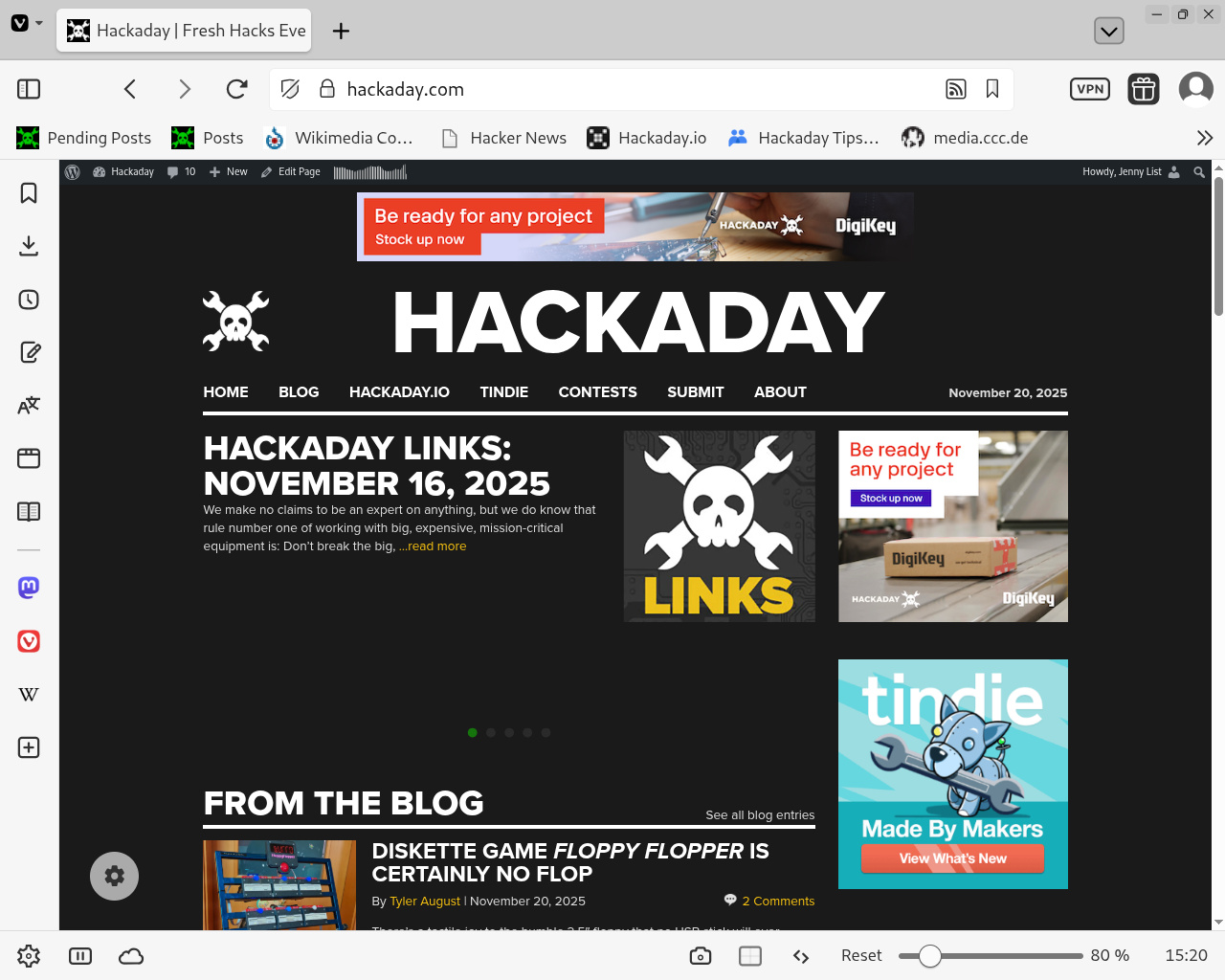
It might surprise you after all this open-source enthusiasm then, to see the browser I’ve ended up comfortable with. Vivaldi may be driven by the open-source Blink engine from Chromium and Chrome, but its proprietary front end doesn’t have an open-source licence.
It’s freeware, or free-as-in-beer, and I think the only such software I use. Why, I hear you ask? It’s an effort to produce a browser like Opera used to be in the old days, it’s European which is a significant consideration when it comes to data protection law, and it has (so far) maintained a commitment to privacy while not being evil in the Google motto sense.
It’s quick, I like its interface once the garish coloured default theme has been turned off, and above all, it Just Works. I have my browser back, and I can get on with writing. Should they turn evil I can dump them without a second thought, and hope by then Ladybird has matured enough to suit my needs.
It may not be a trend many of us particularly like, but here in 2025 there’s a sense that the browser has reduced our computers almost to the status of a terminal. It’s thus perhaps the most important piece of software on the device, and in that light I hope you can understand some of the concerns levelled in this series. If you’re reading this from Firefox HQ I’d implore you to follow my advice and go back to what made Firefox so great back in the day, but for the rest of you I’d like to canvass your views on my choice of a worthy replacement. As always, the comments are waiting.











I will try Waterfox, sounds interesting enough.
It is best choice, however, better is to use both – Waterfox for free surfing, Firefox for private stuff, work, banking etc.
It is even more secure – your valuable stuff is not in same case with browsing unknown and potentially dangerous world.
Use extensions uBlock and NoScript and protectors like Chameleon, Ghostery. TabMixPlus from onemen for multirow tabs.
Use SpyBot Immunization from time to time to cleanup malware from all browsers.
I find Brave pretty good. The built in adblocker is brilliant. I haven’t seen a single ad on YouTube and a lot of news websites since I switched.
“Stop using Brave Browser
Seriously.”
Corbin Davenport, Spacebar, 07 Aug 2023
https://www.spacebar.news/stop-using-brave-browser/?ref=thelibre.news
Good to know, thanks. I’ve always had a bad feeling about Brave, I very much prefer Firefox+uBlock origin.
Forst paragraph and this guy is already ranting about the politics of the founder. Says the browser is pushed by “crypto evangelists”. Seems he knows well his target audience is the type to lap this up while typing on an iPhone.
Bingo. “Stop using a browser because someone exercised their free speech rights”. LMAO. Think I’ll go download Brave now. 👍
i’m sure you would never.
and its not about politics. its about not supporting people that have made tangible and deliberate actions to limit basic human rights to certain parts of the population.
“Seems he knows well his target audience is the type to lap this up while typing on an iPhone.”
I… Come on, man. That’s not an argument and you know it
https://thenib.com/mister-gotcha/
The authour is a female…..
Propaganda news article that interjects nonsensical politics into the matter. There’s nothing wrong with Brave browser, it works great whenever I use it. FF is still my main though
What if I don’t care about the 18 year old news about the CEO’s politics?
I’m far more interested in a functional browser, which brave has been for me.
This article really feels like the author is grasping at straws.
An alternative conclusion that could be drawn is that when an angry internet mob chased Brendan out of Mozilla, Mozilla went downhill and gradually became worse. And when Brendan took over a different browser, it quickly became superior in a multitude of ways.
Seems to me he’s just better at his job than the politically correct candidates he was replaced with at Mozilla.
You rock! :)
Definitely thinking same ✌️
I have seen this link shared in many places and, while I may disagree with the politics of the founder, it has no bearing on the Brave Browser. I’m sorry to say that this “Stop using Brave Browser” article is overused, is an opinion piece and detracts from what the browser achieves. Ads are opt-in, crypto is opt-in. The Brave Shield does what it sets out to do.
I’ve been using Vivaldi as my main browser for maybe five years now.
too many stuff happening at the same time, support is lacking.
They have their own ad system, crypto wallet, coin, it’s too much for a browser.
And now, their own AI! Just what the author wants! Almost like OP just ignored the entire point of the article. The owner’s politics are also ass, too, as he’s on Trump’s side.
The original idea was to give all the tools for modern web browsing.
Everybody talks about the “big scary crypto” (lol), but no one talks about the integrated IPFS client, the torrent client, or even the automatique “archive.org” redirection when a page is not found.
Is it perfect?
Far from it.
But it’s stupid to reject it just because “mhu crypto”.
Indeed Brave for the win!
Why has no one mentioned that Brave now uses AI ? That’s my reason for dumping it and using Vivaldi now.
Been on Waterfox for a good while now and quite happy with it.
I found Vivaldi interesting, but I don’t want to be on Chromium, and I’d miss Sidebery, the Firefox extension I use for tabs.
I don’t like that Vivaldi isn’t FOSS, but I get their reasoning. Most of their work is front-end, since it’s Chromium-based…which brings me back around to “I really don’t want to be on Chromium”.
I can’t imagine Mozilla has a (good) future though, so Ladybird and Servo sound interesting. I will follow those projects.
Unfortunately, Ladybird is run by some real asshats. There’s a reason they left/got pushed out of the SerenityOS project.
You obviously haven’t kept up with the project, I’ve been following Serenity and by extension Ladybird since it was LibJS. Andreas Kling started the Serenity OS project and moved on to work on Ladybird not because he was kicked out, but because he was simply not that interested in working on Serenity OS itself anymore and because he had started to collect some serious sponsorship money to work on Ladybird full time. There was zero animosity in his abdication from the Serenity project, and he is in fact still well loved by those who continue work on Serenity OS.
I think they’re referring more to Andreas’ firm stance on keeping politics out of the development of Ladybird. He rejects virtue signaling PRs that don’t meaningfully contribute to the project, like changing pronouns in documentation. That doesn’t sit right with a lot of people.
He wants to keep silly politics out of open source projects and people are upset about this?
Sounds like he’s keeping out the right people then. Gatekeeping is good.
In general, I abhor a frivolous PR. If you’re merging because you’ve rewritten the whole (insert language here) documentation set, or submitted a new one – fine. If you’re squashing a bug – fine. Retroactively changing a pronoun? That’s a waste of everyone’s time.
This should not be interpreted as transphobia. I just really hate frivolous PRs.
I really hope Servo succeeds, but I doubt it will ever secure enough funding for that.
For the time being, I would just switch to one of those Gecko‑based browsers.
Reading this and then their site I wondered how they kept it funded, but turns out they explain it nicely: https://vivaldi.com/blog/vivaldi-business-model/
I remember trying it years ago but going back to FF because I believe in the different engine. Wish they’d just offer a paid version or something that doesn’t have the cruft. I think it’s time that people came to realise if something isn’t open source and it is free, the cost is being hidden.
“In the Gecko world that should be an easier jump for a Firefox escapee”
I don’t understand that. Why does anyone care which rendering engine they’re using? Why would you want continuity of rendering engine? What am i missing?
Interesting, I don’t understand why someone wouldn’t understand that.
I do care about rendering engine. To me, it’s self-explaining that diversity matters.
Otherwise, there might be a monopoly and no progress anymore (new concepts).
That’s an argument for wishing other people used a diversity of rendering engines.
There is a monopoly, and if i use Gecko then i’m just punishing myself for that monopoly. Besides, in the web, innovation has always been synonymous with monopoly control. When there really was a diversity of rendering engines out there — in the early aughts — innovation was two steps backwards for every step forwards. DOM was different on every innovative browser. CSS was different on every innovative browser. It was a solid decade between when CSS standardized the things i cared about and when i was able to actually use it, because every time i did use it i would discover bugs in MSIE.
I don’t want innovation on the web. CSS is mature.
Stopped reading at the word proprietary. Firefox plus ublock plus duckduckgo works well.
When and where is Mozilla forcing AI ?
Well you’re a real piece of work.
Because of the monoculture issue. If everyone is using the same engine, which comes from Google, they’re all playing second fiddle with Chrome. That means Google can call the tune and everyone else plays along, or tries and fails, which drives users towards Chrome instead.
Remember the triple-E?
https://en.wikipedia.org/wiki/Embrace%2C_extend%2C_and_extinguish
Yes, but if you came along with an error message like “your site behaves poorly with my unusual browser”, what kind of response would you expect?
Each web service development takes effort. In terms of economy that’s “money” which has to be earned first. It’s nice and good and I love it when people try to not feed the dragons. But choosing a different browser because of its engine does not provide any economical or political change.
There is a change if you use a browser that does not phone home. The rendering engine choice itself has no effect on the big players. Not using chrome or safari and maybe also FF cuts of the data steal, and that’s what may make a difference.
Conclusion:
As a consumer I’m OK with using a privacy-optimized chromium whatever.
As a developer I switch between many browsers anyway.
The other side of the coin is that with many different browsers, they’ll all misbehave until they agree to adopt common standards and operate the same. The difference is that there’s not one who gets to dictate what the “same” is.
We’ve been there before.
At least there will be a common implementation standard as opposed to single company dictating what and how the web works. Monopolies are far worse than the pain of having multiple implementations.
Different browsers used to compete and boast about how accurately they follow the CSS specifications etc. Then Chrome took the market and everybody just forgot about it.
But it can also lead to balkanization and loss of cohesion, like how every Linux distribution is trying to be, or has to be its own little island, where things are done correctly and differently because “you must have a choice”. Compare and contrast that to the problem of web developers having to limit features or create exceptions and versions to deal with N+1 different browsers behaving differently – which nudges developers towards just defaulting to Chrome, or Windows for that matter.
If you don’t have the time or the budget, what else can you do? That’s the point. If the alternative is a gaggle of in-fighting nerds, then the biggest bully on the block calls the rules.
“Different browsers used to compete and boast about how accurately they follow the CSS specifications etc.”
@Dude ugh, don’t remind me!
“Back in the day” (early zeros) I very much liked Konqueror’s UI. But so many pages just didn’t work. The Konqueror team had an unhealthy (IMO) obsession with CSS. Konqueror passed all the acid tests years before competitors. But that just meant they neglected javascript! I mean, sure, it would have been an advantage. That is, it would if someone was designing websites to use CSS that the big browsers of the time hadn’t picked up yet and at the same time was coding around every deficiency in Konqueror’s javascript. But who was going to do that? Kde.org???
because if their is only google chrome google would likely close the source to chromium and pretty much own the internet at that point even more than they already do
I am always astonished at this take. By using open source inputs and creating open source outputs, Chrome took over the world. Now you’re afraid that Google will close it up and still control the world.
Google might very well be that stupid (but i doubt it), but if they change away from the tactics that have helped them win then they will stop winning.
I really genuinely believe you should know your enemy. Dreaming of dystopia is fine but it’s only meaningful if your analysis is more than “big company bad.” Big company is bad but there’s more to life than that.
Google is still too smart to announce that they’re doing it all at once but … There are (niche) publications that thrive on predicting android changes from “leaked” commits that are clearly supporting a closed fork. There are improvements kept (at least initially) for only pixels. There are others only available to partners. There is functionality moved to property extensions of Chrome, rather than base chromium.
Opinions can differ on how serious these are, or how likely it is that they will become more and more important if Google has more of a monopoly.
We are already going towards that (the closed internet). It starts with closed video codecs, then something authentication related so it is required for youtube, etc, etc.
Because Google has wrested Chromium into supporting ‘standards’ which make adblocking more difficult or impossible. If the rendering engine doesn’t allow you to remove ads, then you’ve gotta rely on other people making full-fledged browsers to do that part. Look up “Manifest v3” and understand that it’s far less powerful for adblocking in the name of security – when in reality, Google is locking everything down under their control because of adblockers.
Because when an advertising monopoly with a vested interest in harvesting every single mote of data from every single web user gets to dictate web standards, it’s generally acknowledged to be a Bad Thing(TM).
In terms of web browsers considered “mature” or “stable”, you have three browser engines to choose from: WebKit, Blink, or Gecko.
WebKit is a moot point because it’s only available on macOS or iOS (and derivatives).
Blink is the engine developed by Google, originally a fork of WebKit (itself a fork of KHTML). It is nominally open source, but in name only: it’s Google’s project, and Google controls it.
Gecko is Mozilla’s engine that’s used in Firefox, currently the only viable non-Google cross-platform browser engine (except iOS, which mandates WebKit in all browsers).
So when it comes to browsers, you basically have two choices: Mozilla or Google. Edge, Vivaldi, Brave, Chromium, or any other Chromium/Blink-derived browser; all of them are in thrall to Google. Sure, they can block ads, disable tracking & telemetry, even implement their own scummy crypto horseplop; but when Google decides to make changes in their favour, they all have to put up or shut up.
Despite the AI nonsense, despite the shifting language on privacy, despite all the other tone-deaf dumbass ideas, I don’t plan to switch away from Firefox any time soon. I might check out some of the other derivatives mentioned, such as LibreWolf or WaterFox, but I simply cannot make an active choice to use browsers that Google gets to control.
I also switched to Vivaldi a few months ago and have been generally happy with it. Adblockers work well as well as the plugins I need for daily work. I tried Opera but had problems with both of these. It has a large number of easily tunable settings. A lot of FF settings were hidden in its “registry editor”, and not easy to navigate and/or discover. For now, Vivaldi seems fine, I’ll stick with it for a while.
Vivaldi is all I use on my phone. Beats everything else for letting me read blocked pages, etc
I was under the impression that adblockers only work well on Vivaldi, because the devs haven’t yet made the inevitable update which will enforce manifest V3? So your days are numbered.
“I went into my concerns over the direction being taken by Mozilla with respect to their inclusion of AI features and my worries about privacy in Firefox”
You said as much here as you did there which is basically saying they existed with no details as to why or what they are.
concerned with “their inclusion of AI”, and lack of respect for user-privacy; sounds like you got the message just fine.
not really. meaningful existing AI features are all totally optional, and local-only.
the only remotely significant exception to that is the addition of perplexity as a search engine option. not a default and frankly not really different from the long-existing inclusion of google at this point.
am I missing something?
Long Time Vivaldi user here. Totally customizable. Workspace Tab collections / Web Page Tiling with vertical or horizontal splits / Email Panel for all of your accounts in one place / on and on…
Anyone knows how to import my profile from Firefox Portable to Waterfox Portable? I tried copying the data folder over but that doesn’t work.
One thing I don’t get: if it’s so important (and I really think it is!) to maintain alternative browser engines to prevent Google’s monopoly, why choose a chromium based browser in the end?
Because I earn my money working in a browser and my primary need is for one that’s not buggy.
I didn’t mean to blame you for your choice, sorry if I sounded like that.
It’s just that I don’t know what I would choose between two problems: keep using Firefox and see my data used in the wrong way, move to a Chromium based browser and add a nail in Gecko’s coffin.
I guess we don’t have so many good choices anyway.
Win the battle to lose the war.
You hardly touch on the multitude of reasons to use Vivaldi:
wonderful customisability out of the box
privacy features
no AI/crypto/flavour-of-the-month bullshit
non profit organisation with a good ethos and track record
Software as good as this gives me faith in society, it’s very close to perfection.
Minus: reliance on Google’s stuff.
It’s a nice browser, works really well on first try, but as soon as I hit the extensions… hmm… Chrome Web Store… nnnngh…
I’m relatively old school– I actually paid for Opera back in the day, and when I discovered Vivaldi I was all in. And in many ways it is what I’d hoped. The customization is great, and the performance is fine.
However, it isn’t perfect. I’ve definitely had more glitches in Vivaldi than in other browsers. Don’t get me wrong: I still use it exclusively on both my phone and pc, but there are just enough times where it lets me down that I still feel the need to keep backups installed.
I’ve been using Vivaldi for a good 3 or 4 years now. Have had no issues whatsoever with it.
The team behind it are great and the community is awesome too, if there are any questions, the folks on the forum are pretty much always able to help.
Interestingly, as a die-hard Firefox user, Vivaldi was my daily driver a decade ago when Firefox was going through some awkward teenage years (while they worked on shoehorning decent multithreading in to Firefox). I used it for probably a year or two, until Firefox was mature enough again to use on a modern system. I think that was around the first time they broke all plugins on Firefox and required devs to rewrite everything. And unfortunately not the last. Maybe I’ll give Vivaldi another shot, now that Mozilla is up to some questionable shenanigans.
I’ve been using Vivaldi from before Internet Explorer was replaced by Edge, so over 6 years now. I chose it as an alternative to IE which I never liked (being a web developer at the time) and Chrome which was/is a bloated PoS and too tied to Google. Vivaldi is quick and compatible and I’ve remained happy with it ever since. That’s on my PC. On my Mac I stick to Safari as I’m happy with its privacy features.
Long ago switched from Firefox to opera and most chrome forks, including Vivaldi and Brave, by the moment I stay on Brave as it provides everything except a non-chromium engine, particularly it’s crypto wallet (but I recommend disabled all other annoying crypto stuff) it’s safer (paired with supported hw wallet) , has pretty good ad blocking is fast and light on ram (Firefox it’s an huge heavy ram hog), I’ve tried Vivaldi but besides it’s relative cleanness and speed is not better than Brave, and they used to stand an anti-crypto stance enough to red flag the project (later they removed it from blogs), btw I’m not bad at Brendan Eich , I’m not challenged by his political POV, bu I really enjoy Brave (just disabled the annoying unwanted crypto stuff except it’s integrated wallet if you need it of course, but always rely on hw wallet, never type your seed at anything internet connected).
I’m so sorry on Firefox and Mozilla’s disastrous mismanagement.
For me it’s 99% librewolf, and when some stupid site misbehaves due to adblocker, privacy features (or gecko),
I launch a chromium with a script that does sandbox and ditch all local trace when I quit.
No grey zone with brave, no blink unless I have to. May ladybird come fast.
I have been following Vivaldi since the first posts on their blog, as an attempt to resurrect Opera as it once was, but with Chromium engine. As I loved Opera back in the day, and Chromium was compatible with almost everything, I believed it would be a good product. I installed the first public release, a pre-beta release and it quickly replaced Firefox as my daily driver.
When they released the Android version, it instantly became my main browser too.
Firefox stopped working right when I clicked radio streams on Public Radio Fan with my phone I poked around and found the Naked Browser. This was a few years ago before the great Play Store deletion. Not only stripped down but fast as a streaker in a parade. It’s white text on black not a single icon or graphic do-dad, looks something like Hackaday as well as close to low vision accessible.
You have to APK it to your phone now, a rabbit hole I’ve yet to go down. I don’t like the current Firefox on my phone, desktop is OK. So another bunny house visit awaits me.
Naked Browser is just a wrapper. It uses whatever web view provides in android. Which is why the apk is so small.
Yet another “this is the one!” browser? No thanks. I think I’ll stick to qutebrowser. Once you train yourself to use vim keybinds, nothing else will ever feel right again. If you’re up for it, give it a whack. Faster workflows with follow hinting and quick hits with console operations? Yes. I rarely ever use my trackball for browsing anymore.
You couldn’t post a more HaD flavored comment if you tried
I love it, a real parody of itself.
Ain’t nothing wrong with Qutebrowser.
Sorry for your feelings, I guess?
Give DuckDuckgo a try. I loaded Vivaldi and went to a website that I know has adds. Behold – adds. DDG – no adds. Ghostery in Firefox and Opera gets rid of adds. I’ll keep trying Vivaldi for a little while.
DuckDuckGo is a search engine. Do you mean the Tor Browser that hosts DDG as it’s default search engine? I’m bemused that there has been no mention of Tor in the main article or any responses.
DuckDuckGo has a browser, though it is still beta: https://duckduckgo.com/about
I recently switched from Firefox (very long-time user) to Vivaldi and have been pleased. It syncs to my iPhone and iPad, works well and I gather there are a number of tweaks that I haven’t tried yet – but also haven’t felt the need to. It works, it’s fast and that’s 95% of what matters.
I’ve tried to like Vivaldi for years it has been shipping with one of my favorite distros for maybe 6 or 7 years. I just don’t like it. I always go back to a Firefox fork. There are many good ones out there. Waterfox has been around a long time.
Rewrite the entire article, but swap Firefox with Chrome.
I love vivaldi and I use qwant as my search engine. I discovered both by accident as I searched for a browser and search engine that WASN’T American. I am trying hard to divest myself from anything that has even the faintest sniff of the red, white and blue
+1
Qwant is French whose flag is Blue White Red (borrowed from the US flag, if I remember correctly).
Been using Vivaldi for about a year now. Backups are Firefox (almost never used), Chromium (used once) and Tor (rarely if ever used – mostly to read local stuffs that’s blocked otherwise – mind what you are thinking, local news and rumor mills).
Works quite well, no complains.
Oh, the mysterious splash screen that started cropping up sometime after ~2017 is “this resource is blocked in your country due to blah-blah regulations” – quite few countries started copying the chinese firewall and blocking access from “unfriendly” countries’ IPs. Gah, as if there are no ways around, there are always ways around, just the results are not always truly worthy the effort.
My other “pseudo-browser” is RSS reader, but those I’ve been using for some while not always see what I see.
Damn straight, it’s like the pages that tell me to turn off my adblocker! Sure, I could do that, or I could accept that your page is probably a waste of time and go somewhere else. The internet is a big place, it turns out I don’t actually need to read Forbes magazine or whatever crap the Murdoch press is spewing today.
Have been on Brave for a while, but reset the laptop to 100% scaling for more room.
Brave has refused to make any attempt to allow users to make the URL bar font size resizeable, and I finally jumped to Vivaldi.
Disabled V’s ad blocking and it still runs Ublock Origin with Manifest 2.
Has CSS modifications available just like Firefox too.
Way more customizations than I need/want, but it works.
I reluctantly made the switch from Firefox to Vivaldi, but now could not be happier. Vivaldi works great on Android too
I’ve been loving Floorp. It’s another Firefox fork.
My beef with Firefox is that they include a lot of stuff that nobody asked for, but still won’t include stuff I need daily, like Webserial.
There really is just nothing wrong with Firefox, I’m sorry but if you think otherwise I think you’re trying a little too hard to be this perfect paragon of internet purity testing.
It will soon stop supporting Manifest v2, so it’s a big NOOOOOOOO
I ended up here myself after trialing Waterfox.
Madness that I’m using Edge on Android currently. 2010 me would be flabbergasted.
I have Zen installed, and it will get a shot, but I’m hitting browser fatigue right now.
Much like I’m hitting IDE fatigue too.
Shortly followed by Terminal fatigue 😂
Vivaldi all the way. Its what the Opera used to be up to ~2012.
Everything is customizable in Vivaldi. You can modify how things look using official right click Customize menu, you can edit UI CSS, you can even dig deep into UI JavaScript and change its behavior.
My biggest complain was always speed. Vivaldi React (aka slow javascript) UI used to be painfully slow, but its been pretty fine for a while now.
The only problem left is non committal to persisting webRequestBlocking support past Chrome 142 aka MV3 deadline.
Hacks like https://0x44.xyz/blog/web-request-blocking show factitious nature of “untenable developer burden” claims when talking about continuing Mv2 support. Main Mv2 -> Mv3 change that kills active adblocking is just one JavaScript addListener binding to internal Chrome C API. C API that is not going anywhere.
I have been using Vivaldi as a backup for a long time but never been quite happy as it makes a lot of outgoing connections to Google – even with the Google stuff unchecked in the config. At least Brave proxys those connections (although of course this also means that you can’t see what its doing exactly)!
Now Mullvad browser is my weapon of choice with Brave as a backup. I have removed Firefox entirely from my phone as well and no longer use it – mainly due to AI inclusion and open connections to Google.
Compared to Google, Mozilla is by far the lesser evil, so much so that one could say it’s not evil at all. I’ll just keep using my Firefox for now, thank you :)
I moved from Firefox to Vivaldi some months back.
I don’t have any complaints.
I’d really like something that I can install on Windows, Linux and Android and sync at least the bookmarks across all of them. Which both Firefox and Vivaldi do. But I am tired of having to trust some company to “not be evil”. I don’t care how not-evil they are before they get big. That never lasts. I really want something where the sync isn’t back to the browser author and is instead back to my own server.
I also want the data back at my server to be in a format that I can easily retrieve and convert to something else if the author goes belly-up. If it was a MySQL database with a clear and simple schema.. that would be great. I could even write my own software to interact with that. But if it was just a flatfile or something, I could live with that too so long as it is a readable text format and not some proprietary binary goop.
I think my best bet is to learn to develop plugins and write my own. But I have lot’s of other projects on the list before that…
vivaldi keep google monopoly over rendering engine.
and vivaldi rendering engine is controlled by google.
So basically you are using reskin chrome.
Realistically there are only two browsers, Chrome or Firefox. The security response is really what matters not the feature set.
In my book Google is kinda out, since they are making efforts to DRM the web, so nobody can skip the ads.
I suspect that Firefox will have about:config options to disable the things you don’t like. That is still better that some other LooksLikeABrowser alternative, that might not receive the same security scrutiny as Chrome or Firefox.
What about Zen browser? I have been using it after long time using Vivaldi and wanting to move away from chromium. Very reminiscent of another favourite of mine: Arc.
If using a chrome derivative isn’t an issue why not use ungoogled chromium? It’s Chrome but it doesn’t phone home.
Pale Moon.
If you want a pre-Australis-like Firefox browser.
I love Zen browser. I wanted to get away from Chromium and Zen has been a great one. It’s still a small team but it has all the important stuff and had workspaces and some other great tools before Firefox
I also switched from Firefox to Vivaldi, earlier this year. A big reason for me was that it seems much lighter on my laptop’s power consumption.
I’ve hit some occasional weird UI bugs in Vivaldi, and it kept randomly logging me out of Google for a period until a recent update. And while I love the Opera-ish UI overall, its tab organization doesn’t match Tree Style Tabs IMO. But it’s my current favorite browser overall.
I made the same switch myself earlier this year!
In search of gold, bro lost a diamond.
Have been using Vivaldi for a while, love it.
This isn’t a mistake. I went through this 10 years ago, as Chrome wasn’t cutting it for me. Firefox want much good then and it’s only got worse since. I’ve been using Vivaldi all this time and it’s only getting better. The power features are an absolute lifesaver and I use a ton of custom commands.
I’ll convinced the Vivaldi team are in it for the long haul, they do a fantastic job and you made the right choice 😁
Now using
– Supermium and CatsXP from chromium world
– Floorp/Midori and custom FF fork for win 7 from Gecko-world
– rarely – UXP browsers and mailers: PaleMoon, Basilisk, Borealis, Interlink
– and always – old good K-Meleon (now Goanna based) for tech support, troubleshooting and personal purposes.
And my dream is to make KM great again!
Thanks for checking out Basilisk. Glad to see people in the wild talking about it.
Thanks to this and the previous article, I actually switched back from Brave to Firefox+ublock on Android (and I just keep using Firefox on PCs). Absolutely nothif wrong with Firefox.
Even if you don’t care about Google moving towards a monopoly with Chrome/Chromium, I just don’t understand why anyone would want to use a web browser made by an advertising company. Seems like a massive conflict of interest.
I’ve been using Firefox almost since I’ve been online and yes I’ve seen it change from being relaxing ad-free spacious landscape into becoming an intrusive data-mining servant of Google. Might it even grow into the profiling thug-like Google servant that Youtube has become? Now Google recently took away Firefox’s 100 page or 100 hits per page option, which I frequently relied on when doing the thorough searches I needed for important projects. Presumably, if going to Vivaldi I will regain that tool, yes? But most things have downsides, so what do I lose going from Firefox to Vivaldi?