

The modern office environment has shifted in recent years. Employees are routinely asked to collaborate with co-workers half way around the globe and be camera ready, or whatever passes for webcam ready, in order to telecommute when they are out of office. Every office laptop, tablet, or cell phone these days comes equipped with some sort of camera sensor capable of recording at HD resolution. Twenty years ago, that was not the case. Though tech conglomerates like HP had a different idea of teleconferencing to sell back in 2005 dubbed the Halo Collaboration Studio.
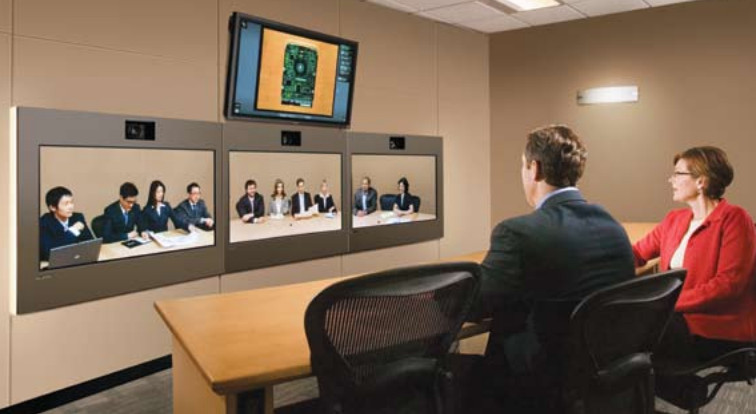 The Halo Studio was a collaboration between HP and Dreamworks that was used during the production of Bee Movie. Studio heads at Dreamworks thought it necessary to install the HP teleconferencing solution inside the New York office of Jerry Seinfeld, the writer of the film, as to allow him to avoid long trips to Dreamworks production offices in Los Angeles. According to the HP Halo Collaboration Studio brochure, “Halo actually pays for itself, not only by reducing travel costs, but also by encouraging higher productivity and stronger employee loyalty.” Certainly Dreamworks believed in that sales pitch for Bee Movie, because the upfront asking price left a bit of a sting.
Less of a singular machine, more of an entire dedicated room, the Halo Studio had a $550,000 asking price. It utilized three 1280×960 resolution plasma screens each fitted with a 720p broadcast camera and even included an “executive” table for six. The room lighting solution was also part of the package as the intent was to have all participants appear true to life size on the monitors. The system ran on a dedicated T3 fiber optic connection rated at 45 Mbps that connected to the proprietary Halo Video Exchange Network that gave customers access to 24×7 tech support for the small sum of $30,000 a month.
For more Retrotechtacular stories, check out Dan’s post on the Surveyor 1 documentary. It’s out of this world.








I worked at HP as a contractor in the early 2010s and got to meet some of the people that developed the Halo system.
The rooms were set up very specifically. One of the tricks was placing the tv and cameras quite a bit away from the table you sat in. This was to as much as possible make it look like you were looking straight at the people on the otherside of the screen. They talked about studies of interpersonal communication and how looking up or down at someone was often interpreted as low or high confidence/arrogance.
The rooms were special too. Lots of sound insulation, special quiet air conditioning, behind the tv wall was a small computer rack of workstations for the video processing. They had even looked at using passive cooling cases for the workstations.
There was also something about Microsoft not properly trademarking the name Halo, which surprised them when then picked the name. But my memories get a bit fuzzy about the exact situation there. Some of their internal boxes used the Halo font.
I used a similar Cisco system in about 2012 and it blew me away how realistic it felt. Genuinely felt as though I could reach across the table and shake hands. I haven’t seen that type of system since that day. Zoom or FaceTime just isn’t the same.
My colleagues and I were subjected to a version of this developed by a government entity we were working with (nothing spectacular or security-related) in the mid 90s. There was a camera (one) on the end of the table and a screen behind that, and the same arrangement on the other end – the idea was to have the long meeting table carry over to the other office in another city.
To hand paper documents back and forth there was a fax machine on the table. They’d contracted a dedicated line to carry the (gasp!) video bandwidth as well as audio. The fax ran on a standard phone PBX system.
Let’s just say that it worked about as well as you’d expect and the arrangement wasn’t repeated for very long, though it was the butt of running jokes for quite a while. The fax machine came through though.
T3 eh? Be interesting duplicating that at the house.
Since the brochure states “OC class connection”, this was likely a DS3 circuit from an add/drop SONET mux at each site.
I don’t know of any actual T3 circuits that weren’t mis-named DS3 coax pairs.
My understanding is that DS3-on-coax was an indoors-only standard, it never left the building since it could only go a few hundred feet on coax.
In the early days, there may have been dedicated T3-on-fiber terminals, but they were quickly obsoleted as soon as SONET arrived, and by the time I got into the industry, all DS3 circuits leaving the building were payloads within SONET, yes.
However, despite the glass coming into the facility being capable of much more, the telco would still only sell you the fractional or full or multiple DS3 increment of transport you wanted, because the cross-connects couldn’t handle a full STS3c or STS12c or whatever. Cross-connects were done as human-plugged DS3 coax jumpers for yeeeeeears at many offices, and only well into the 2000s did they get Titan and other DACS that could schlep a whole STS3c between fibers without breaking it down to STS1s or DS3s first.
I’ve always wondered what the landscape would be like if ISDN had caught on and continued to evolve into the gigabit future. Would we have dialable low-latency circuit-switched paths muxed into the same bitstream as our packet-oriented bulk data?
This reminds me of Cisco’s TelePresence, which used oval/u-shaped desks with screens on the far side to make it appear that remote people were on the other side of the desk. It was something like the CTS-3000 – some example images at https://www.dekom.com/gb-en/video-conferencing/product/cisco-cts-30103210/
I seem to remember that it wanted around 15Mbps of dedicated bandwidth, with latency less than 150ms, and low jitter (<10ms). Given this was the mid 2000s, that was a big ask for clients who had global networks.
I mean, the one I saw looked neat – like they’d thought about how best to make it feel more natural. I never had an oppertunity to see it in action though.
We have systems like this in several of our conference rooms. I don’t work with or use them. It is pretty cool to see in action though as it looks like the conference room table has a mirror at one end, except, the people in the mirror are not the same ones at the table in the room.